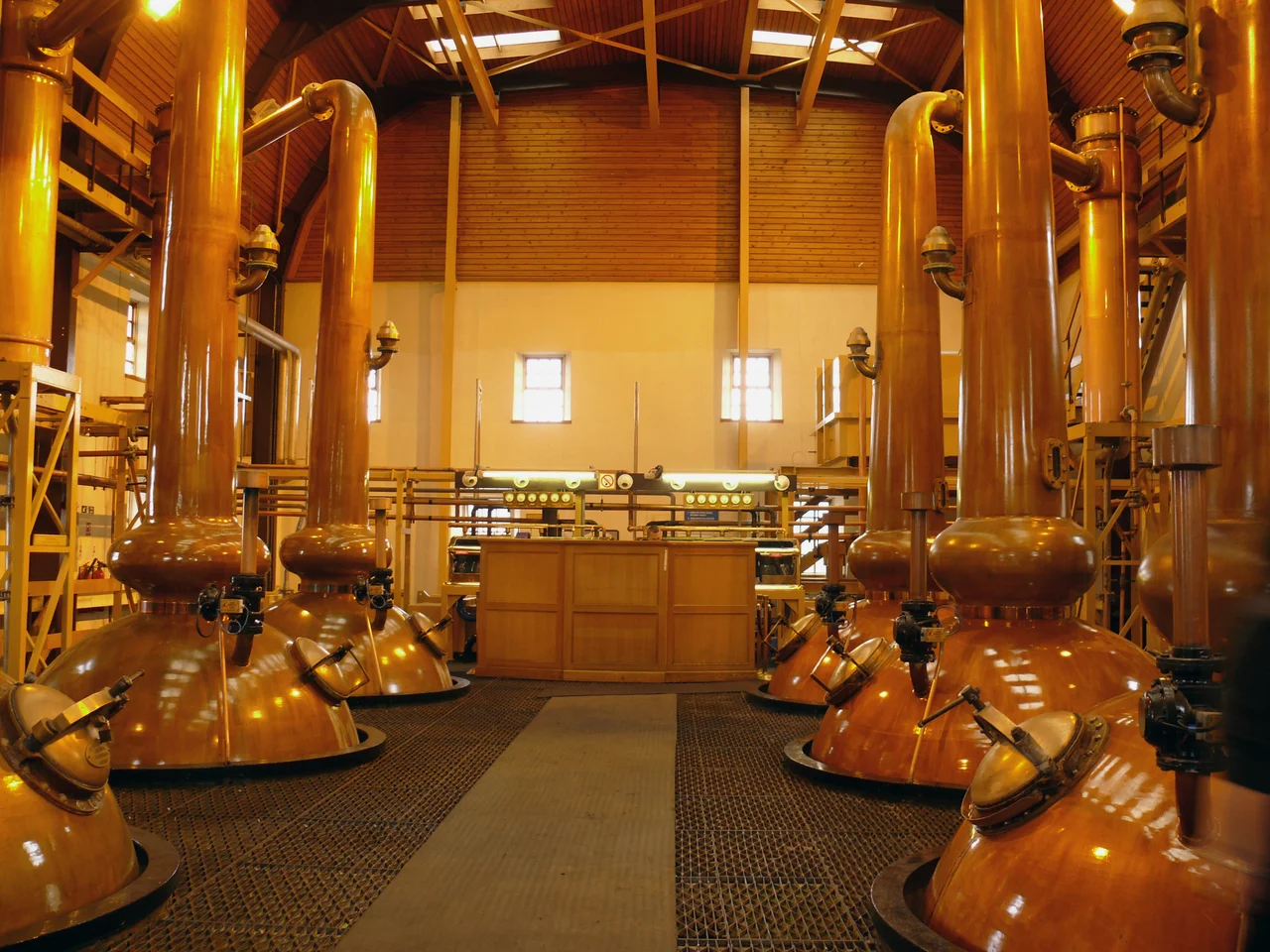

Glenmorangie Distillery
The stills are the tallest in Scotland - twenty-six feet from base to top, with sixteen-foot necks rising like copper smokestacks above the still house floor. That extra height is the point of Glenmorangie. The vapors rising from the wash have to climb farther before they condense, and along the way the heavier compounds fall back into the boil. What comes off the top is light, floral, more delicate than almost any other Highland malt. The distillery has been here in Tain since 1843, and for decades the people who ran it were so few in number that they had their own name: the Sixteen Men of Tain.
Morangie Farm, 1703
The earliest record of alcohol production at Morangie Farm dates to 1703 - a brewery using the Tarlogie Spring, which still feeds the distillery today. In the 1730s, a more permanent brewing operation was built. Then in 1843, William Matheson - a former distillery manager at nearby Balblair - bought the farm and converted the brewery to a whisky distillery. He fitted it with two secondhand gin stills, taller than ordinary whisky stills because gin makers wanted heavy reflux, and the unusual height stayed when Matheson switched to single malt. The Macdonald family took over and held the company for nearly ninety years. The name comes from the Gaelic *Gleann Mòr na Sìth*, vale of tranquillity, or possibly *Gleann Mór-innse*, vale of big meadows - the etymology is contested. The pronunciation, however, is not. Glen-MOR-angie, stress on the second syllable, rhyming with *orangey*.
The Sixteen Men of Tain
For most of the twentieth century, the entire distilling operation - mash tun, wash backs, those vast stills, the cask filling room - was run by just sixteen workers. They worked year round, with breaks only for Christmas and scheduled maintenance shutdowns. The team became famous enough that the jazz fusion guitarist Allan Holdsworth named a 2000 album after them: *The Sixteen Men of Tain*. The water comes from the Tarlogie Springs in the hills above the distillery, hard from the limestone it passes through - one of the few sources in Scotland that is. The hard water carries minerals that subtly shape the final spirit, the way different terroirs shape wine.
Wood, Sea, and Cellar 13
Once the spirit comes off the still it goes into casks - and here Glenmorangie has built its modern reputation. Wood finishes were the company's signature innovation: aging in former bourbon casks first, then transferring to barrels that had held Port, sherry, Sauternes, or other wines for a final period. The bottlings carry names like Quinta Ruban (Port), Lasanta (sherry), and Nectar (Sauternes). One special edition, Cellar 13, comes only from the warehouse closest to the sea, where the maritime air is believed to affect the maturing whisky in distinctive ways. Glenmorangie has been the best-selling single malt in Scotland almost continuously since 1983 - around ten million bottles per year, six percent of the global single malt market. In 2004 the company was sold to Louis Vuitton Moët Hennessy.
A Glass on the Rocks
In the 1986 film *Highlander*, Connor MacLeod walks into a bar and orders a double Glenmorangie on the rocks. It is a small cameo, but it captured the distillery's positioning - Highland heritage, sword and dragon, a single malt to be sipped by an immortal Scot. The reality is somewhat less mythological. The bottling now happens at a purpose-built plant outside Edinburgh; the Glen Moray brand was sold off in 2008; the Sixteen Men of Tain have been joined by automation and new colleagues. But the stills remain in place, still the tallest in Scotland, still pushing the heavy compounds back down toward the wash. The shape of the apparatus settles the shape of the spirit, and that shape has not changed since Matheson installed his secondhand gin stills in 1843.
From the Air
Glenmorangie Distillery sits at 57.83°N, 4.08°W on the south shore of the Dornoch Firth, just north of Tain. Best viewed at 1,500-3,000 ft AGL for the distillery buildings, warehouses, and surrounding farmland. The site is right on the firth, with the water flat to the north and the Tarlogie Hills rising to the south. Nearest ICAO airport is Inverness (EGPE) about 30 nm south. Look for the cluster of warehouse roofs and the unmistakable pagoda-style kiln chimney that marks most Scottish distilleries.
Nearby Stories
- Moray Firth 1.1 km away
- Culloden Viaduct 1.2 km away
- Cardhu Distillery 9.5 km away
- Clynelish Distillery 10 km away
- Alladale Wilderness Reserve 15 km away
- Corrimony Chambered Cairn 18 km away
- Ardvreck Castle 31 km away
- Hill o' Many Stanes 40 km away