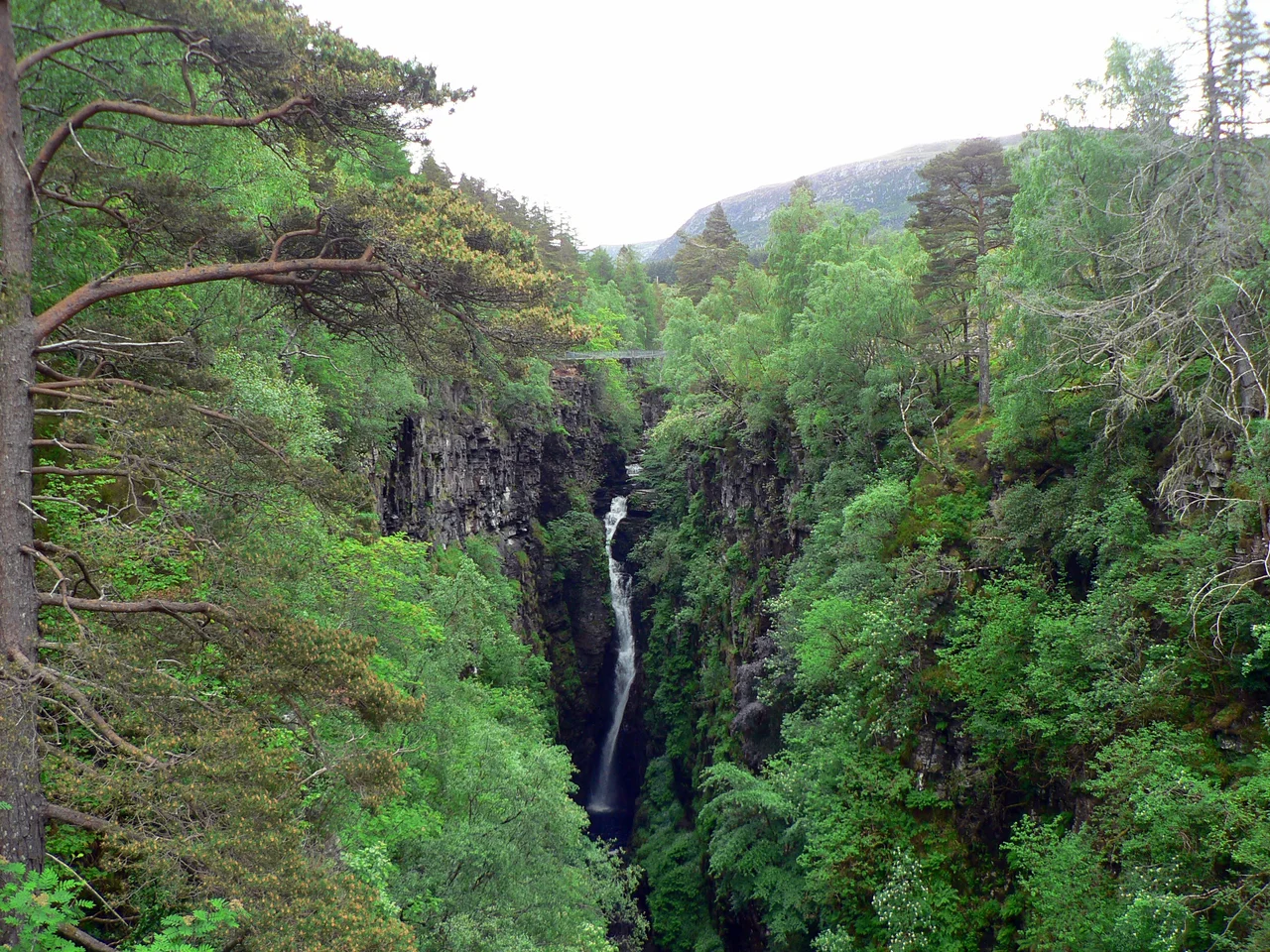

Corrieshalloch Gorge
The Gaelic name is *Coire Shalach* - the unattractive corrie - and you can hear in it exactly what a working Highlander once thought of the place. A slot in the hills sixty metres deep, too narrow to graze, too steep to plough, a confounded nuisance to anyone trying to move cattle from one side to the other. Then the Victorians arrived with their new taste for the sublime, slung a suspension footbridge across the gap, and rebranded the unattractive corrie as one of the most photographed gorges in Scotland. Today a National Trust honesty box at the trailhead takes £2 for parking, and the wind that runs through the ravine carries the boom of the Abhainn Droma plunging through the Falls of Measach into the cleft below.
A Slot Carved by Meltwater
Corrieshalloch is a textbook glacial slot gorge, cut by an enormous volume of meltwater pouring off the retreating ice that once buried the western Highlands. The Abhainn Droma still drains through it, sliding the last few metres over the lip of the Falls of Measach before disappearing into the narrow chasm. Below the gorge, the landscape opens out into the broad, flat-bottomed glacial trough that runs north-west to the head of Loch Broom and on to Ullapool, twenty kilometres away. From the suspension footbridge slung across the gap, the river is a thin white thread on stone far below your feet. The Victorian engineers who built the bridge knew their audience: nothing in nineteenth-century tourism sold better than a small wobble underfoot, a great drop beneath, and a roar in the air.
What Grows Where Goats Cannot
The genius of a gorge as a habitat is that almost nothing four-legged can get to its walls. Centuries of grazing have stripped most of Wester Ross of its woodland understorey, but Corrieshalloch's dark, humid sides preserve a slice of what the surrounding hills probably looked like before the sheep. Ferns and feather mosses cling to the stone. Sanicle thrives in the damp shade. Wood millet - rare almost everywhere in northwest Scotland - grows here. Higher up, where the slopes open to sunlight, wych elm and birch mix with sycamore, Norway maple and beech. Among the rotting deadwood in the wetter pockets lives the nationally rare cranefly Lipsothrix ecucullata, whose larvae spend their days in waterlogged dead branches. The gorge is small enough to walk past in an afternoon and ecologically rich enough that it has been designated a National Nature Reserve and a Site of Special Scientific Interest - the smallest of Scotland's forty-three NNRs.
Protection and a Quiet Battle
The National Trust for Scotland has owned Corrieshalloch since 1945, managing it jointly with NatureScot, and it is classified by the IUCN as a Category III protected area. In December 2019 a £2.3 million investment was announced for upgraded parking and a new visitor centre - a modernisation aimed at handling the steady summer flow of visitors who come for the bridge and the view. A quieter battle plays out along the gorge walls. Rhododendron and Japanese knotweed - aggressive incomers, beautiful at a distance, ruinous up close - have begun to invade the cliffs, and specialist climbing teams are being deployed to reach the gorge floor and walls to control them. The same isolation that protected the rare plants is now what makes the invaders hard to fight. Stand on the footbridge in mist, with the falls roaring out of sight below, and the Gaelic name feels generous. Nothing about this place is unattractive. It is simply, by Highland standards, useless for grazing - and that, in the end, may be the best protection a gorge can ask for.
From the Air
Corrieshalloch Gorge lies at 57.755N, 5.020W in the Scottish Highlands, about 20 km south of Ullapool near the A832/A835 junction at Braemore. From altitude the gorge itself is hard to see - a thin slot in the floor of a glacial trough running northwest to the head of Loch Broom. Nearest airport is Inverness (EGPE), 60 nautical miles east-southeast; the A835 from Inverness to Ullapool is the principal road approach. Expect cloud frequently capping the Dirrie Mountains to the south.
Nearby Stories
- Loch Tollaidh 0.2 km away
- Beauly Priory 6.6 km away
- Bealach na Bà 9.3 km away
- Lairg 10 km away
- Suilven 12 km away
- Fyrish Monument 15 km away
- The Minch 21 km away
- Lochalsh 25 km away