
Flow Country
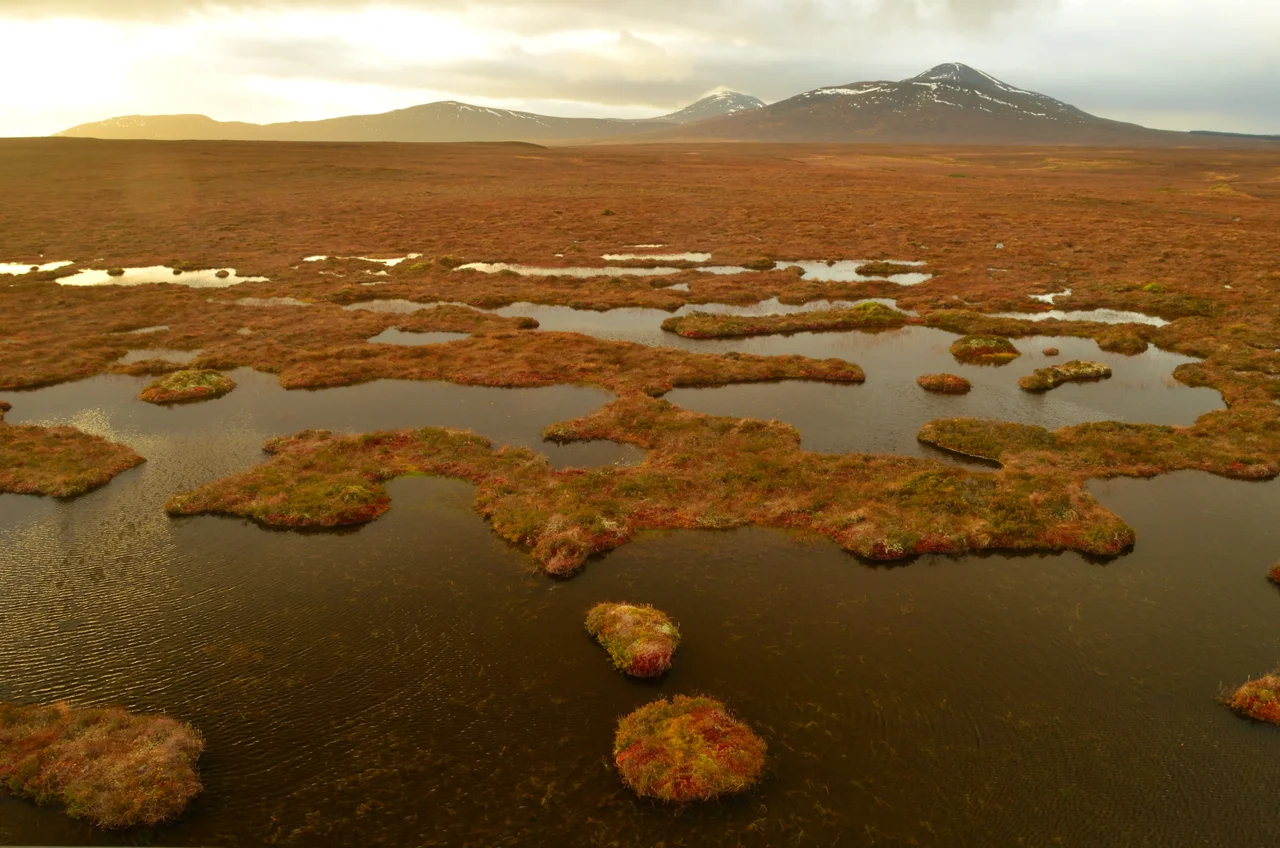
Flow is a Scots word for a bog. It probably came north from the Old Norse - the Icelandic word floi means the same thing - and the Vikings who named it knew what they were looking at. Four thousand square kilometres of waterlogged peat lies across Caithness and Sutherland, the largest blanket bog in Europe, dotted with thousands of small pools that catch the sky. The peat is on average three metres thick. In some places it is more than ten. The whole thing has been quietly growing since the last ice age ended, building up about a millimetre a year, with the dead remains of sphagnum moss accumulating faster than they can decay - because the water keeps them anaerobic, and the anaerobes preserve them. What you walk on in the Flow Country is, in effect, ten thousand years of plants that never quite finished dying.
The Carbon in the Ground
Peat is dead vegetation, and vegetation is mostly carbon. The Flow Country holds an enormous amount of it - more carbon, by some estimates, than all the trees of Britain combined. Left alone, this carbon stays in the ground. Drained, dried, dug, or burned, it goes into the atmosphere as carbon dioxide. The chemistry is the same as a coal seam, except faster. The blanket bogs of northern Scotland are, in climate terms, one of Britain's largest natural carbon stores, and the question of what we do with them is no longer purely an aesthetic or ecological matter. In 2024 UNESCO inscribed the Flow Country as a World Heritage Site, citing its unparalleled blanket bog habitat. It is one of only three natural World Heritage landscapes in the United Kingdom; the others are the Giant's Causeway in County Antrim and the Jurassic Coast in Dorset. The recognition came forty years after the bog nearly disappeared.
The Forestry Disaster
In the 1970s and 1980s, the British government created tax breaks designed to encourage commercial forestry. Wealthy investors discovered that by buying tracts of upland and planting them with non-native conifers - Sitka spruce, mostly - they could shelter income from tax at a remarkable rate. The Flow Country was cheap, available, and theoretically capable of growing trees if it could be drained. Hundreds of square kilometres of bog were ploughed, drained, and planted. The trees grew badly because peat is the wrong soil for spruce; the drainage damaged the surrounding bog whether trees grew or not; carbon released to the atmosphere; and birds that nested in the open peatlands - golden plover, dunlin, greenshank, merlin - lost habitat. In 1987 the Nature Conservancy Council in London published a report that was savage about the foresters. The following year, in the Finance Act 1988, Chancellor Nigel Lawson scrapped the tax reliefs entirely. The Flow Country was, more or less, saved. The damage took longer to undo than it had taken to inflict.
What Lives Here
Stand still on a Flow Country boardwalk in June and the bog tells you what it is by sound. A greenshank pipes from somewhere unseen. A snipe drums - that vibrating mechanical note made by its tail feathers in a display dive. A golden plover whistles a long, slow note. A hen harrier slides low over the moss. Underfoot the surface is alive: sphagnum mosses of half a dozen species, each storing many times its own weight in water; sundews and butterworts catching insects on sticky leaves because the peat has too little nitrogen for them to grow otherwise; bog cotton's white tufts; bog asphodel's yellow stars in summer. Red deer cross the bog all year; the rare roe deer keep more to the edges. In autumn the stags roar in the early morning, and the sound carries for kilometres across the flat. The Royal Society for the Protection of Birds runs the Forsinard Flows National Nature Reserve at the centre of the area, with a visitor lookout tower above the peat.
Restoration in Geological Time
The RSPB has been buying back drained, planted land for decades. The conifers are felled and left to rot in the plough furrows, in the hope that in thirty to a hundred years the bog will return. This is not gardening; it is a project conducted on the timescale of peat itself. Around 1,500 square kilometres of the Flow Country is now protected under European designations as a Special Protection Area and Special Area of Conservation, under the umbrella name of the Caithness and Sutherland Peatlands. The Flows to the Future project, an RSPB-led restoration partnership, funded the lookout tower at Forsinard and helped pay for the slow work of un-draining the moor. The Far North Line stops at Forsinard station, which means you can reach the centre of one of Europe's largest carbon stores by train from Inverness, in about three hours, and step out into a landscape of water and sky that has not been settled by anyone for ten thousand years. It is the opposite of every other journey by train you have ever made.
From the Air
The Flow Country covers roughly 4,000 square kilometres centred near 58.37°N, 3.66°W, spanning interior Caithness and Sutherland between the north and east coasts. Best viewed at 2,000 to 5,000 feet AGL on a clear day: from altitude the surface reads as a stippled mosaic of dark peat and thousands of small bog pools - the pattern is unmistakable and like nothing else in Britain. Wick (EGPC) lies 25 nm east; Inverness (EGPE) about 60 nm south-southeast. The Forsinard reserve and lookout tower are at roughly 58.36°N, 3.89°W. Weather is exposed: expect rapid changes, low cloud, and frequent rain. The interior is largely treeless and roadless.
Nearby Stories
- Battle of Altimarlach 1.4 km away
- Pentland Firth 2.9 km away
- Helmsdale 7.3 km away
- Langdale Broch 8.2 km away
- Loch Shin 21 km away
- Old Man of Hoy 25 km away
- HMS Bullen 37 km away
- Cullen Viaduct 58 km away