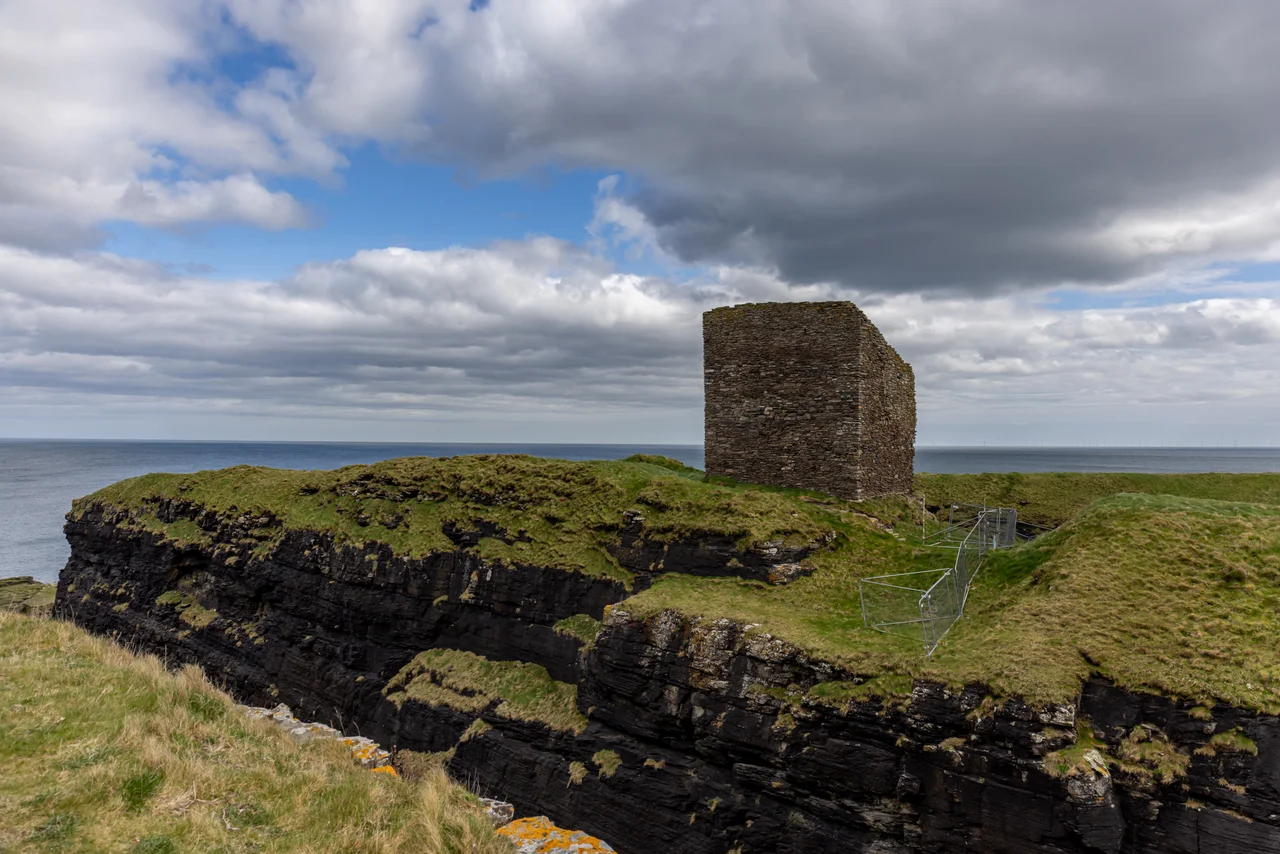

Castle of Old Wick
It stands on the very tip of a narrow peninsula southwest of Wick - three roofless storeys of stone, hammered by the wind, surrounded on three sides by sea cliffs that drop straight to the North Sea. The Castle of Old Wick is one of those Scottish ruins that has shed almost all of its story along with its roof: nobody is entirely sure when it was built, by whom, or for whom. What is certain is that it stood here in the early 14th century, that it served some lord well enough to be passed down through three families, and that whoever chose this site understood defense from the bones up.
A Peninsula Made for War
Geography did most of the defensive work. The castle sits on a narrow rocky headland surrounded by sea cliffs, and the only landward approach was cut by not one but two moats. The square tower that remains was originally four storeys tall; only three storeys still stand. The ground floor contained the kitchen and storage. The first floor was the hall, entered from the southeast. The upper floors held the personal quarters of whichever lord was in residence. A narrow courtyard ran from the tower down the centre of the peninsula, lined with buildings on both sides - barracks, brewery, chapel, the daily working spaces of a small fortified community. Outside the second moat a defensive wall doubled as the back walls of these buildings. To reach the mainland and the rest of Caithness, you crossed a drawbridge spanning a wide ditch cut into the rock, protected by a gatehouse and another defensive wall. Almost nothing of all this remains except the tower.
An Obscure History
The early history is genuinely lost. Tradition once attributed the castle to Harald Maddadson, the 12th-century Jarl of Caithness and Orkney, but the surviving structure dates to the 14th century. Reginald le Chen of Inverugie and Duffus is known to have held it in the early 14th century - he is the first documented owner. After his line, the records fade for centuries. It came to the Sinclair family, the great Caithness clan, in 1644. After the death of George Sinclair, Earl of Caithness, without an heir, it passed to John Campbell, Lord Glenorchy - the same Campbell who later became 1st Earl of Breadalbane and Holland. Glenorchy did not keep it long. He sold the castle to the Dunbars of Hempriggs in 1690, and the Dunbars held it until 1910. By then it was already a ruin, picturesque and useless, the kind of romantic stub a Victorian guidebook would call a "shattered keep."
What the Wind Does
The Castle of Old Wick today is in the care of Historic Environment Scotland, open year-round, free to visit. The walk out from the road is short but exposed - half a mile of low coastal path along the cliff edge with the North Sea heaving below. Storm petrels and fulmars nest on the cliffs. Sailors used the tower as a landmark for centuries; it appears on old charts simply as "the Old Man of Wick." Standing in the shell of the tower with the wind ripping through the empty window slots, you can see exactly what the original builders saw - the sea, the cliffs, and the narrow neck of land that would have made this place all but impossible to take by force. The roof is gone. The lords are gone. The peninsula and the sea remain.
From the Air
58.4233N, 3.0816W. On a narrow coastal peninsula about 1.5 miles south of Wick, the tower stands at the very tip with sheer sea cliffs on three sides. Look for the distinctive squared stub silhouetted against the North Sea. Best at 800-1,500 ft AGL on a southerly coastal track. Nearest airport: Wick (EGPC) 2 nm north. Coastal turbulence and salt spray common in winds above 20 knots; approach with care.
Nearby Stories
- Battle of Harpsdale 4 km away
- Tomb of the Eagles 5 km away
- Helmsdale 11 km away
- SS St Petersburg 38 km away
- HMS King Edward VII 40 km away
- HMS Daring (H16) 46 km away
- Brora Distillery 55 km away
- Orcadian Basin 64 km away