
Tomb of the Eagles
In 1958, a South Ronaldsay farmer named Ronald Simison was digging up flagstones for a field wall on a piece of clifftop pasture he owned at Isbister. He hit a slab that did not want to come up. When he eventually levered it free he found himself looking down into a Neolithic chambered tomb that had been sealed for the better part of five thousand years. Inside lay human bones - many human bones - and mixed among them, the talons and skulls of white-tailed sea eagles. Simison took out a few bones and a few skulls, looked at what he had, and decided the rest could stay where it was. He filled the entrance back in and waited eighteen years for the experts to take an interest.
Sixteen Thousand Bones
The full excavation finally started in 1976 and pulled an extraordinary collection of material from the tomb. By the time it was written up in a 2002 review, the count stood at sixteen thousand individual human bones from at least 324 separate people. No intact skeletons - the bodies had been disarticulated, perhaps deliberately, perhaps by time. Mixed with the human remains were the talons and bones of eight to twenty white-tailed sea eagles, *Haliaeetus albicilla*, the largest bird of prey in northern Europe. Archaeologist John Hedges, who led the project, wrote a popular book called *Tomb of the Eagles* that made the name stick. The *Archaeological Journal* reviewed his book politely but coolly - 'reasonably well done', the reviewer said, before adding 'but how very much better it might have been'. The name, regardless, took.
Not Quite What We Thought
The original interpretation was elegant: the eagle was a totem animal for the community that built and used the tomb, and the birds were buried with the dead as a sacred deposit. New dating techniques eventually challenged that reading. When the eagle bones themselves were dated, they came back at around 2450 to 2050 BC - up to a thousand years after the tomb was first built. The eagles were not buried with the original dead. They were added long afterwards, by people who had inherited a much older monument and continued to use it for purposes their distant ancestors would not have recognised. The same pattern shows up at other Orkney tombs: long-running cycles of use, periodic reuse and rededication, generations of mourners returning to the same chambers across thousands of years. The eagles arrived late. They arrived anyway.
Building the Stone Room
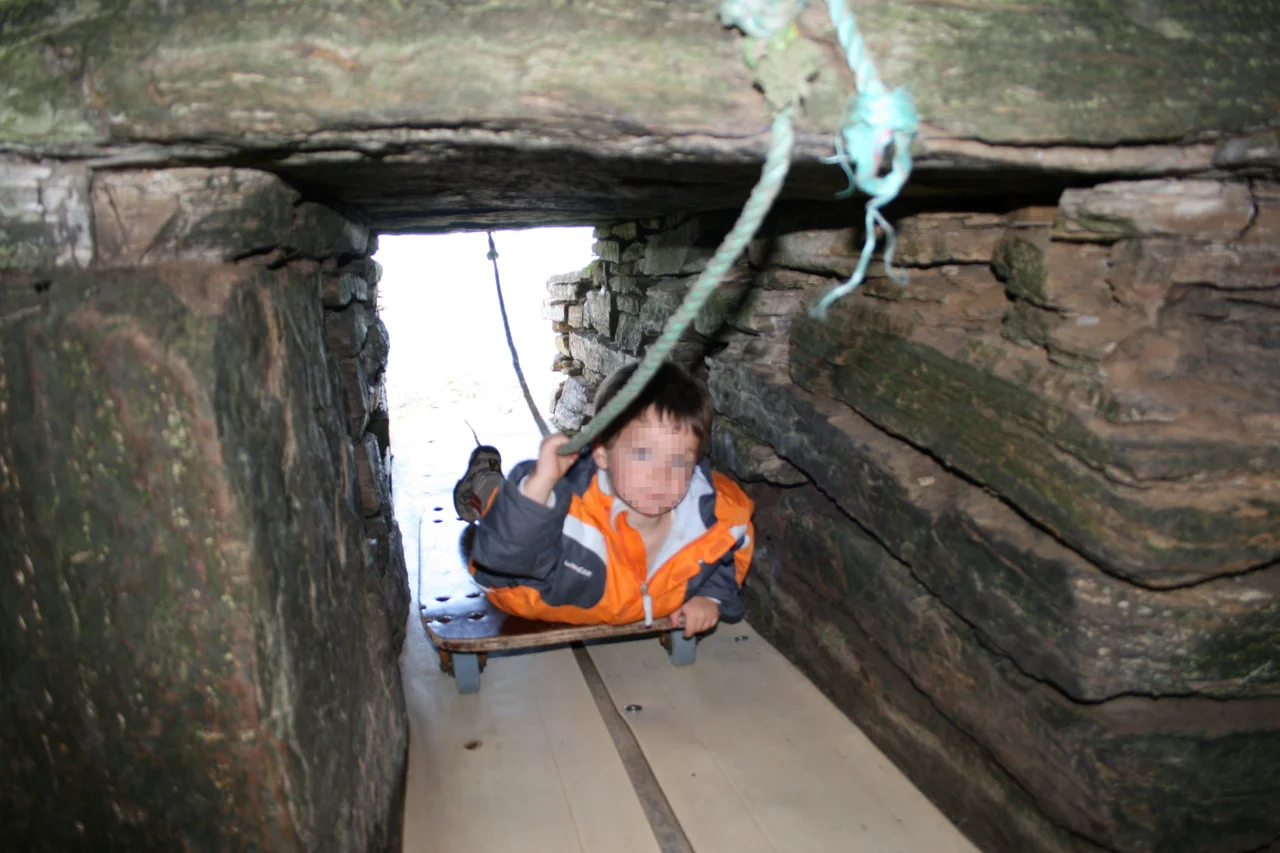
The tomb itself sits right on the cliff edge above the eastern shore of South Ronaldsay, a position that would have been chosen carefully. It is a chambered cairn of the Orkney type - a low rectangular mound of stones covering an interior of slab-built compartments accessed by a narrow passage. Inside, the visitor crawls along the passage and emerges into a main chamber tall enough to stand in. The walls are thin flagstone slabs of local Devonian sandstone, the same material every Orkney tomb is built from because it splits naturally into slabs and the islands have nothing else. The roof is reconstructed. The original was probably corbelled - successive stones cantilevered inward until they met overhead - and like every Orkney corbelled roof it eventually fell in. Above the chamber the cliff drops sharply to the sea. The dead were laid in a place where the wind never stopped.
Closed, Reopened, Closed
The Simison family ran the tomb as a small private museum from the 1970s onwards. Visitors crawled in along the passageway, sometimes pulled on a trolley, and emerged into the chamber where they could examine the reconstructed setting. The site closed to the public in 2020. In June 2025, however, a community group on South Ronaldsay successfully took the site into local ownership with a £101,607 grant from the National Lottery Heritage Fund, with plans to reopen access. The tomb was featured in 2017 on the BBC Two archaeology series *Britain's Ancient Capital: Secrets of Orkney*. Whatever its future as a visitor site, the place itself - the chamber, the cliff edge, the bones of 324 unknown Orcadians and the eagles laid among them - has been in use since before Egypt's first pyramids. It will outlast the latest closure too.
From the Air
Tomb of the Eagles sits at 58.74°N, 2.92°W on a clifftop at Isbister near the south tip of South Ronaldsay, overlooking the North Sea. From the air look for the low cairn-shaped mound on the cliff edge of South Ronaldsay's east coast, about a mile from the south point. Kirkwall Airport (EGPA) is sixteen miles north-northwest. Wick (EGPC) is forty miles south across the Pentland Firth. Recommended viewing altitude 1,500-3,000 feet. The cairn is best picked out by the cliff edge it sits on - look for the dark line of cliffs running north-south along the east coast and trace it south to the headland. Photographs are most striking in low morning light when the sun strikes the cairn from the east across the sea.
Nearby Stories
- Battle of Harpsdale 5.8 km away
- Noss Head Lighthouse 7.2 km away
- Broch of Gurness 8.7 km away
- Thurso 23 km away
- HMS Daring (H16) 45 km away
- German submarine U-58 (1938) 60 km away
- Fair Isle 70 km away
- The Laki Eruption: The Volcano That Changed World History 954 km away