.jpg)
Noss Head Lighthouse
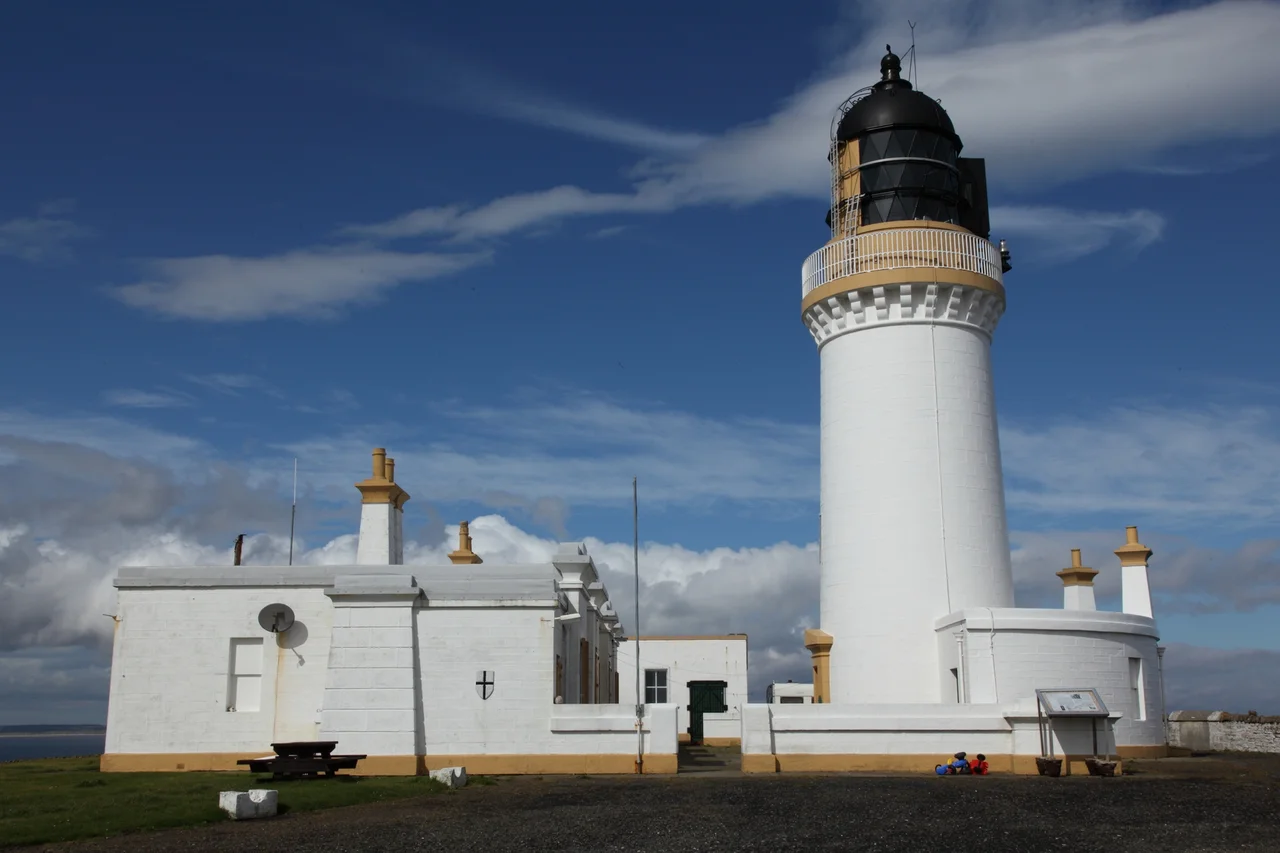
Look closely at the windows of any modern lighthouse and you'll see something the Victorians figured out here first: the glass panes set on the diagonal, framed in slim metal cross-pieces, designed to let as much light out as physically possible. Noss Head Lighthouse, which first lit its lamp in 1849, was the prototype. Standing on a peninsula at the north-west edge of Sinclair's Bay, three miles northeast of Wick, the 18-meter white tower changed lighthouse design for the next century and a half - and continues to flash, every twenty seconds, white or red depending on which way you approach.
Why Diagonal
The traditional lighthouse lantern was framed with vertical metal struts holding rectangular panes of glass. The problem was the struts themselves: every vertical bar cast a finger of shadow across the beam, interrupting the light at exactly the moments a sailor most needed to see it. The engineer Alan Stevenson - whose family had been Scotland's lighthouse engineers for generations and would later produce the novelist Robert Louis Stevenson - solved the problem by setting the panes diagonally. The diagonal framework was structurally stronger, and the shadows fell in directions that did not blind any one approach line. Noss Head was the first lighthouse built to this design, and the Northern Lighthouse Board adopted it as the standard for every lighthouse it built afterward. A small piece of engineering history, born of the need to keep ships off the Caithness rocks.
The Tower at Work
Construction began at the urging of the Northern Lights Commissioners - the formal name for the Northern Lighthouse Board, which still maintains every lighthouse in Scotland and the Isle of Man. The white cylindrical tower rises 18 meters from the headland and supports a single gallery with a black cupola at the top. There are 76 steps to the top. The focal height of the light is 53 meters above sea level, and the beam reaches 25 nautical miles out into the Moray Firth and the Pentland approaches. The light characteristic is a flash every twenty seconds. The colour varies with direction: white over safe water, red over hazards - a coded language sailors learn to read at a glance through the spray. In October 2017 the original rotating optic was retired, and the Northern Lighthouse Board replaced it with a static LED beam. The light still flashes; it just no longer turns.
Private Owners, Public Light
Like many British lighthouses, Noss Head was automated and the keepers' houses sold off. A private company bought the adjacent cottages for £200,000, and during their restoration the Northern Lighthouse Board collaborated with the new owners to renovate the whole station as a single coordinated project - tower, cottages, outbuildings - rather than piecemeal as funding allowed. When the work was complete, the local Member of the Scottish Parliament, David Stewart MSP, was invited to inspect both the renovated tower and the restored keepers' houses. From the cliffs around the lighthouse you can see the ruins of Castle Sinclair Girnigoe just to the south, three miles of coast that includes one of Scotland's most dramatic Sinclair-clan ruins and one of its most quietly important Victorian engineering achievements - the lighthouse that taught every other lighthouse how to shine.
From the Air
58.479N, 3.051W. At the tip of Noss Head, a peninsula on the north-west coast of Caithness overlooking Sinclair's Bay, about 3 nm northeast of Wick. The white tower with black cupola is highly visible against the sea cliffs. Castle Sinclair Girnigoe ruins are immediately south on the same coastline. Best at 800-1,500 ft AGL on a coastal northerly track. Nearest airport: Wick (EGPC) 3 nm southwest. Coastal turbulence common in onshore winds; the headland projects into open North Sea weather.
Nearby Stories
- Battle of Harpsdale 4 km away
- Tomb of the Eagles 5 km away
- Helmsdale 11 km away
- SS St Petersburg 38 km away
- HMS King Edward VII 40 km away
- HMS Daring (H16) 46 km away
- Brora Distillery 55 km away
- Orcadian Basin 64 km away