
Alness
For most of the 1990s and into the 2000s, Alness kept winning Britain in Bloom. That sounds like a small thing until you understand what flower competitions were actually doing for the town. The judges came and looked, and the awards came back, and the housing estates won separate awards of their own, and over the course of a decade a former Highland staging post had reinvented itself as somewhere that took its own appearance seriously. In 2018 the same instinct paid off again, when Alness was named Scottish champion at the Great British High Street Awards.
The Town on the River Averon
Alness sits on Easter Ross at the mouth of the River Averon, which runs through it and feeds the Cromarty Firth. Invergordon is three miles east, Evanton four miles southwest, and Inverness about twenty miles south. The 2011 census put the parish population at 5,310, but the Highland Council says it has grown roughly 20 per cent since then, reaching 6,101 by 2016. The town divides into two old parishes - Alness west of the river, Rosskeen east of it - which historically belonged to different presbyteries and now contain three churches between them: Church of Scotland, Free Church, and Baptist. The new Alness Academy, which opened on 28 October 2020 after the previous building had been branded by councillors as the worst school in the Highlands, brought a public swimming pool and an all-weather floodlit sports facility with it, part of a £230 million Scottish government programme to upgrade nineteen schools.
The Skirmish and the Folly
In September 1715, the Jacobite rising of that autumn brushed through Alness in a skirmish that pitted MacKenzies and MacDonalds under the Earl of Seaforth against pro-government Munros, Rosses, and MacKays under the Earl of Sutherland. The Jacobites drove their opponents over the Struie ridge to Bonar Bridge. Sixty-seven years later, in 1782, a more permanent landmark went up on Fyrish Hill behind the town. Sir Hector Munro of Novar - the local laird, a general who had fought in India - commissioned a stone replica of the Gate of Negapatam, the Indian port he had taken for the British in 1781. He built it partly as private memorial and partly as work relief. The Highland Clearances were under way, his people were being pushed off their land, and the monument was a way to keep them in paid labour. Legend says he rolled stones from the summit back down to the base each day to extend the hours. The monument is visible from almost anywhere in Alness or Kiltearn parishes.
Two Distilleries
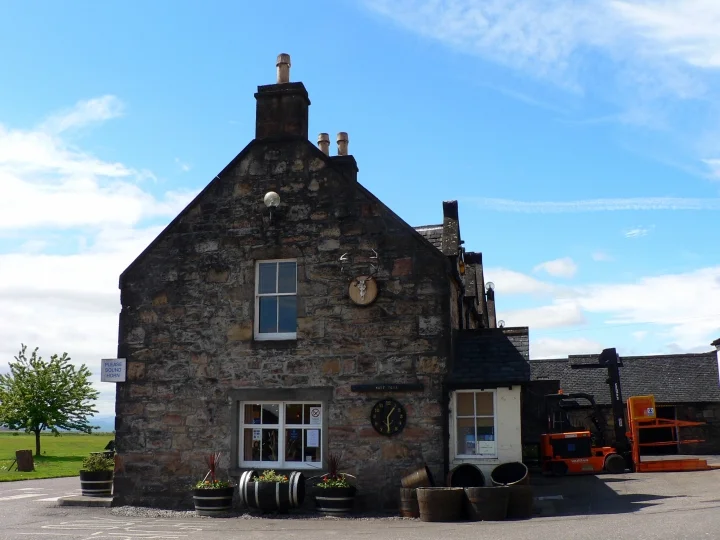
Whisky has been part of Alness for two centuries. Dalmore distillery, on the firth shore, dates from 1839 and is now owned by Whyte and Mackay, which in turn is owned by the Philippines-based Emperador Inc. Its old single malts have made headlines for the prices they fetch at auction; the casks beside the firth have weathered both world wars and the explosion that flattened part of the distillery in 1920 when a Royal Navy mine detonation went wrong. The town's second distillery, Teaninich, was founded in 1817 by Hugh Munro on his Teaninich Castle estate. It survived early competition from illegal stills and by 1830 was producing thirty times its initial output. Cameron took it over completely in 1904; after his death in 1933 it passed to Scottish Malt Distillers. The two distilleries have shaped the town's economy in quiet, continuous ways across two centuries, with the smell of mash hanging now and then on the eastern wind.
The Catalinas and the Sunderlands
During the Second World War, Alness was home to RAF Alness, a major training and operational base for Catalina amphibians and Sunderland seaplanes. The base extended from Invergordon to Alness Point - now an industrial estate - and trained the crews who flew long-range maritime patrol and anti-submarine missions over the North Atlantic from bases all around Britain. Many of those crews did not come back. A memorial to the men killed on operational flights was placed at the industrial estate in 2001. A propeller from one of the Catalinas was found and restored by RAF apprentices and now resides in the town. The tennis courts on the industrial estate are the only physical remains of the wartime base. The Far North Line railway, which lost the original Alness station in 1960, reopened the stop on 7 May 1973, and the town still has rail connections north toward Wick and south to Inverness.
From the Air
Located at 57.70 N, 4.26 W on the north shore of the Cromarty Firth, about 16 nm north-northeast of Inverness Airport (EGPE), the nearest major ICAO field. The Cromarty Firth itself is an obvious linear visual reference, and the Fyrish Monument on Fyrish Hill behind the town is a recognizable small landmark on the hilltop. Ben Wyvis (1,046 m) rises to the southwest. Best viewing 2,000-3,500 ft AGL to take in the firth, the distilleries, and the town's grid layout. Watch for orographic cloud on Ben Wyvis and rapid weather changes off the North Sea.
Nearby Stories
- Lairg 1.4 km away
- Corrieshalloch Gorge 6 km away
- Tomnahurich Cemetery 9.2 km away
- Battle of Tarbat 10 km away
- Speyside Way 14 km away
- North West Highlands Geopark 17 km away
- Helmsdale 17 km away
- Glen Affric 24 km away