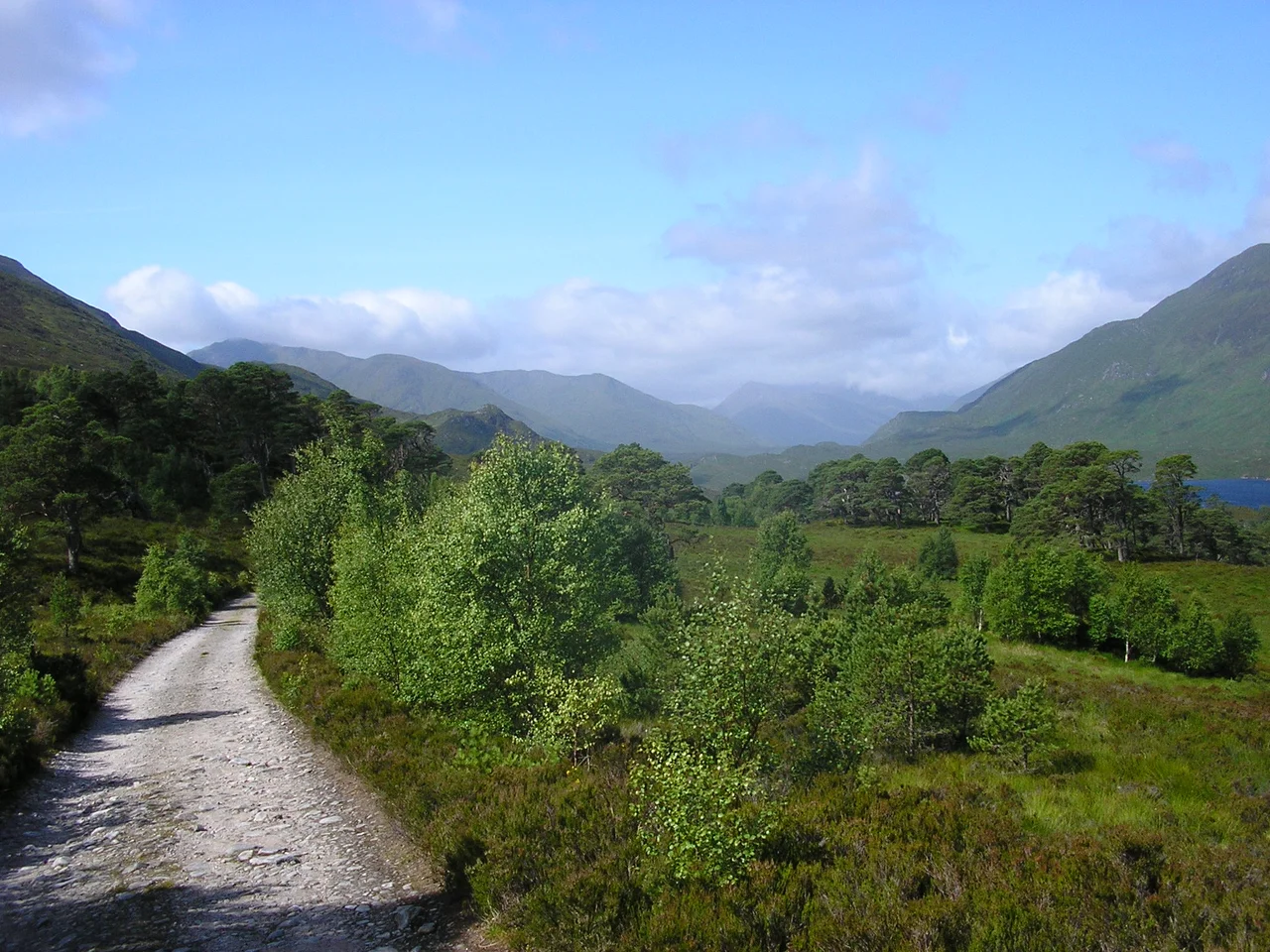

Glen Affric
In 2019 a single elm tree in Glen Affric was named Scotland's Tree of the Year and given the nickname 'The Last Ent of Affric'. Around 1868 a Liberal MP named Dudley Marjoribanks bred the first golden retriever litter from a yellow wavy-coated dog named Nous and a Tweed water spaniel named Belle at his kennels near Guisachan House at the foot of the glen. In about 1500 someone in this valley wove a piece of tartan that fell into a peat bog and stayed there for four hundred years before researchers recovered it in the early 1980s and identified it as the oldest known true tartan in Scotland. None of those three facts feels at all out of place once you have stood in Glen Affric. This is a glen that collects strange survivals.
The Granny Pines
Glen Affric runs southwest from the village of Cannich, about fifteen miles west of Loch Ness. The River Affric flows along its length through Loch Affric and Loch Beinn a' Mheadhoin. The glen contains the third-largest remaining area of ancient Caledonian pinewood in Scotland - the surviving fragment of the great pine forest that once covered most of the Highlands before centuries of felling and grazing reduced it to a few isolated remnants. The oldest trees here are the 'granny pines', gnarled Scots pines that survived generations of timber cutting and now stand alone in open ground, twisted by wind and weather. Scots pines first colonised this area between 10,000 and 8,000 years ago, soon after the last Ice Age retreated. In the early 1950s, when the Forestry Commission began surveying, they found almost no Scots pines in the glen younger than a hundred years. Sheep and deer had eaten every seedling. The restoration project that followed is now seven decades old and still continuing.
Bog-Preserved Tartan And A Birthday At Guisachan
The Glen Affric tartan is a faded fragment of cloth, perhaps half a metre square, in greens and browns and reds and yellows. A walker found it in a peat bog near the glen in the early 1980s. Carbon-14 dating placed it between 1500 and 1600 AD, which makes it the oldest piece of true tartan ever recovered in Scotland. It went on public display at V&A Dundee in 2023, and in January 2024 a team of researchers announced that they had succeeded in recreating the original weave and colours from dye analysis and microscopic study of the surviving cloth. Two hundred and fifty years after the wearing of tartan was made illegal in 1746, someone here was wearing it on a hillside, possibly lost it, possibly buried it. The bog did the rest. As for the golden retrievers: Lord Tweedmouth's kennels at Guisachan produced the founding stock of the breed in the 1860s and 1870s. His son Edward, the 2nd Baron Tweedmouth, married Lady Fanny Spencer-Churchill, a cousin of Winston Churchill, and she was also an enthusiastic owner pictured with one of the original golden retrievers. The dogs went to other estates from here. Most modern golden retrievers can trace their pedigree back to these few Highland kennels.
Eight Munros And A Way Across The Country
Glen Affric is the access route to some of the remotest mountains in Scotland. The north ridge holds eight Munros including Carn Eige at 1,183 metres - the highest peak north of the Great Glen. At the far western end of the ridge stand Sgurr nan Ceathreamhnan, Mullach na Dheireagain and An Socach, often climbed from the Scottish Youth Hostels Association hostel at Alltbeithe, which is itself one of the remotest hostels in the country. The Affric Kintail Way runs seventy kilometres from Drumnadrochit on Loch Ness, through Glen Urquhart and Glen Affric, over the watershed and down to Morvich on Loch Duich - a four-day cross-country walk taking in the entire breadth of the central Northwest Highlands. The route is suitable for walkers and mountain bikers. Most who complete it remember a particular point near the head of Glen Affric where the Caledonian pines give way to open mountain and the whole geography of Scotland seems to open out.
Wildcats, Capercaillies, And A National Park That Never Was
After seventy years of restoration the biodiversity is returning. Glen Affric supports black grouse, capercaillie, crested tit and Scottish crossbill - all woodland birds of the old pine forests. Ospreys and golden eagles hunt over the open ground. Scottish wildcats, the rarest mammal in Britain, are present though seldom seen. Otters work the rivers and lochs. The brilliant emerald dragonfly, a rare species, breeds in the boggy lochans. In October 2025, beavers were officially reintroduced to the glen for the first time in centuries. Glen Affric has been proposed for full national park status repeatedly - by the Ramsay Committee after the Second World War, by the Scottish Campaign for National Parks in 2013, by a coalition of local groups in 2024. The Scottish Government had promised to designate a new national park by 2026. In 2025 the plan was quietly dropped. Whether or not the glen is ever formally designated, the people who walk it know what it is.
From the Air
Located at 57.2638 N, 4.9855 W in the central Highlands of Scotland, southwest of Loch Ness. The glen runs roughly east-west for about 25 km, from Cannich in the east to the Kintail watershed in the west. Distinctive aerial features: the elongated narrow lochs Loch Affric and Loch Beinn a' Mheadhoin, dark patches of mature Caledonian pinewood on the lower slopes, the dam at Loch Beinn a' Mheadhoin (part of the Affric-Beauly hydroelectric scheme), Carn Eige (1183 m) on the northern ridge - the highest peak north of the Great Glen. Nearest aerodrome: Inverness (EGPE) approximately 35 km east-northeast. The glen is reached by a single narrow road as far as Loch Beinn a' Mheadhoin; beyond that, footpaths only. The Affric Kintail Way crosses the glen east to west. Best lit in early morning from the east when sun strikes the granny pines on the south-facing slopes. Maintain 2000 ft AGL through this area - mountain weather forms quickly and the surrounding peaks rise to over 1100 m.
Nearby Stories
- Kyle Rhea 3.2 km away
- Stand-off at the Fords of Arkaig 5.8 km away
- Beauly 6.5 km away
- Foyers hydropower schemes 7.3 km away
- Loch nan Uamh Viaduct 9.3 km away
- Loch Torridon 14 km away
- Ben Alder 17 km away
- Cape Wrath Trail 19 km away