
Foyers hydropower schemes
When the British Aluminium Company powered up its Victorian turbines at Foyers in June 1896, it took something away from the Falls of Foyers. The water that had thundered down the gorge in front of MacBrayne's pleasure steamer passengers was now diverted through a 30-inch cast iron pipe to make aluminium. Robert Burns had once praised those falls in verse. The aluminium plant ran until 1967, then closed; the falls partly returned. But by 1974, a much larger scheme buried in the hillside above was using all of Loch Ness as a battery, pumping water 580 vertical feet up to Loch Mhòr at night and letting it fall back through 300 megawatts of reversible turbines by day.
The Smelter That Reshaped a Loch
The Heroult-Hall process, perfected on two continents in 1886-1887, required staggering amounts of electricity to extract aluminium from bauxite—around 24 megawatt-hours per ton produced. The British Aluminium Company, formed in 1894, bought the Lower Foyers estate of 8,000 acres along with water rights specifically to avoid Parliamentary approval and public objections about the falls. They built a concrete and masonry dam at the south-western end of Loch Garth, raised its waters 20 feet, joined it to Loch Faraline, and called the combined reservoir Loch Mhòr. From there, water travelled along the original course of the River Foyers to the top of the Upper Falls, then through a half-mile rock tunnel and cast iron penstocks to a powerhouse on the Loch Ness shoreline. Five Girard vertical-shaft turbines and Oerlikon direct current generators produced 3.75 megawatts at 65 volts and 8,000 amps—enough to make 200 tons of aluminium a year from June 1896 onwards.
Crow-Stepped Gables on the Shore
Cameron Burnett probably designed the smelter building, erected in 1895-96. It consists of eight crow-stepped gables behind a long shed, with a corrugated iron roof, pairs of round-headed windows piercing the end walls, and a louvered saddle-back vent running along each ridge. Historic Environment Scotland gave it Grade A listed status not for elegance but for primacy: this was the first use of large-scale hydroelectric power for industrial purposes in Scotland. The Loch Mhòr dam, built at the same time, is concrete, masonry and rammed earth, with a crenellated control tower echoing the smelter's silhouette. When world demand for aluminium caught up with supply, the plant gave up sideline products like calcium carbide and concentrated on aluminium alone. By 1954, larger smelters at Kinlochleven and Fort William had made Foyers the inefficient relation; it survived as a refining plant producing 'super purity' aluminium until economics finally closed it in 1967.
The Pumped-Storage Giant
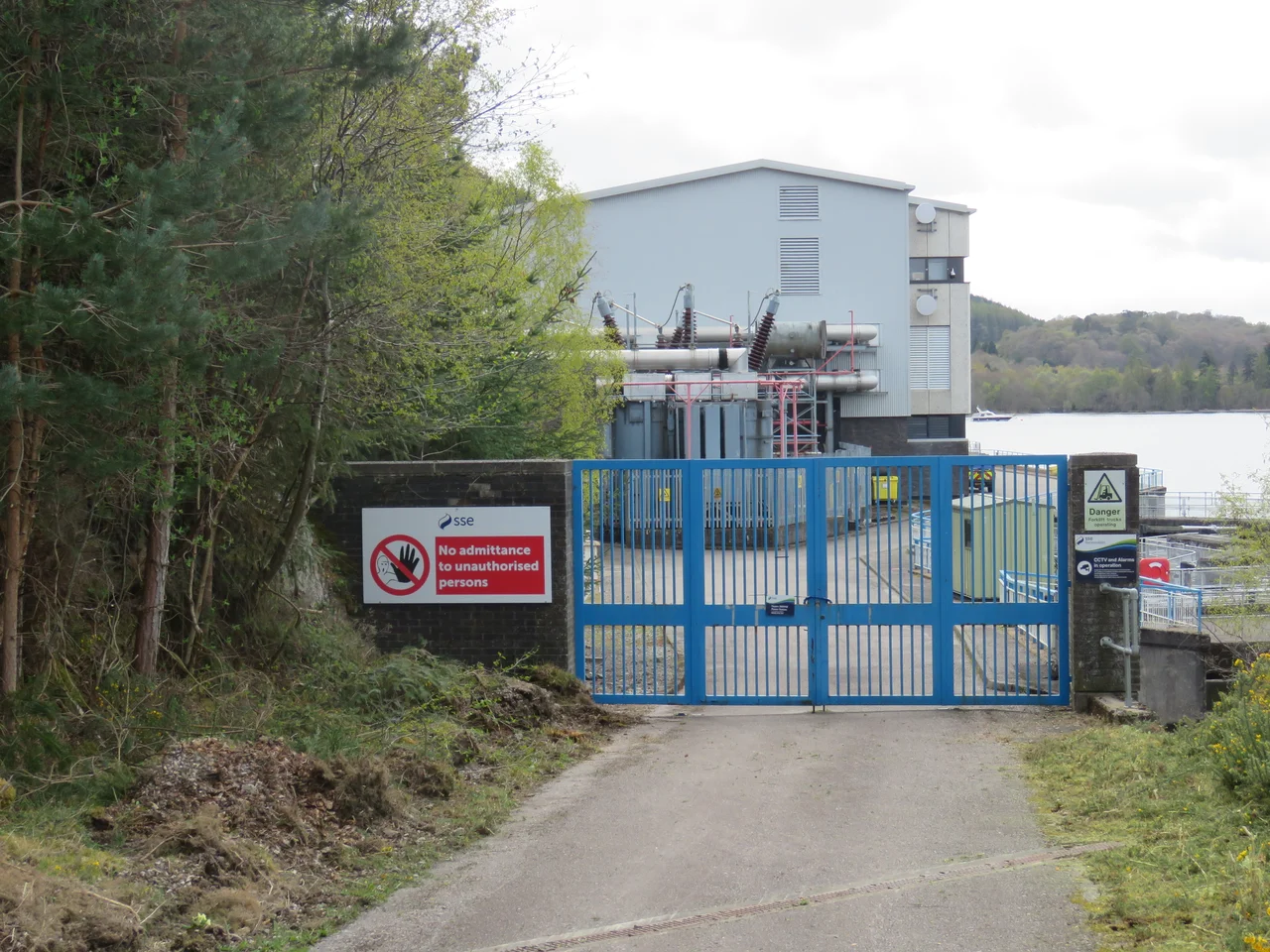
The North of Scotland Hydro Electric Board took over the site within a year of the smelter closing, replaced the five Girard turbines with a single 5 megawatt unit, and began planning something far larger. In 1968 the Board promoted a 300 megawatt pumped-storage scheme using Loch Ness as the lower reservoir and Loch Mhòr as the upper. Work began in 1969 and finished in 1974, just before the Board's run ended—Foyers was its last project. Two reversible 150 megawatt turbines sit in shafts 35.1 metres below the level of Loch Ness, deliberately placed below water level to suppress cavitation. The shafts are 19.35 metres in diameter, their centres 39.3 metres apart, with a pillar of rock between them. At night, when demand drops, the turbines run as pumps and lift water up to Loch Mhòr. By day, when prices peak, the same machines run as generators.
The Shatter Zone of the Great Glen
The final cost came in at £202 million, nearly twice the original estimate. Sixty per cent of the overrun was inflation; most of the rest was geology. The scheme threads through the shatter zone of the Great Glen Fault, the tectonic suture that splits Scotland from coast to coast, and the rock here is anything but reliable. In 2002, steel lining separated from concrete in one of the high-pressure tunnels 160 feet below Loch Ness. Kvaerner Markham engineers from Sheffield had to cut away the damaged steelwork, weld redesigned linings in situ, and use 400 anchor bolts to attach them. A separate gauntlet of fish protection—smolt screens at the lower control works, agreed compensation flows for Atlantic salmon—reflects the conditions imposed by SEPA on a scheme that lives in the same water as Loch Ness's most famous resident.
Forward by Day, Backward by Night
The hybrid nature of the scheme—about 25 per cent of its planned output comes from natural inflow to Loch Mhòr—makes it both a battery and a generator. Some River Fechlin water is diverted through a tunnel into the River E upstream of Loch Mhòr to boost catchment. The 18 kV generated at Foyers is stepped up to 275 kV on site and carried by an underground oil-filled cable, the last of its kind on the Scottish transmission network, to the switching station. SSE has been planning its replacement since 2019. The Victorian 5 megawatt station beside the 300 megawatt giant marked its fiftieth anniversary in 2025; the Loch Mhòr dam still bears the crenellated control tower that Cameron Burnett designed in 1895. In June 2023, Ofgem fined SSE £9.8 million for charging excessive amounts to reduce Foyers's output during grid constraints—a modern grievance for an ancient site.
From the Air
Located at 57.262N, 4.484W on the south-east shore of Loch Ness, near the village of Foyers. Inverness Airport (EGPE) sits 17 nm north-east. The crow-stepped gables of the original smelter building are the easiest landmark from altitude—eight peaked ridges paralleling the shoreline. Loch Mhòr, the upper reservoir, sits visibly higher in the hills behind. Recommended viewing altitude 2,500 to 4,500 ft AGL. The Falls of Foyers are partly visible upstream of the powerhouse when river flow allows. Winds along the Great Glen funnel hard from the south-west and can be unpredictable near the loch surface.
Nearby Stories
- Clava cairns of Aviemore 3.1 km away
- Beauly 4.1 km away
- Commando Basic Training Centre 4.4 km away
- Glen Affric 6.5 km away
- Dalwhinnie distillery 9.6 km away
- Battle of Auldearn 11 km away
- Blair Castle 20 km away
- Cape Wrath Trail 27 km away