
Hilton of Cadboll Chapel
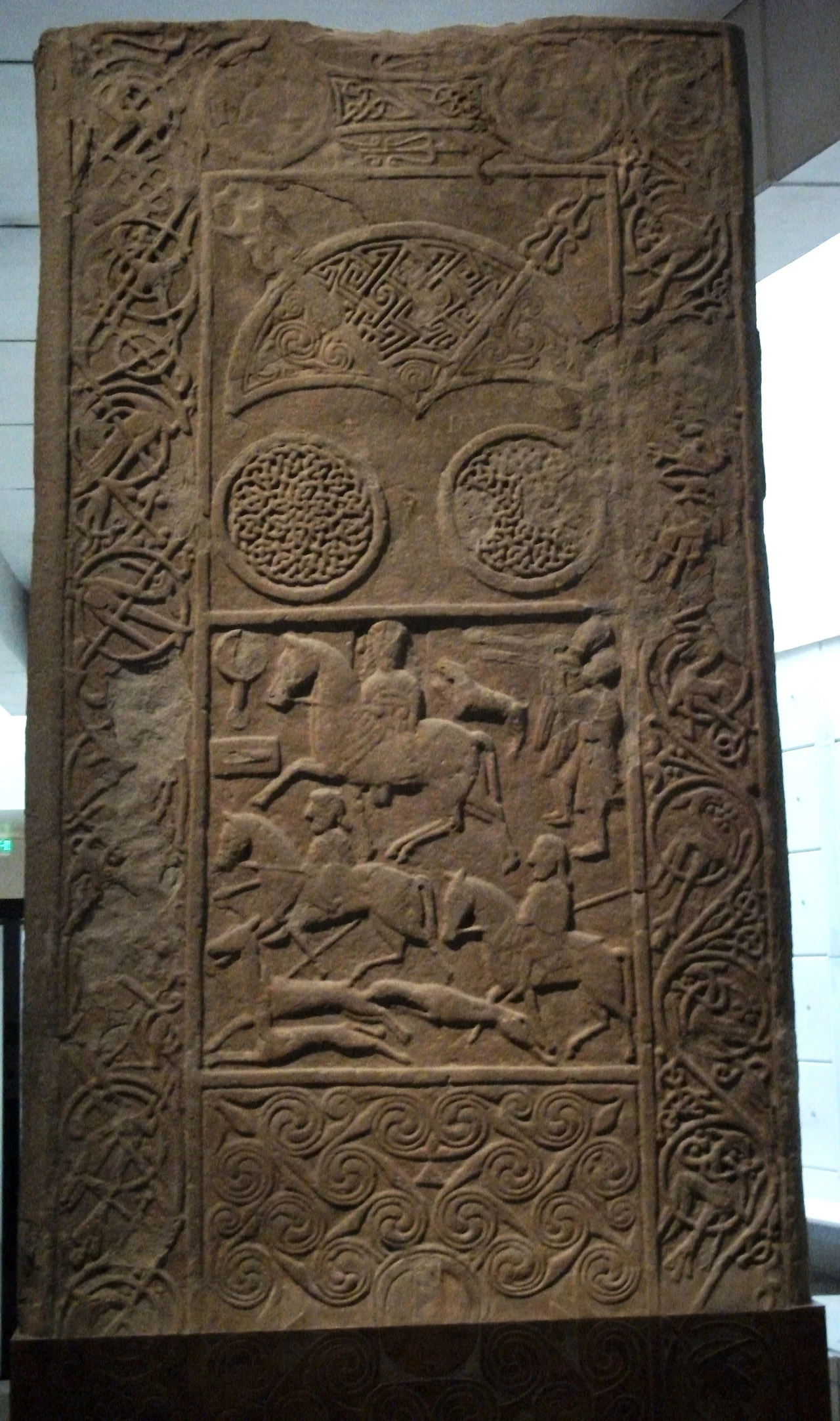
The stone is gone now - moved away in the 1860s, broken, eventually carried to Edinburgh, where it stands in the National Museum of Scotland. What remains at Hilton of Cadboll is the foundation of the chapel that once held it, low turf-covered banks running across the grass, and a replica of the stone standing where the original used to be, visible from the chapel ruin like a memory in the wrong place. The site looks east over the Moray Firth from a low rise five meters above sea level, and Pictish people were burying their dead here twelve hundred years before the medieval chapel was built.
A Layered Holy Place
Archaeology at Hilton of Cadboll has revealed at least four distinct phases of activity stacked on the same patch of ground. Pictish burials beneath the site date from 650 to 900 CE - human bone fragments from these centuries have been recovered during limited excavation. Around the year 800 CE, the famous Hilton of Cadboll Stone was carved and erected on the gable of an earlier chapel, probably wooden. A medieval chapel of stone, dedicated to the Virgin Mary, was built sometime in the 13th century. The site has been in the care of the state since 1978. The chapel walls were sandstone bound with shell mortar over a rubble core, oriented east-west, about 12 by 6.5 meters - a simple rectangle. Where the entrance was, nobody knows.
The Enclosures
The chapel sits inside two concentric enclosures of low turf-covered banks. The inner enclosure - 32 by 23 meters, oriented east-northeast to west-southwest - is the older. Its construction began somewhere between the 7th and 9th centuries and continued through to the mid-twelfth century, likely defining the original burial ground. At some point the inner walls were extended to the northeast and southeast. Centuries later, between the 16th and 19th centuries, a second enclosure was built around the first - 45 by 34 meters, a drystone wall on an earthen bank. The site overlooked the Moray Firth and would have been visible from water and land alike, a navigational marker as well as a holy place.
Children Buried in Order
Excavation west of the chapel uncovered the burials of four children and youths. Two were buried contemporary with the chapel's medieval construction; the other two came later, sometime in the medieval or early post-medieval period. The pattern hints at spatial zoning - specific parts of the graveyard reserved for specific categories of dead - and the site continued to serve as a burial ground for unbaptized infants until the end of the 19th century. The treatment of unbaptized children in Scottish Christian tradition was complicated and often cruel; consecrated ground was officially denied them, and parents resorted to liminal places like this one, where the line between holy and unholy could be blurred enough to give a dead child a respectable burial.
Where the Stone Stood
The Hilton of Cadboll Stone was a Pictish cross slab of exceptional quality - one of the finest survivors of the entire tradition. Carved around 800 CE, it likely stood in a small semicircular setting on the western gable of the chapel from the time of its making through to about 1150. Then it was moved to a second setting roughly thirty centimeters away, where it remained until 1674. By the 1860s it was removed from the site entirely. In 2001 the broken-off lower portion of the stone was recovered and taken away for conservation. Today the original is in Edinburgh. The replica that stands at the former site is visible from the chapel ruin - close enough to see, distant enough to feel the absence. Of "Oure Lady-Well," the holy well once associated with the chapel, no trace now remains. North of the chapel lies a broken stone font.
From the Air
Hilton of Cadboll Chapel sits at 57.77°N, 3.90°W on the eastern shore of the Tarbat peninsula, overlooking the Moray Firth. Best viewed at 1,500-2,500 ft AGL for the village of Hilton of Cadboll and the coastal setting. Nearest ICAO airport is Inverness (EGPE) approximately 30 nm south-west. The Tarbat peninsula juts northeast into the Moray Firth, with the chapel near the southeastern shore. The site itself is small - low foundations and a standing replica stone - but the firth coastline and village make easy reference points.
Nearby Stories
- Moray Firth 1.1 km away
- Culloden Viaduct 1.2 km away
- Cardhu Distillery 9.5 km away
- Clynelish Distillery 10 km away
- Alladale Wilderness Reserve 15 km away
- Corrimony Chambered Cairn 18 km away
- Ardvreck Castle 31 km away
- Hill o' Many Stanes 40 km away