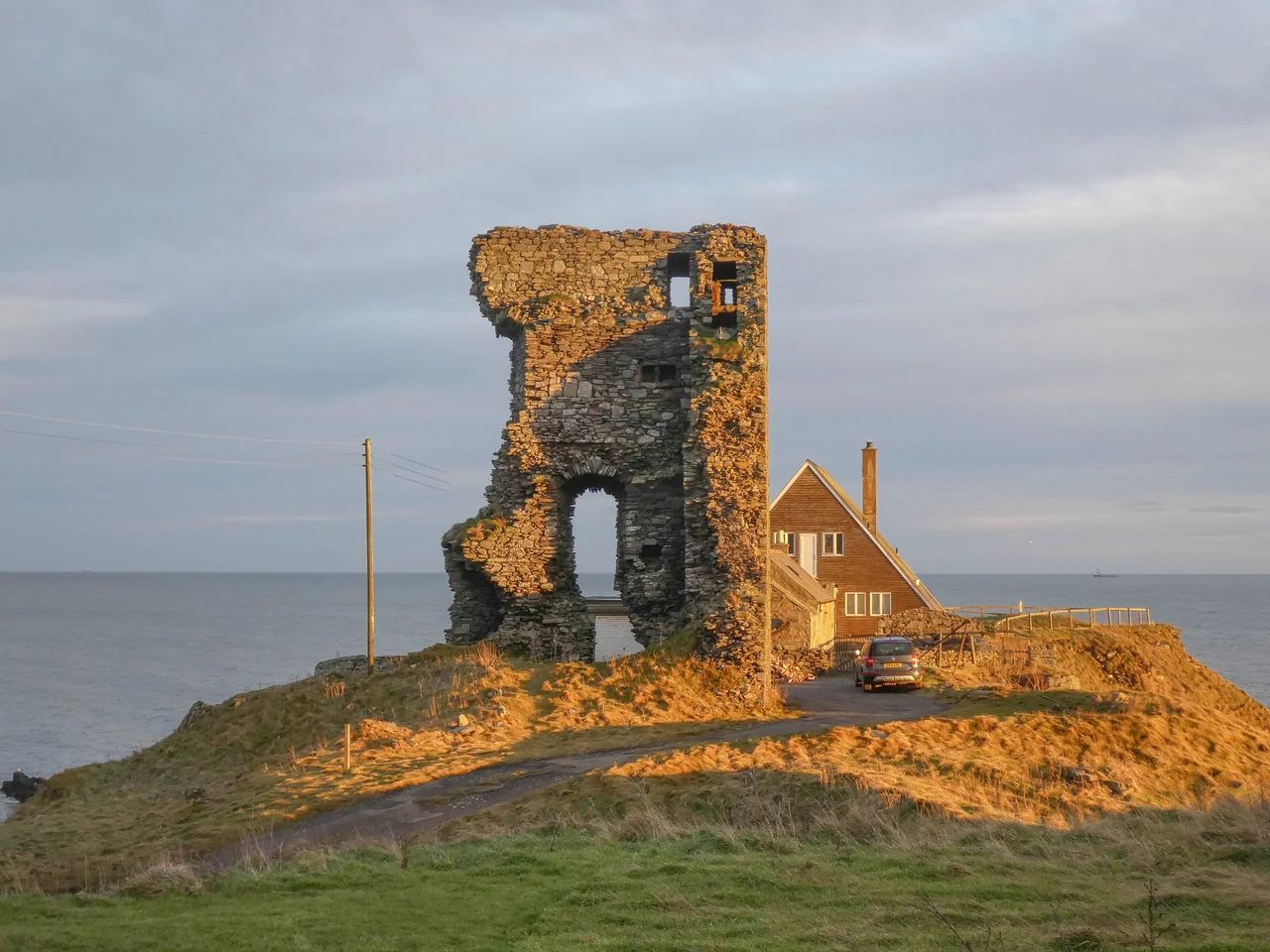

Old Slains Castle
On 1 November 1594, Aberdeen Town Council shipped twenty stone of gunpowder up the coast to a five-storey keep at Collieston, along with pickaxes, shovels, and a stonemason named John Fraser. King James VI had given the order. Francis Hay, ninth Earl of Erroll, had sided with a Catholic rebellion in the north, and James had decided to settle the matter not by siege but by demolition. The blast brought down most of the keep. Two walls met at a corner and refused to fall. They are still there, four centuries later, jutting out of the Aberdeenshire cliff like the broken edge of a torn page.
From the Comyns to the Bruce
The castle was built in the thirteenth century by the Comyns, Earls of Buchan, the family that briefly held a real claim to the Scottish throne. After they backed the wrong side in the Wars of Independence, Robert the Bruce stripped them of their estates and handed Slains to Sir Gilbert Hay in recognition for his loyalty in the war against the English. The Hays held it for three hundred years. The castle commanded the cliff above the North Sea, a five-storey oblong keep with thick walls, defended on the landward side by a curtain wall added in the early sixteenth century when guns started to change what castles needed to be. By the late 1500s it had become a Catholic redoubt in an officially Protestant Scotland.
The Earl, the Rebellion, and the Gunpowder
Francis Hay, 9th Earl of Erroll, hosted what one chronicler called so many English and Scottish Catholics in his tower that he was put to great expense. In April 1589 James VI rode north to Aberdeen and placed a royal garrison at Slains, but Erroll slipped the leash and joined the rebellion outright. The Battle of Glenlivet in October 1594 broke the Catholic army, though Erroll himself escaped. James decided that the answer was to remove the castles his enemies might come back to. Aberdeen Council billed the crown five hundred and forty-eight pounds, six shillings - a vast sum - for the gunpowder and tools needed to demolish houses and fortalices. Old Slains came down on 1 November. A corner of two intersecting walls, perhaps twenty-five metres high, refused to collapse with the rest.
The Guidwife of Clochtow
Erroll's wife, Elizabeth Douglas, Countess of Erroll and a personal friend of Anne of Denmark, came north in 1595 with masons to repair the keep. They could not save it. She moved instead into a farmhouse called Clochtow, just north-west of the ruins, and stayed there long after Francis Hay was pardoned and the estates restored in 1597. For the rest of her life she preferred to be called the Guidwife of Clochtow rather than the Countess of Erroll - the only title, she said, that the crown had never taken from her, and the one she had borne all the years her husband was a wanderer abroad and plain Francis Hay. Francis built a new tower house called Bowness several miles north along the coast, and that is the building we now call New Slains Castle - the one Bram Stoker would visit centuries later.
What Time Did Next
On 31 May 1979, after four hundred years of standing through North Sea storms, the south-facing wall of Old Slains finally let go. An estimated hundred tonnes of rubble fell across the coastal road, blocking traffic and partially burying a lorry that happened to be passing. The two remaining wall sections, still about twenty-five metres tall, are now a scheduled monument. In the 1950s someone built a three-storey house inside what was left of the keep, adjoining an eighteenth-century fishing cottage that had crept up against the ruin. Archaeologists excavated the site in stages between 1991 and 2007. The cliff is high, the wind is constant, the sea below is grey, and a corner of medieval masonry still meets in the air where King James's gunpowder failed to finish its work.
From the Air
Old Slains Castle stands at 57.36 degrees north, 1.91 degrees west on the cliffs near Collieston, about nine nautical miles north-east of Aberdeen. The two surviving wall sections jut from a coastal headland just south of the village. Aberdeen Dyce Airport, ICAO EGPD, is the nearest commercial airfield. From altitude the ruin appears as a small stone fragment on the cliff edge; best viewed at 1000-2000 feet AGL in slanting morning or evening light, which throws the wall corners into relief. Do not confuse with the much larger and more famous New Slains Castle five nautical miles to the north-east.
Nearby Stories
- Tarlair Swimming Pool 1.7 km away
- Fraserburgh Lifeboat Station 5.8 km away
- Bridge of Dee 11 km away
- Mither Tap Hillfort 12 km away
- Battle of Lumphanan 15 km away
- Piper Alpha 132 km away
- German submarine U-1274 170 km away
- HMS Nottingham (1913) 212 km away