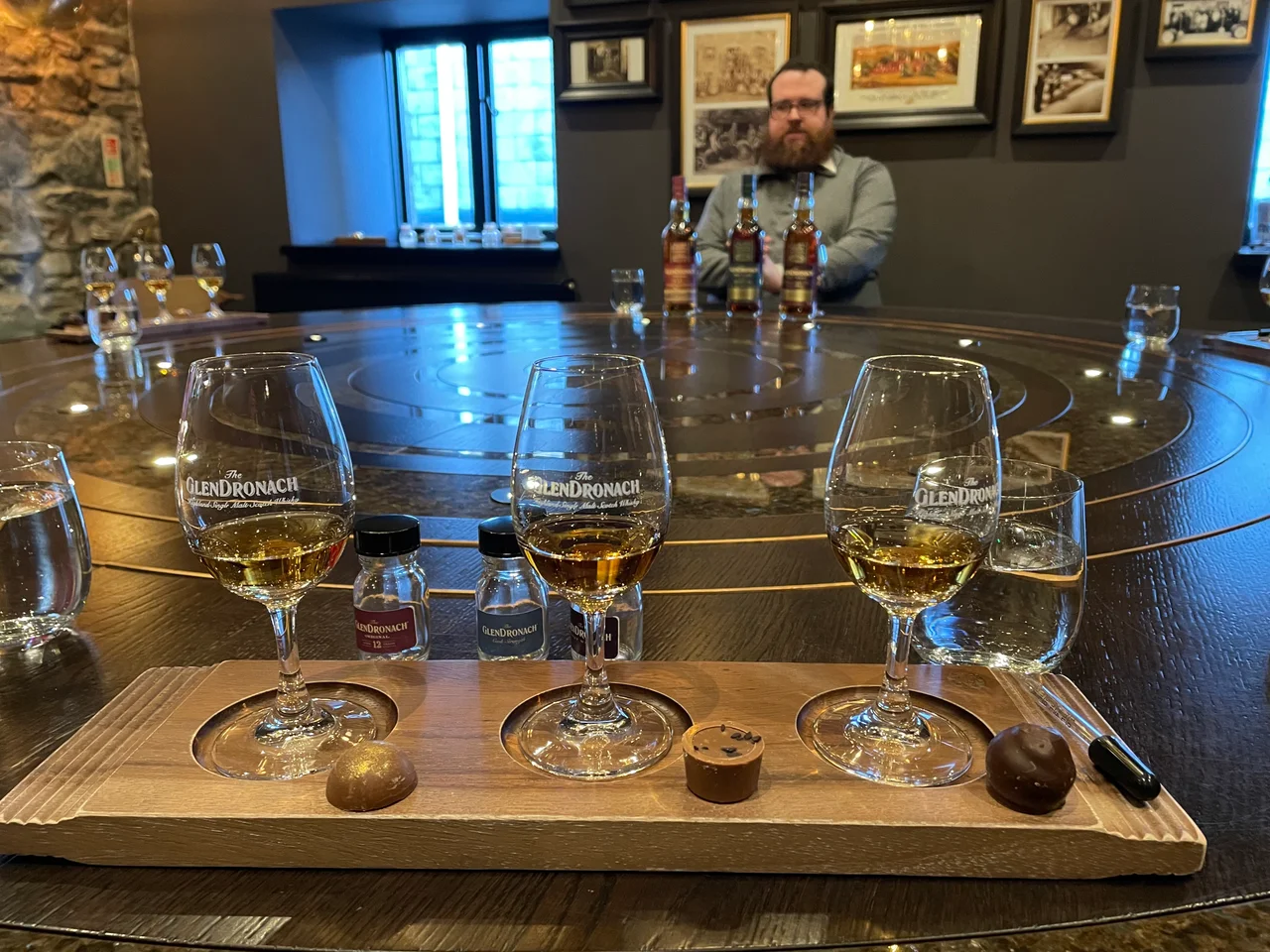

Glendronach Distillery
In 1823, the British government did something quietly transformative for Scotland: it passed the Excise Act, which finally allowed Scottish farmers and distillers to legally produce whisky. Until then most Highland whisky had been smuggled - made in clandestine stills hidden in the glens, ferried to market under cover of night. The Act changed everything. Within a few years the great Speyside and Highland distilling tradition we now know began. The second distillery in the entire country to apply for a licence under the new law was a small operation in a quiet valley near Forgue, north of Huntly. Its founder was James Allardes. The name he gave the place, from the Scottish Gaelic gleann dronach, meant "valley of the brambles." Glendronach has been making whisky there ever since.
Brambles, Burns and a Burn-Fed Distillery
The Gaelic name gleann dronach can be read two ways - valley of the brambles, or valley of the blackberries. Both fit. The valley around Forgue lies in the rolling agricultural country between Huntly and Banff, country where blackberries still tangle along stone dykes in late summer. The distillery sits beside the Dronac burn, the small stream from which it draws its water. Highland whisky depends absolutely on its water - soft, slightly mineral, filtered through the local geology - and the Dronac burn provides the foundation of every bottle that has ever left this site. Two wash stills and two spirit stills do the actual distilling. The buildings still include their own floor maltings, a now-rare survival in modern Scotch production, where most distilleries buy in commercial malt instead of making it themselves.
The Licence of 1826
James Allardes - often referred to as Allardice in older sources - founded Glendronach in 1826. Some sources credit a consortium of farmers and businessmen for the foundation, of which Allardes may have been one. Either way, the licence was granted under the recently enacted Excise Act 1823, and Glendronach became only the second legal Scottish whisky distillery of the new era. To put that in perspective: when Glendronach started, the smuggling tradition was still alive in the glens around it, and many of its first customers were probably men who had previously bought their drink off the back of a horse at midnight. By going legal so early, Allardes was making a bet on the future - that Scottish whisky, taxed and registered, would become a respectable industry rather than a criminal one. He turned out to be right.
Walter Scott, Charles Grant, and the Centuries
Glendronach changed hands several times across the nineteenth and twentieth centuries, each owner adding a layer to its story. In 1852 it was acquired by Walter Scott - not the novelist, who had died in 1832, but a businessman of the same name. In 1920 it passed to Charles Grant, son of the founder of Glenfiddich, joining one of Scottish whisky's most famous family lineages. Allied Domecq took over in the late twentieth century. The distillery was mothballed in 1996 - whisky distilleries close periodically when the market floods - and reopened in 2002. Chivas Brothers, part of the Pernod Ricard group, owned it from 2006. The BenRiach Distillery Company bought it in 2008. In 2016, Brown-Forman, the American spirits company that owns Jack Daniel's, acquired BenRiach and with it Glendronach. The distillery is now in its third century of operation under its eighth or ninth ownership - all of them honoring the same valley.
The Sherry-Cask Style
What sets Glendronach apart in the crowded Highland whisky world is its devotion to sherry cask maturation. The core range is matured in former oloroso and Pedro Ximenez sherry casks shipped from Andalusia in Spain - a tradition that gives the whisky its distinctive dark colour, rich dried-fruit and spice notes, and characteristic depth. The standard expressions step up by age: 12 years, 15 years, 18 years, and 21 years. Sherry cask maturation is more expensive and more demanding than bourbon-cask finishing - the casks are harder to source, the maturation is more variable, and the wood has to be in excellent condition. Glendronach has built much of its modern reputation on doing this difficult thing consistently well. The distillery is protected as a category B listed building.
Tasting the Valley
A glass of Glendronach is, in a quite literal sense, the taste of a small Aberdeenshire valley translated into a liquid. The barley was malted on these floors. The water came from the burn that runs through the grounds. The peat smoke - what little there is - drifted from a kiln a few yards away. The whisky was distilled in stills that have stood here, or close to it, for nearly two hundred years. The sherry casks brought a memory of Spanish heat and oxidative slow-aging. Then the spirit sat for a decade, or two, or three, in cold stone warehouses while the seasons cycled past. A well-made single malt is a slow record of a place. Glendronach has been making that record in this valley of the brambles since the year after Beethoven died. It is still making it now.
From the Air
Glendronach Distillery sits at 57.485N, 2.625W, near the village of Forgue, in rolling agricultural country approximately 5 nm north-east of Huntly. From the air look for the cluster of distillery buildings, pagoda-roofed malting kiln, and warehouse blocks beside the small Dronac burn. The country around is gently undulating farmland and small woodlands - classic eastern Aberdeenshire whisky-growing country. The Spey valley, the great heartland of single malt production, lies further west. Nearest airport: EGPD (Aberdeen Dyce), 28 nm to the south-east. Aberdeen-to-Inverness railway runs through Huntly to the south.
Nearby Stories
- Mormond Hill 4.3 km away
- Glen Grant distillery 4.9 km away
- Mither Tap Hillfort 6.7 km away
- SS St Petersburg 10 km away
- Brig o' Balgownie 14 km away
- Corgarff Castle 16 km away
- Tarbat Ness Lighthouse 36 km away
- HMS Exmouth (H02) 54 km away