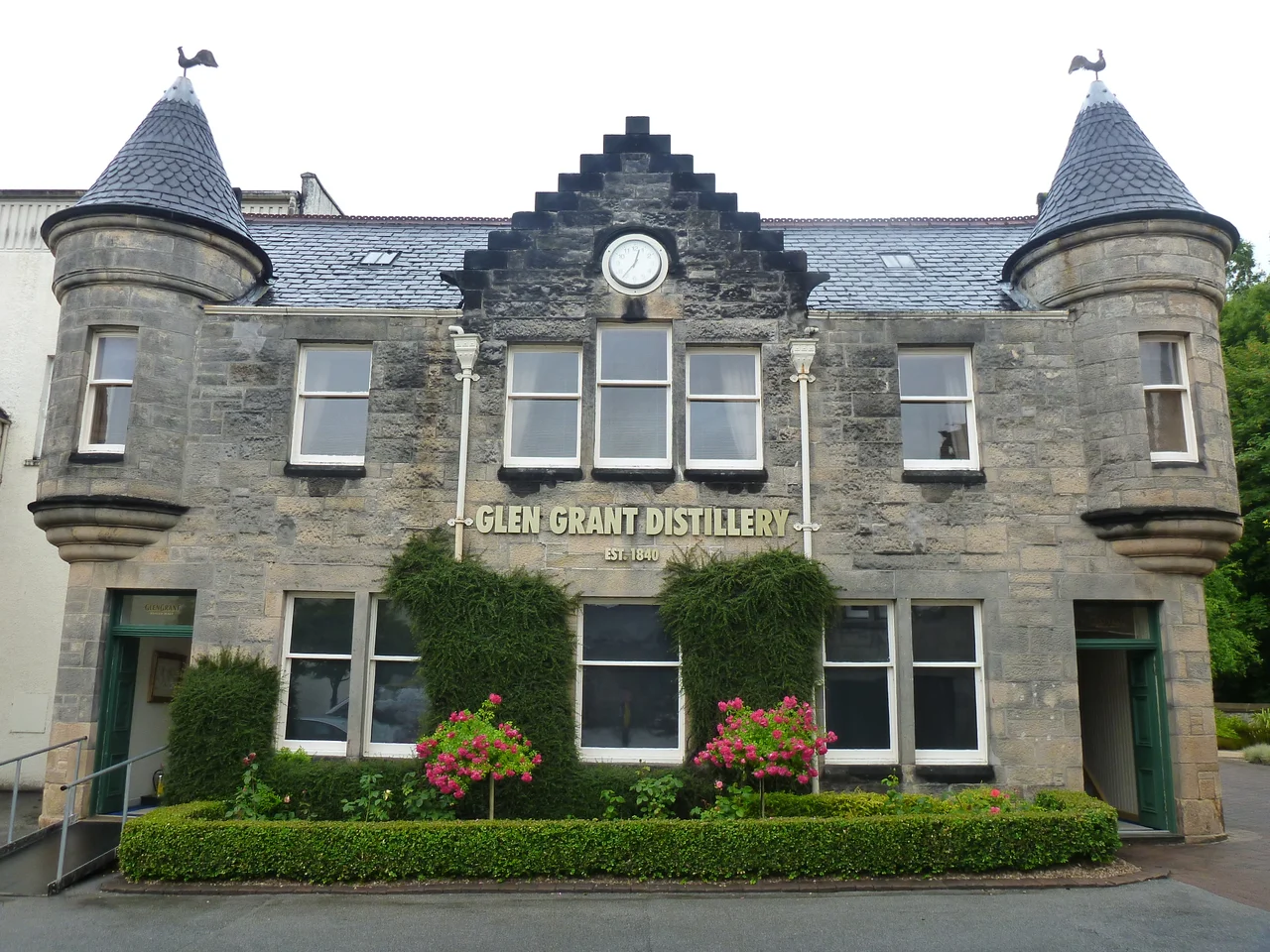

Glen Grant distillery
The Grant brothers had been illegal distillers and smugglers. By 1840 they decided they would rather hold a license than dodge excise officers across the hills. John and James Grant set up Glen Grant in Rothes, a small Speyside town where the River Spey, the port of Garmouth nearby on the coast, and the barley-growing plains gave them every raw ingredient that whisky-making required. They built a distillery that would become, nearly two centuries later, the biggest-selling single malt Scotch in Italy. The route from smuggler's still to Campari boardroom passed through one of the most distinctive figures in 19th-century Scotch whisky — and through a Victorian garden that you can still walk in.
From Illegal Stills to Legal Founders
John and James Grant grew up in the era when most Highland whisky was illicit. The 1823 Excise Act had begun to change the economics — making it possible, for the first time, to distill legally at a profit if you accepted regulation and paid duty. By 1840 the brothers had built their own distillery in Rothes, a town that sits a few miles north of the modern centre of Speyside whisky production. The setting was ideal. The Spey ran nearby; the sea port of Garmouth gave access to wider markets; the surrounding fields produced the barley. The brothers brought practical knowledge of distilling that came from years of doing it without permission. By the time they died, their nephew was ready to take over.
The Major Inherits
James Grant, known throughout Speyside as the Major, was born in 1847 and inherited Glen Grant from his uncle John. He took the title Glengrant along with the business, and over the late 19th century turned the distillery into something more ambitious than a working still. The Major travelled widely — he is credited with introducing Speyside to plants and species he brought back from journeys to India and Africa, planted in a Victorian garden behind the distillery that has been restored and is open to visitors. He laid out a network of paths along the Glen Grant burn, with a footbridge known as the Major's safe leading to where he stored bottles of whisky cooling in the stream. The story is fanciful but the bridge and the safe are real.
An Italian Single Malt
The 20th century saw Glen Grant pass through several owners, including The Glenlivet Distillers and Seagram. Chivas Brothers, best known for the blended Chivas Regal, held it before December 2005, when the Italian company Campari Group acquired it. The choice made commercial sense: Glen Grant had become the dominant single malt in Italy, a market where the lighter, gentler Speyside style suited tastes shaped by aperitivos and lunch wines. Today Glen Grant is the biggest-selling single malt Scotch in Italy, and the Italian ownership has been an unusually comfortable fit. The garden is still there. So are the long, slim stills with their distinctive purifiers that give Glen Grant its light, clean character — different from the rich, sherried Speyside style and very much its own thing.
From the Air
Located at 57.532 N, 3.211 W in Rothes, on the Spey valley in Moray. The distillery sits on the south side of the small town, with the Glen Grant burn running through its grounds. Inverness (EGPE) is about 50 km west; Aberdeen (EGPD) is 70 km east. Cruise at 2,500-4,000 feet AGL to follow the Spey valley itself — one of the most distillery-dense valleys in the world, with the pagoda roofs of malt kilns visible at most settlements. The country is gently rolling, with the higher Cairngorm massif visible to the south.
Nearby Stories
- Royal Brackla distillery 3.9 km away
- Battle of Alford 9.1 km away
- Royal Dornoch Golf Club 11 km away
- Huntly Castle 13 km away
- Corgarff Castle 17 km away
- Monadhliath Mountains 17 km away
- Tarbat Ness Lighthouse 26 km away
- SS St Petersburg 46 km away