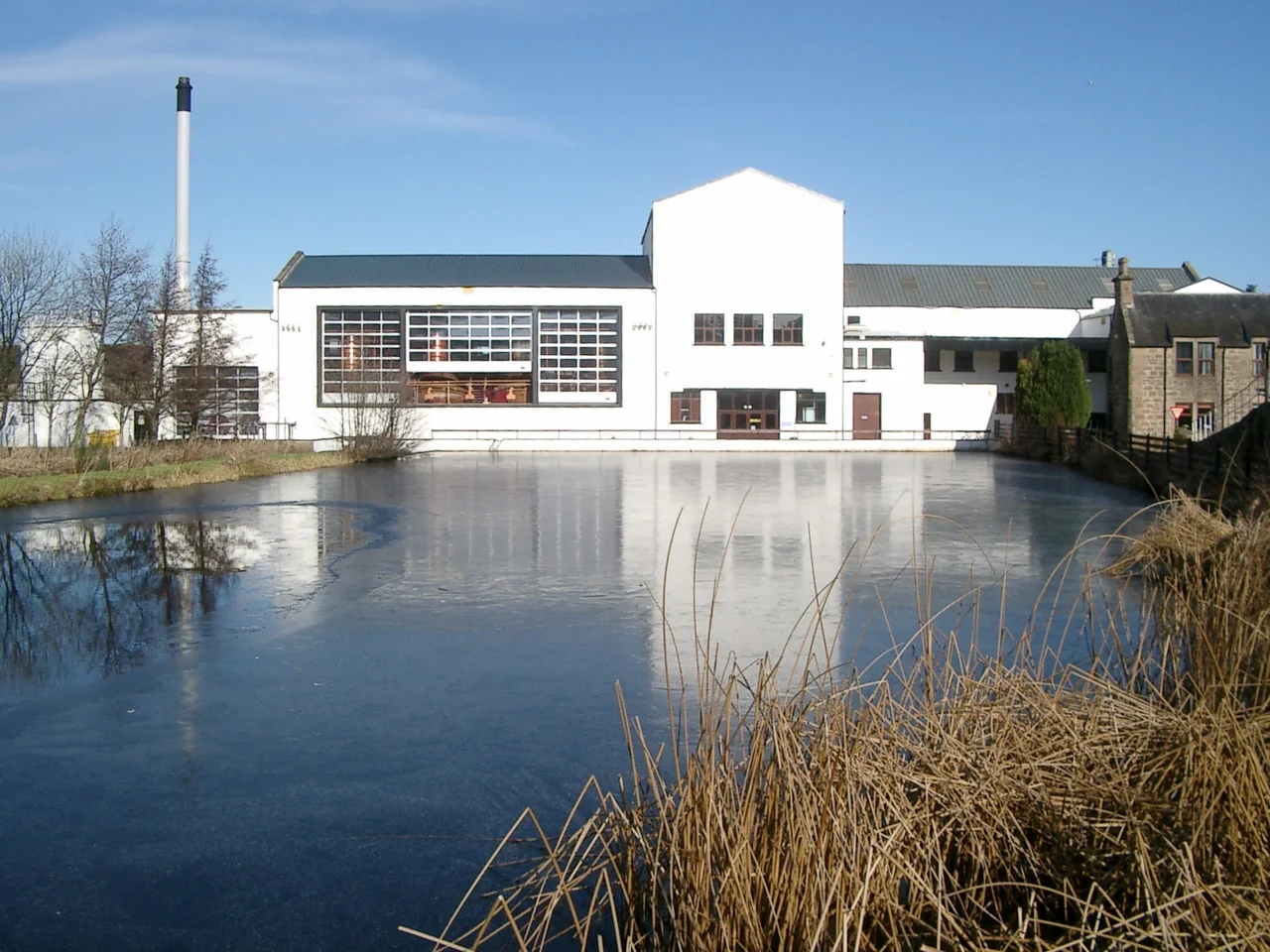

Royal Brackla distillery
In 1833 King William IV granted a royal warrant of appointment to a small Highland distillery at the edge of the Cawdor estate. It was the first time any whisky distillery had received the honour - and there have only ever been three Scotch distilleries entitled to put 'Royal' before their names. The other two, Royal Lochnagar and Glenury Royal, came later; Glenury was demolished decades ago. Royal Brackla remains. Queen Victoria renewed the warrant in 1838. The distillery sits on land leased from the Earl of Cawdor, drawing its water from Cawdor Burn - the same stream that flows past Cawdor Castle, the ancient seat made famous by a Shakespearean Thane who, the play insists, killed a king to become one. The whisky now goes mostly into Dewar's blends. The royal warrant is over a century out of date. The continuity is, if anything, the more remarkable for the lapses.
Captain Fraser's Distillery
Captain William Fraser of Brackla House built the distillery in 1812, at a time when most Highland whisky was still being made illegally in hillside bothies and sold to drovers and smugglers. The 1820s were the decade in which the British government tried, by act of parliament in 1823, to bring Highland distilling into the legal economy by lowering excise duties and making the licit business viable. Captain Fraser's distillery was one of the early beneficiaries. By 1833 its whisky was good enough that William IV granted it a royal warrant - an unprecedented endorsement of any distillery, anywhere. Queen Victoria renewed the warrant in 1838. The honour drew attention; the 1830s newspapers ran flattering notices. Fraser passed the business to his son Robert in 1852, and Robert sold it to a partnership called Robert Fraser & Co in 1878. The next year the company reconstituted itself as the Brackla Distillery Co Ltd. By 1897 the prospectus describes a business capitalised at £100,000 with a thirteen-acre site held under lease from the Earl of Cawdor: 'Brackla's whisky has long been known as one of the best Highland malt whiskies in the market. The demand for it has for years been much in excess of the supply.'
The Long Closures
Scotch distilling has a way of going through cycles, and Brackla has gone through more than most. The distillery closed in 1964 for major reconstruction and reopened in 1966 with internally steam-heated stills replacing the old coal-fired direct heating. An underground water supply originally drilled during the Second World War for a nearby airfield was acquired in 1965 and pressed into service for cooling the spirit vapour. In 1970 a second pair of stills was added and the boiler converted from coal to oil. New racked warehouses replaced the older dunnage warehouses in 1975. Then in 1985 the distillery closed again - this time as part of the wider Scotch industry's painful contraction during the 'whisky loch' overproduction crisis. The casks already laid down sat in the warehouses, quietly maturing, while the stills stood silent. In 1998 the distillery came back under the management of John Dewar & Sons, a subsidiary of Bacardi, and has been producing since. Bacardi relaunched the Royal Brackla single-malt range in 2019 with 12-, 18-, and 21-year-old expressions finished in oloroso, palo cortado, and Pedro Ximénez sherry casks.
Method
Royal Brackla operates with a 12.5-tonne mash tun and eight wash backs holding a combined 480,000 litres. The water comes from Cawdor Burn for cooling and process water; the springs at Cursack supply the mashing liquor. The distillery runs four copper pot stills - two wash stills and two spirit stills, each pair sharing a combined capacity of about 42,000 litres. Fermentation takes seventy hours, longer than the industry average, and the stills themselves are tall, designed to encourage reflux so that heavier compounds fall back into the boiling spirit rather than carrying through into the condensate. The slow distillation maximises copper contact and produces a deliberately light, fragrant spirit. Maturation happens in oak casks - now predominantly sherry casks for the single malt range. The result is a whisky that tastes nothing like the smoky, peaty malts of Islay or the rich sherried bombs of Speyside; it is delicate, floral, fruit-forward, and built on the fact that the spirit is allowed to come slowly off the still. The Flora and Fauna release of 1993 - bottled at 43 percent and graced with the image of a small bird called a siskin on its label - was the first widely available single-malt expression. The Rare Malts Collection of 1998 followed with a cask-strength 20-year-old distilled in 1978.
From the Air
Royal Brackla distillery sits at 57.54°N, 3.91°W on the Cawdor estate between Inverness and Nairn, about 6 nautical miles east of Inverness Airport (EGPE). The site is north of Cawdor village and a short distance south of the A96 trunk road. Recommended viewing altitude is 2,000-3,500 ft AGL. The white-painted distillery buildings nestle in mature trees beside Cawdor Burn; Cawdor Castle itself - the more famous landmark on the estate - lies about 1 nm south. The Moray Firth coastline is 4 nm to the north and makes a clean visual handrail. EGPE provides full instrument approaches and is plainly visible to the west. Forres aerodrome lies about 12 nm east. The terrain here is gentle Highland coastal plain with patches of woodland, easily flown in good weather.
Nearby Stories
- Conon Hydro Scheme 2.3 km away
- Royal Dornoch Golf Club 5.4 km away
- Alladale Wilderness Reserve 5.6 km away
- Pluscarden Abbey 5.8 km away
- Monadhliath Mountains 16 km away
- Fort Augustus 19 km away
- Corgarff Castle 23 km away
- Hill o' Many Stanes 58 km away