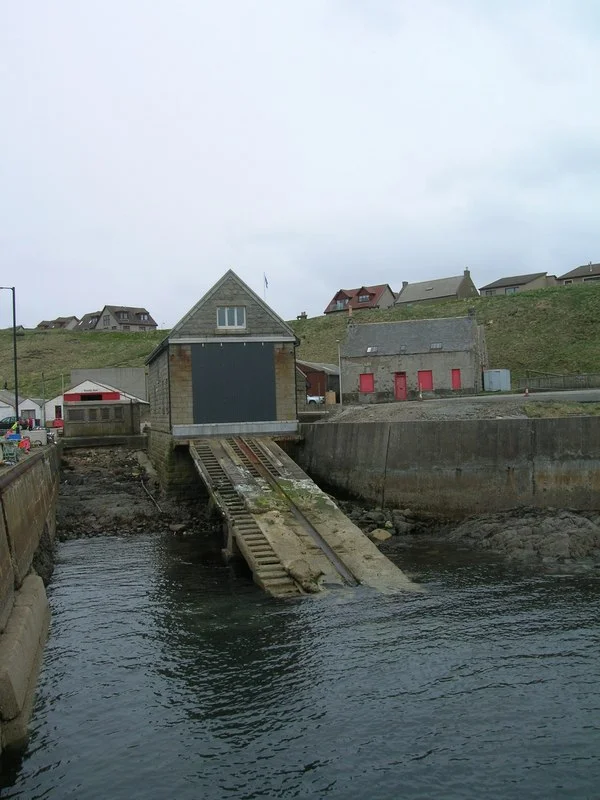

Whitehills Lifeboat Station
The problem at Banff in 1917 was not the boat. The problem was the crew. World War One had taken so many men from the harbour that there was no longer a roster from which to launch a lifeboat. The station closed temporarily, then never quite reopened. By 1923 the Royal National Lifeboat Institution had given up trying to find seven able-bodied volunteers in Banff or Macduff at the same hour of any given storm. They moved the boat instead - down the coast to Whitehills, where the herring fleet still gathered and the men to crew a lifeboat could still be found.
Why Whitehills
Whitehills sits on the south shore of the Moray Firth, a small fishing harbour tucked into a stone-built cluster of houses on the north Aberdeenshire coast - then part of old Banffshire. In 1859 Captain MacDonald of the Banff coastguard had written to the RNLI urging them to put a boat on this exposed stretch where prevailing northerly weather drove ships straight onto the rocks. With the Banff Harbour Trustees behind him, he persuaded the Institution; a lifeboat arrived in 1860. After moves to Macduff and through the first war's enforced silence, the boat finally settled at Whitehills Harbour in 1923 on a one-year trial. Crew turnout was what made it work. The trial held.
The Difficult Delivery of 1932
Whitehills got its first proper motor lifeboat in 1932 - a 35-foot 6-inch self-righting boat, 35 horsepower, top speed seven and one-third knots. She had to travel from her builder's yard at Cowes on the Isle of Wight, all the way around the British coast. The boat reached Aberdeen on the night of 13 August. At eight o'clock the next morning she set out for Whitehills. The engine failed. She limped back into Aberdeen, where the No.1 lifeboat Emma Constance (ON 693) was launched, took her in tow, and brought her home. It was not the heroic delivery the station had hoped for. The naming ceremony, held on 5 October 1932, made up for it.
Civil Service No.4
The ceremony was a grand affair. The Banff Pipe Band played. The Turriff Silver Band played. Lord Southborough handed the boat to the Institution. The Duke of Montrose accepted it and passed it to the local branch. The Reverend J. G. Ledingham gave the service of dedication, and Princess Arthur of Connaught, Duchess of Fife - granddaughter of King Edward VII - broke a bottle of champagne on the bow and named her Civil Service No.4 (ON 756). She was one of two lifeboats that year funded by Britain's civil servants. Her sister, Civil Service No.5, went elsewhere on the coast. A year later, in 1933, a new stone boathouse was built on Harbour Place to house her properly.
Forty-Five Years
The Whitehills boat served through the Second World War, through the post-war fishing boom, through the slow transformation of the inshore fleet. After 45 years of cover - with neighbouring stations to the east and west sharing the work - the RNLI decided in 1969 to withdraw the all-weather lifeboat at Whitehills. The reasoning was the reasoning that closes small stations everywhere: faster boats elsewhere could cover the same water, and crew numbers were thinning again. The station shut. The 1933 boathouse stood empty on Harbour Place. The decision held for only five years.
The Boat Came Back, But Not Here
In March 1974 the RNLI reversed itself - and re-established the station, but not at Whitehills. The boat went back to Macduff, where the fishing port had become large enough to support a roster again. Macduff Lifeboat Station has held that cover ever since. Whitehills today is a quiet harbour of pleasure boats and a small commercial fleet, the old boathouse still standing as a record of the 45 years when this village kept watch over its share of the firth. The list of services - silent tows in fog, oar-pulls into north-easterly gales - belongs to the RNLI's archive now, not to a working roster. But on a clear day the harbour mouth still faces the same exposed water it always did.
From the Air
Whitehills Lifeboat Station sat at Harbour Place, 57.6796 N, 2.5787 W, on the south shore of the Moray Firth between Banff and Cullen. From altitude the harbour reads as a small protected basin tucked into the rocky coast. Nearest major airport is Aberdeen (EGPD) about 40 nm to the south-east; RAF Lossiemouth (EGQS) lies west along the firth. The active RNLI station is now Macduff, a short distance east along the coast.
Nearby Stories
- Aberlour Distillery 4.2 km away
- Pitsligo Castle 5.8 km away
- Lossiemouth 7.7 km away
- Battle of Slioch 7.8 km away
- Old Slains Castle 18 km away
- Helmsdale 32 km away
- HMS Exmouth (H02) 35 km away
- German submarine U-58 (1938) 39 km away