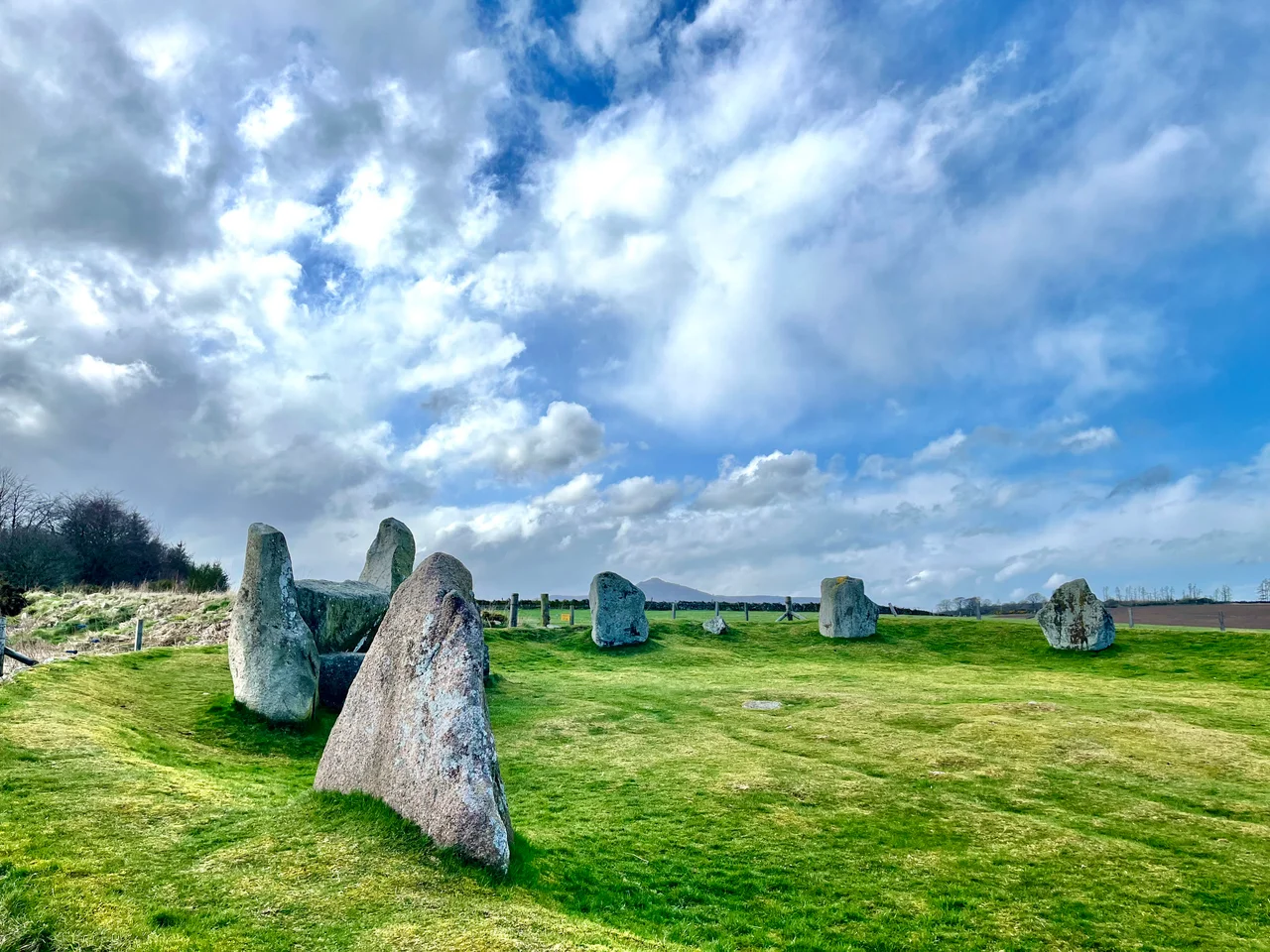

Easter Aquhorthies Stone Circle
There are perhaps a hundred recumbent stone circles in north-east Scotland, and they are the region's signature contribution to British prehistory. None of them is as completely intact as Easter Aquhorthies. Every stone is original. Every stone is still standing. None has been re-erected, restored, or replaced. Climb the gentle hillside about a mile west of Inverurie, push open the small wooden gate, and you stand inside a four-thousand-year-old monument that has weathered every century since without losing its bones. The flat-topped recumbent stone, 3.8 metres long, still lines up with the southern moonset over the distant Hill of Fare, exactly as its builders intended.
What a Recumbent Stone Circle Is
The recumbent stone circle is a regional invention - a peculiar variant of the British stone circle tradition that flourished only in Aberdeenshire and the lands immediately west, sometime in the third millennium BC. The defining feature is a single massive horizontal stone, the recumbent, laid flat on the south-south-west arc of the ring and propped between two upright "flankers" that frame it like the jambs of a doorway. The rest of the circle's stones step down in height from the flankers around to a single low stone directly opposite. Easter Aquhorthies follows this rule almost perfectly. The flankers stand 2.5 metres tall. The recumbent stretches between them, level along its upper edge, like a ceremonial lintel laid across a horizontal threshold.
Red, Grey, and the Use of Colour
The ring of nine standing stones has a secret that you only see when the light is right. Eight are grey granite. One is red jasper. The recumbent itself is red granite flecked with crystals and lines of quartz. And the builders placed the reddish stones deliberately on the south-south-west side and the grey ones opposite, in what archaeologists call polychromy - the conscious use of colour as part of the design. When the casts of the stones were made in 1985 for an Edinburgh exhibition, the cleaning revealed subtleties in the colouring that had been obscured by lichen and weathering. Whatever the builders wanted the colours to mean - red for the southern arc, grey for the north - it mattered enough to choose, carry, and place specific stones across the landscape to make it happen.
Aligned to the Moon
The recumbent stone at Easter Aquhorthies is aligned so that its level top points toward the southern moonset over the Hill of Fare. Recumbent circles across the region show similar lunar alignments, varied to match local horizons - the moon, not the sun, was the celestial body these builders watched. The southern moonset is the lowest the moon reaches in its 18.6-year cycle, an event that recurs only at intervals of nearly two decades, and that requires sustained generational observation to anticipate. Whoever planned this circle had paid attention for a very long time before laying a single stone. The cist found near the centre - a stone-lined burial box once covered by a capstone - hints that the alignment was meant to oversee something specific: the dead, the ancestors, the passage of one generation into the territory of memory.
Two Centuries of Visitors
The site survived the early modern centuries by being unremarkable enough to leave alone. Surrounding farmland was cultivated, but the circle itself was protected from grazing cattle by a stone dyke called a roundel, built between 1847 and 1866-67. The Victorians arrived next. In the 1870s and 1880s painters and writers brought Easter Aquhorthies to wider attention. Some of their interpretations were peculiar - Christian Maclagan reconstructed the ring as a kind of broch, the wrong building entirely. In 1884 the archaeologist Augustus Pitt Rivers took an interest, and five years later his assistants visited to measure, photograph, and build a scale model, which is now part of the collection of The Salisbury Museum in Wiltshire. In 1900, Fred Coles found the circle in excellent preservation. By 1920 it had vanished under whin bushes "as high as our heads." In 1925 it became a scheduled monument; in 1963 the state took guardianship.
Standing Inside
What strikes you on the ground is how small the circle is - only 18.4 by 18.1 metres across the slightly squashed ring - and how big the stones feel inside it. The recumbent is the size of a kitchen counter laid flat at chest height; the flankers loom on either side. Acoustic surveys have noted that the ring has unusual resonant properties, though it is unclear whether this was the case before the cairn was dismantled and the surrounding wall built. There is a temptation, standing inside, to clap or to speak quietly and listen for echoes. The builders certainly did. Whatever ceremony they conducted here, four thousand years ago, they conducted it knowing the stones would answer. Today, when you stand at the recumbent and look south-west to the Hill of Fare, the alignment still works. The moon has not moved. Only the people watching it have changed.
From the Air
Easter Aquhorthies Stone Circle sits at 57.277N, 2.446W on a gentle hillside about 1 mile (1.6 km) west of Inverurie. From the air it appears as a small ring of stones in a fenced grass enclosure, visible in good light. Key landmarks: Inverurie town to the east, the imposing hill of Bennachie 8 nm to the west-south-west, the Hill of Fare to the south-east (the target of the recumbent's lunar alignment). The nearby Brandsbutt Pictish symbol stone is on the outskirts of Inverurie. Nearest airport: EGPD (Aberdeen Dyce), 14 nm to the south-east.
Nearby Stories
- Dunnottar Castle 5.4 km away
- Kildrummy Castle 5.9 km away
- Delgatie Castle 10 km away
- Keith, Moray 11 km away
- Battle of Mons Graupius 12 km away
- German submarine U-58 (1938) 84 km away
- Longstone Lighthouse 146 km away
- HMS Daring (H16) 158 km away