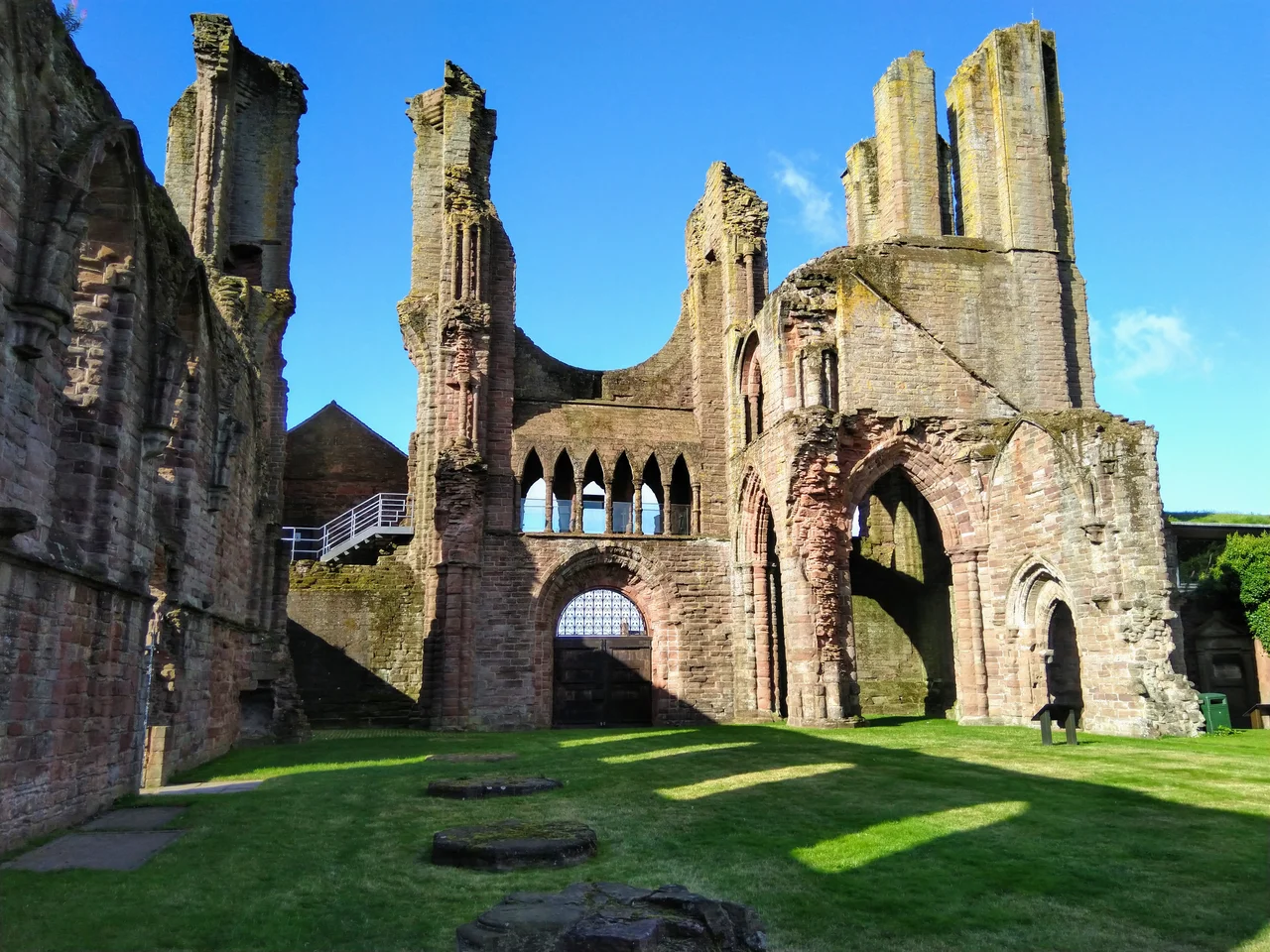

Arbroath Abbey
"It is in truth not for glory, nor riches, nor honours that we are fighting, but for freedom - for that alone, which no honest man gives up but with life itself." Those words, written in Latin and sealed with wax in this roofless church on the 6th of April 1320, were sent to Pope John XXII at Avignon by eight earls and forty-five barons of Scotland. Robert the Bruce had won at Bannockburn six years earlier, but the Pope had excommunicated him and backed the English king. The Declaration of Arbroath was Scotland's reply: cool, eloquent, and entirely unwilling to be ignored. Seven centuries later, the red sandstone walls that witnessed its drafting still stand at the head of Arbroath's High Street, the wind moving through the empty lancets where stained glass used to filter the light.
King William's Penance
Arbroath Abbey was founded in 1178 by King William the Lion, who endowed it with a generosity that bordered on competitive: income from twenty-four parishes, land in every royal burgh, and the right to run markets and build harbours. The dedication was unusual. William consecrated the church to Saint Thomas Becket, the Archbishop of Canterbury murdered in his own cathedral by knights of Henry II of England eight years before. William had known Becket personally at the English court. The connection was both pious and pointed. King John of England later granted the abbey the extraordinary privilege of buying and selling toll-free anywhere in England except London. William was buried before the high altar in 1214, and the abbey kept growing for another twenty years until it was finally complete.
The Round O
Look at the south transept and you will see what remains of Scotland's largest lancet windows, narrow and impossibly tall. Higher still is a round window known locally as the Round O. The story goes that it was once lit at night with an oil lamp as a beacon for ships at sea. Mariners coming up the Angus coast in foul weather watched for that red light glowing above the cliffs. Inhabitants of Arbroath still call themselves Reid Lichties - Scots for "Red Lights" - in memory of it. The abbey was built from local red sandstone, and the towers and processional doorway in the west front mix Norman roundness with Early English Gothic, the result of sixty years of construction across changing fashions. The triforium above the western doorway is unique in Scottish medieval architecture. There is nothing else like it in the country.
Ruin and Robbery
After the Scottish Reformation in the 16th century, the abbey fell out of use, and the people of Arbroath quietly took it apart. From 1590 onward, its stones were carted off to build the houses and shops of the town below. The lead from the roof was rumoured to have been melted down during the civil wars. Travellers in the 17th and 18th centuries came to sketch the ruins, which by then were not so much a building as a quarry with a view. The plundering continued for over two centuries until 1815, when the remaining ruins were finally taken into state care. Today they are looked after by Historic Environment Scotland, the same body that maintains Edinburgh Castle and Stirling.
The Stone Returns
On Christmas Day 1950, four Scottish nationalist students drove south to Westminster Abbey in London and took the Stone of Destiny - the ancient slab on which Scottish kings had once been crowned, kept under the English coronation throne since 1296. It was an audacious act of theft and patriotism. On the 11th of April 1951, the stone was found lying on the site of Arbroath Abbey's altar, draped in a saltire, exactly where the Declaration of Arbroath had been sealed six hundred and thirty-one years before. The symbolism could not have been more pointed. The stone went back to London until 1996, when it was finally returned to Scotland for good. The pageant commemorating the Declaration has been held within these roofless walls intermittently since 1947, with smaller commemorations every April 6.
From the Air
Arbroath Abbey sits at 56.56°N, 2.58°W, on the head of Arbroath's High Street, about a quarter mile inland from the harbour. The distinctive red sandstone ruins are visible from the air at 2,000-3,000 ft AGL in clear weather; look for the red walls just inland from the small coastal town on the Angus coast. Nearest airports: Dundee (EGPN) 14 nm southwest; Leuchars (EGQL) 18 nm southwest; Aberdeen (EGPD) 35 nm northeast. The coast here runs roughly southwest to northeast; the abbey lies about 16 nm northeast of Dundee.
Nearby Stories
- Edzell Castle 4.7 km away
- Coupar Angus Abbey 7.5 km away
- Isle of May 8.5 km away
- Lochleven Castle 15 km away
- Lochnagar 21 km away
- Eyemouth Disaster 39 km away
- River Dee Ferryboat Disaster 40 km away
- Girdle Ness Lighthouse 70 km away