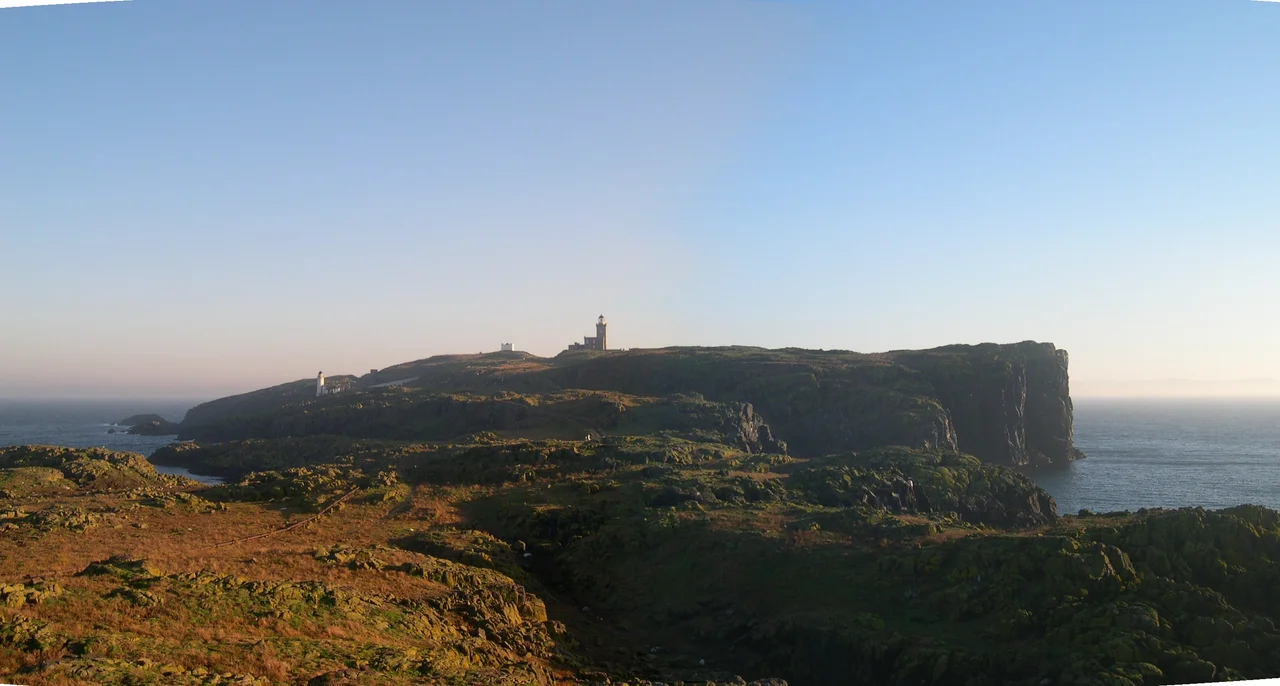

Isle of May
Five miles offshore and just a mile-and-a-half long, the Isle of May is too small to live on year-round and too important to leave alone. In summer it hosts about 200,000 nesting seabirds, the densest puffin colony on the east coast of Britain. In winter the seal pups arrive. The first lighthouse here, a coal-fired beacon kept burning by three keepers and 400 tonnes of coal a year, was Scotland's first permanently manned light, lit in 1635. A 1791 disaster killed an entire keeper's family except the eleven-month-old baby. The island has been a pilgrim's destination, a plague quarantine station, a sonar listening post against U-boats, and is now a national nature reserve. Eleven thousand people visit each year by ferry from Anstruther or North Berwick. Nobody lives there.
The Coal Beacon
The Forth was busy. By the 1630s, ships heading for Leith, the Forth ports, and Edinburgh's coal trade had no light to mark the mouth. James Maxwell of Innerwick, with John and Alexander Cunningham, set up a coal-fired beacon on the May in 1635 or 1636, paid for by a tonnage levy on passing ships: two Scots shillings per ton from Scottish vessels, double from foreigners. The beacon used roughly 400 tonnes of coal a year. Three keepers shifted the loads up the 12-metre tower. It was the first permanent light in Scotland and at the time among the best lights anywhere. It also accumulated ash. By January 1791, a decade's worth of clinker had piled against the keepers' quarters and one night smouldering coal set it alight. George Anderson, his wife Elisabeth, and five of their six children were suffocated by the fumes. Their eleven-month-old daughter Lucy was found still alive three days later, still in her cradle. She was the family's only survivor.
Stevenson's Castle on a Rock
By 1814 the May beacon was Scotland's last remaining privately-owned light. The newly formed Northern Lighthouse Board bought the island from the Duke and Duchess of Portland for 60,000 pounds, and in 1816 Robert Stevenson, founder of the Stevenson lighthouse dynasty and grandfather of Robert Louis, replaced the coal beacon with a proper lighthouse. It is unusual: a gothic tower on a castellated stone base, deliberately designed to resemble a castle, 24 metres tall, with quarters for three keepers and their families. The 1886 upgrade was a triumph of Victorian engineering, two steam-powered generators, the largest of their kind, driving an arc lamp through eight kilowatts of total output, with a paraffin lamp kept smouldering as backup. The current light pulses two white flashes every 15 seconds, visible 41 kilometres at sea, monitored remotely from Edinburgh. The lighthouse went automatic on 31 March 1989.
Pilgrims, Plague, and Pups
The island had a medieval priory dedicated to St Adrian, who according to tradition was martyred here by Vikings in the 9th century. King James IV visited in June 1504 and gave ten shillings to the hermit of May, brought the clerks of the Royal Chapel to sing Mass, and came back twice more, once in new yellow breeches. In August 1539 Mary of Guise and her husband James V made a pilgrimage by three ships. In the 16th century, the island doubled as a quarantine station: any ship suspected of plague was ordered to sit at anchor off the May until everyone aboard was either obviously well or obviously not. The Cellardyke fishermen of Fife made an annual summer picnic to the island for their wives and children. On 1 July 1837, one of the small ferry boats overturned at the Kirkhaven landing and thirteen people, mostly women and children, drowned within sight of their families on the shore. The May has known both holy days and bad ones.
The Seabird City
Today NatureScot manages the May as a national nature reserve. The island is closed to visitors from 1 October to Easter to protect the grey seal pups born along the rocky shore. In summer the cliffs and the slopes are layered with puffins, guillemots, razorbills, shags, kittiwakes, fulmars, terns, and eider ducks, around 200,000 birds at peak. The Centre for Ecology and Hydrology has run the Isle of May Long Term Study for decades, tracking what each species eats and how that has changed. Lesser sandeels, the dietary staple of the 1980s, have collapsed as the North Sea warmed; the birds have shifted to other prey, with mixed success. Migratory rarities turn up after easterly gales: lanceolated warblers, bridled terns, calandra larks blown across from Scandinavia and Asia. The Navy maintained an anti-submarine listening post here from the late 1930s until 1946, six ASDIC units on the seabed watching for U-boats trying to enter the Forth. The wires came up. The puffins continued.
From the Air
Isle of May: 56.188 N, 2.557 W, an island 1.5 km long in the outer Firth of Forth, about 8 km off the Fife coast. Best viewed at 1,500-3,000 ft AGL on a north-south overflight; cliffs on the western side rise to 45 m. The Stevenson lighthouse is conspicuous as a castellated tower near the summit. Nearest airport is RAF Leuchars (EGQL), 16 nm north-west; Edinburgh (EGPH) is 32 nm south-west. The island lies at the inner edge of busy North Sea shipping lanes. Avoid low overflight during seabird nesting season (April-August) to protect colonies.
Nearby Stories
- Edinburgh City Bypass 1.4 km away
- Eyemouth Lifeboat Station 3.3 km away
- Yester Castle 4.7 km away
- Fingask Castle 5.6 km away
- Kirkcaldy 5.7 km away
- Carnoustie Golf Links 9.3 km away
- Eyemouth Disaster 30 km away
- River Dee Ferryboat Disaster 79 km away