_p4.228_-_Fingask_Castle,_Perthshire.jpg)
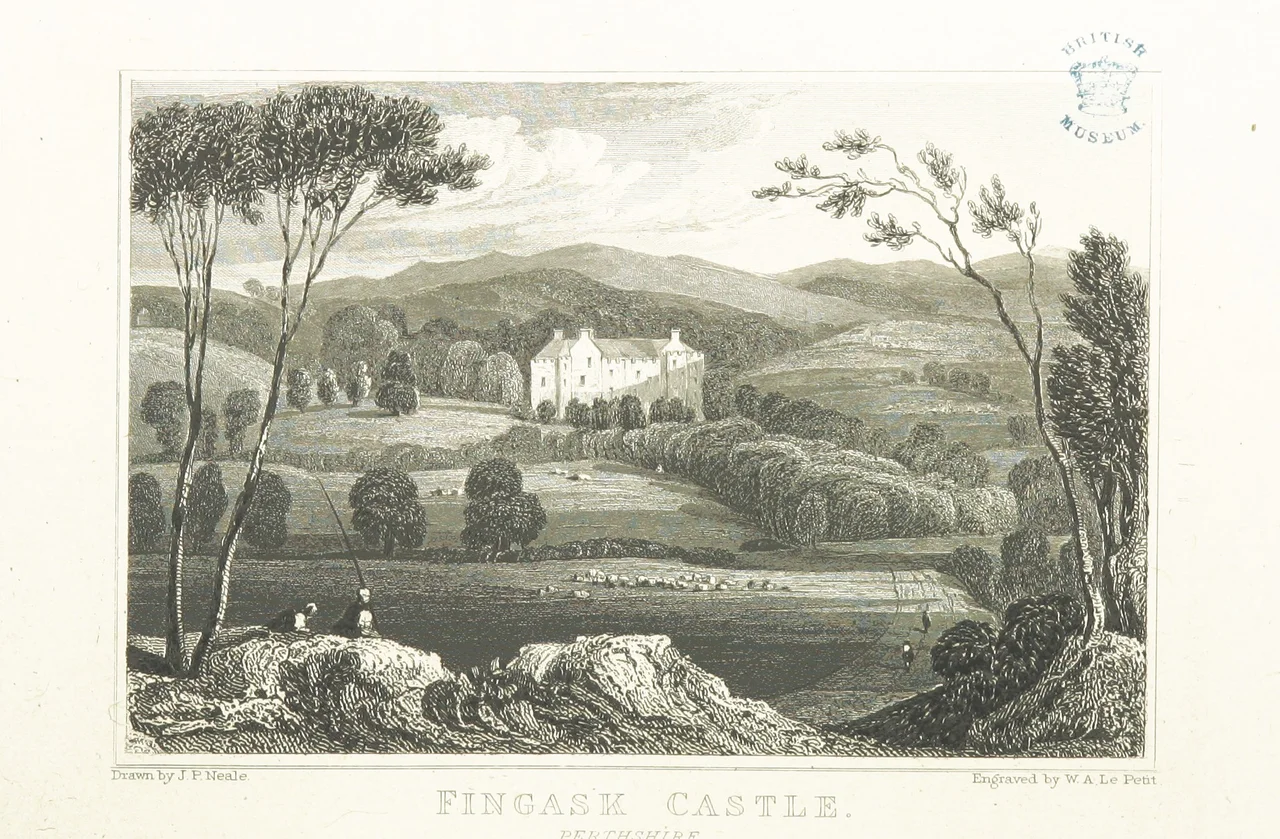
Fingask Castle
When Miss Jessie Threipland died in May 1871, a family friend wrote that "the life of the old house went out" with her. That single sentence captures something true about Fingask. This is a place where every stone, every yew, every gravel walk carries the weight of one family's two-and-a-half-century romance with a small castle on a hillside in the Carse of Gowrie. The Threiplands lost Fingask. They got it back. They lost it again. They bought it back. The story is still being written.
Built on a Hillside in 1592
Fingask sits on a south-facing slope above the broad agricultural plain of the Carse of Gowrie, with Fife visible across the Tay on a clear day. The current castle is dated 1592, built around a 12th-century structure that came before it. Sir Patrick Threipland, 4th Baronet, laid out the park in the early 19th century, and his son went on to plant the famous topiary gardens and install the statuary that still draws visitors today. Between 1828 and 1840, additions extended the castle to the south and west. The shape that survives now is a small, idiosyncratic Scottish country house wearing the architectural fingerprints of every century since the Armada.
Statues in the Yew
The garden statuary at Fingask was largely carved by Charles Spence, a footman and mason who served the Threiplands and became known across Perthshire as the Bard of Gowrie. Spence sculpted scenes from Burns - Tam o' Shanter and his cronies drinking at Kirkton Jean's, Wilson's Meg and Watty - and arranged them among the topiary and yew hedges. The result is a garden that reads like a literary anthology in stone. Among the figures, the old Perth Mercat Cross sits as a reminder of the city's medieval market rights. Walking the paths today, you encounter Robert Burns's characters frozen mid-revel, watching the river flow toward Dundee.
The Whisky Baronet's Tragic End
The Threiplands lost Fingask in 1917 to Sir John Henderson Stewart, a whisky merchant whose fortune seemed unshakeable. In 1917 the estate ran to 2,587 acres - arable land, hill, and woods - and brought in £4,000 a year in rent. Then American Prohibition arrived in 1920, devastating the export market for Scotch whisky. Sir John fell deeply into debt. On 6 February 1924, unable to see a way through, he took his own life at the castle. The estate passed to H. B. Gilroy of Ballumbie in 1925. Gilroy saved the house from ruin but remodelled it heavily, removing the spiral staircases and demolishing the 19th-century frontal additions. Fingask survived, but not quite as it had been.
The Family Returns
In 1969, against all odds, the Threiplands came home. Mark Stepney Murray Threipland, a grandson of Colonel William Murray Threipland, bought back the property. By then the estate had shrunk to 75 acres, a fraction of what it had been at its peak. In 1996 it passed to Andrew Murray Threipland, who has spent the decades since making Fingask one of the most distinctive private cultural venues in Scotland. The Fingask Follies, a long-running comic revue performed in the castle hall, draws audiences from across Tayside each year. In 2020, Andrew unveiled plans to create a barrow cemetery on a section of the estate known as Witches Knowe, with over one thousand plots and a semi-underground candle-lit chamber for the deposit of ashes - a deeply unconventional final chapter to a property that has spent four centuries refusing to be conventional.
From the Air
Fingask Castle sits at 56.43 degrees north, 3.25 degrees west, on a south-facing slope above the Carse of Gowrie, roughly 8 nautical miles east-northeast of Perth and 12 nautical miles west of Dundee. EGPN (Dundee) is the nearest controlled airfield, with EGPT (Perth/Scone) closer at hand for general aviation. Best viewed at 1500-2500 feet AGL in clear weather; the topiary gardens are visible in their full geometric pattern from the air. The broad silver gleam of the Inner Tay Estuary lies to the south, making navigation along this corridor straightforward in VMC.
Nearby Stories
- Carnoustie Golf Links 5.9 km away
- Lochleven Castle 6.3 km away
- Edzell Castle 8.9 km away
- Dunblane Massacre 9.5 km away
- Croft Moraig Stone Circle 11 km away
- Isle of May 17 km away
- Lochnagar 21 km away
- Battle of Dalnaspidal 23 km away