.jpg)
Girdle Ness Lighthouse
The Oscar went ashore in a storm in April 1813. She was a whaler returning to Aberdeen, and she ran aground in Greyhope Bay just south of the harbour mouth, where the tide and the rocks did the rest. Forty-four men were on board. Two survived. The disaster was not, strictly speaking, the fault of any missing lighthouse - the crew were drunk and incapable, the chroniclers noted with Scottish bluntness - but it left Aberdeen with no doubt that a light was needed on the Girdle Ness headland. Twenty years later, in October 1833, Robert Stevenson's tower was lit for the first time. The Astronomer Royal would call it the best lighthouse he had ever seen. It still flashes today, two white flashes every twenty seconds, automated since 1991 and monitored from Edinburgh, but otherwise doing exactly what it was built to do: warning ships off the rocks that killed the Oscar's crew.
The Stevenson Family Builds Another One
Robert Stevenson designed Girdle Ness in 1832-33, with James Gibb as principal contractor and Alexander Slight as resident inspector. Stevenson's son Alan, who would later design the magnificent Skerryvore off the west coast, served as resident engineer. The Stevensons were the dominant lighthouse-building dynasty in Scotland - Robert had built Bell Rock in 1810, the world's oldest surviving sea-washed lighthouse, and his sons and grandsons would build most of the Scottish coastline's warning lights through the nineteenth century. Robert Louis Stevenson, the novelist, was Robert's grandson, and his decision to write fiction rather than engineering was, in family terms, a kind of small scandal. Girdle Ness is a tapering cylindrical tower, white-painted, thirty-seven metres tall, with a black lantern and a watch room about a third of the way up. There are 182 steps from the base to the lantern. The keepers' cottages alongside have been sold off; the lighthouse itself remains active, managed by the Northern Lighthouse Board out of Edinburgh.
What Was Lit, and How It Changed
The 1833 lantern burned sperm oil - high-quality whale oil that produced a clean, bright flame - in eighteen Argand burners arranged at the focus of a 21-inch silvered-copper parabolic reflector. The light was fixed, not flashing, and remarkably for a single station it operated at two levels: the main lantern at the top of the tower, and a second level of thirteen lights at the height of the watch room, displaying white light from both heights simultaneously. The unusual double display was meant to give vessels approaching from different angles a more reliable bearing. In 1847 a dioptric lens was installed - the Fresnel-style technology that revolutionised lighthouses worldwide - and the original parabolic lantern was sent to Inchkeith Lighthouse in the Firth of Forth, where it continued in service. Paraffin replaced sperm oil experimentally in 1870. In 1890 the two-level display was abandoned in favour of a single revolving 200,000-candlepower light, the configuration that essentially remains today though now electric and automated.
The Best Lighthouse I Have Seen
In 1860 George Airy, the Astronomer Royal, visited Girdle Ness as part of a Royal Commission inspection. Airy was a careful, technical man, not given to easy compliments. He had reviewed lighthouses across Britain and Ireland, and he wrote of Girdle Ness that it was the best lighthouse that I have seen. The compliment is the more remarkable because Stevenson lights were already considered the gold standard of British lighthouse engineering. Whatever specific qualities Airy admired - the precision of the optics, the design of the reflector array, the cleanliness of the installation - the praise stuck. The Northern Lighthouse Board has cited it ever since. The light was automated in 1991; the keepers went home, and the building sat down to its quieter modern life. A racon, a radar beacon, was added after 1968 to extend the warning into electronic navigation. DGPS towers stand nearby. There is no public access to the tower, but the path along Girdle Ness gives walkers a close view, and the lighthouse remains one of Aberdeen's most photographed landmarks.
The Torry Coo
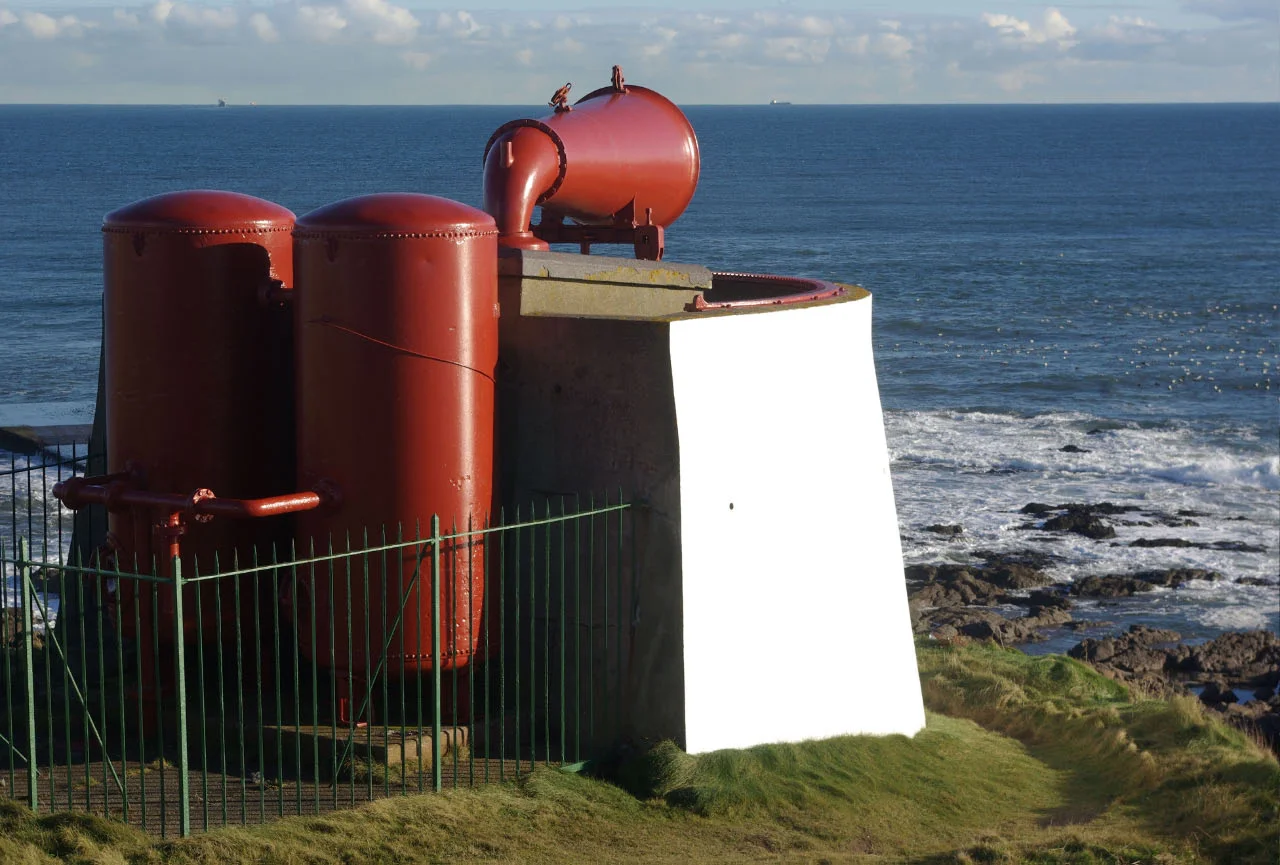
Until 1987 a foghorn at the base of the headland sounded whenever visibility dropped below five nautical miles. Aberdonians called it the Torry Coo - Torry being the neighbourhood across the Dee, coo being Scots for cow - in playful comparison to the Turra Coo, a famously photogenic Aberdeenshire farm animal of the early 1900s. The Torry Coo could be heard, locals claim, twenty miles away. Its deep wet bellow rolling out across the North Sea in heavy weather was one of the city's signature sounds for a century and a half. The horn was decommissioned in 1987 when satellite navigation and radar made fog signals largely obsolete, but the siren itself was preserved as a piece of harbour heritage. The lighthouse keeps flashing through the dark, two white flashes every twenty seconds, mostly silent now but still keeping its long appointment with the rocks of Greyhope Bay.
From the Air
Girdle Ness Lighthouse stands at 57.14N, 2.05W on the Girdle Ness peninsula just south of Aberdeen Harbour's mouth. From altitude, look for the white tower at the seaward tip of the headland, with the Torry Battery's earthworks just inland and Greyhope Bay's curve immediately south. Aberdeen International (EGPD) lies 5nm northwest. Best viewed at 1,500-3,000 ft AGL in clear conditions; the lighthouse is striking against the North Sea's grey-blue, especially with the harbour entrance, North Pier, and city skyline forming the backdrop. The cliff edge here drops sharply - the same rocks that killed the Oscar.
Nearby Stories
- Monymusk Priory 3.9 km away
- Deer Abbey 8.6 km away
- Glendronach Distillery 9.8 km away
- Fettercairn Distillery 13 km away
- Dunnottar Castle 16 km away
- Piper Alpha 146 km away
- German submarine U-1274 151 km away
- HMS Nottingham (1913) 192 km away