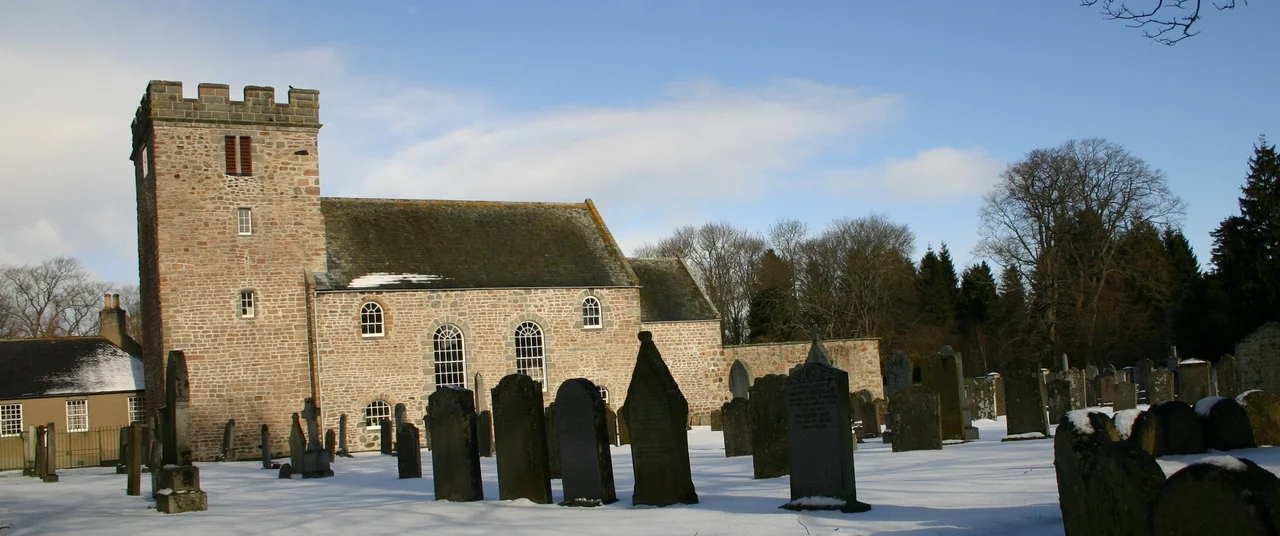

Monymusk Priory
Before the Augustinian canons, before the Romanesque arches went up in the second half of the 12th century, Culdee monks lived here on the bank of the Don. They came from somewhere west, possibly Whithorn, possibly older still, and they kept their own counsel about prayer and silence. A 9th-century Pictish carved stone, found in a nearby field and now displayed inside the parish church, hints at how long this scrap of Aberdeenshire ground had been considered holy. By the time anyone wrote down the priory's history, the place already had a past.
A Grant of Land, A Way of Life
In 1130, the Culdees at Monymusk received a formal land grant — probably a legal recognition of a community that was already settled and praying here. They got rights to a dormitory, a refectory, an oratory, and burial in the parish cemetery: the architecture of a settled monastic life, written into law. By the last decade of the 12th century, Gille Críst, Mormaer of Mar, had founded a proper monastery on the site, and the older Culdees had given way to Augustinian canons. The new Romanesque church served two purposes at once. It was the parish church for the people of Monymusk — births, marriages, burials, the rhythms of village life — and it was the conventual church for the canons, who used its unusually long chancel for their daily round of psalms and offices. Around it spread a small medieval economy: a school, three gardens, a croft, pastures for animals, a fish-pond for Fridays, and the cluster of monastic buildings where day-to-day work happened.
The Reliquary That Travelled
For some span of years — long enough that tradition still remembers it — the canons of Monymusk held custody of a small house-shaped box of yew wood plated with bronze and silver. Roughly the size of a loaf of bread, it had been made in the 8th century, probably to hold a relic of Saint Columba. Scotland knew it as the Brecbennoch, and later as the Monymusk Reliquary. According to long-standing tradition, this little shrine was carried at the head of Robert the Bruce's army at Bannockburn in 1314, blessed by an abbot to bring victory over Edward II's English forces. Whether the canons here personally watched it leave for that battle, no one can say for certain. But for a stretch of the Middle Ages, one of Scotland's holiest objects lived in this quiet glen, kept safe by Augustinian hands. Today the reliquary survives — it is held by National Museums Scotland — but it began its public life here.
Decline, Fire, and Stone Recycled
By the early 1500s, the priory was fading. The last religious prior, David Farlie, was charged with murder and other crimes, and in 1542 a lay commendator named John Elphinstone took over — a sign that the institution had become a piece of property to manage rather than a vocation to live. In 1554, fire gutted the buildings. The canons could not afford to rebuild. About 1587, the Forbes family quarried what was left, using the priory's worked stone to build the present House of Monymusk just along the valley. In 1617 the lands passed to the bishopric of Dunblane. Only the Romanesque church survived, and it kept serving the village it had always served. Today the Church of the Blessed Mary still stands above the Don, its 12th-century walls absorbed into a working parish kirk, the 9th-century Pictish stone displayed inside as a reminder of how much older this site is than any of its surviving stonework.
From the Air
Monymusk Priory sits at approximately 57.23°N, 2.52°W, in the Don valley about 20 nautical miles west of Aberdeen. Recommended viewing altitude is 2,500–4,000 feet AGL; the parish church and adjacent House of Monymusk are visible against the open farmland of Donside. Nearest controlled airspace is EGPD (Aberdeen International). Weather in this region is changeable — low cloud and rain off the North Sea are common; clearest viewing tends to be summer mornings before the haar rolls in from the coast.
Nearby Stories
- Glendronach Distillery 0.8 km away
- The Macallan Distillery 2.6 km away
- Aikey Brae Stone Circle 4.4 km away
- Brig o' Balgownie 4.4 km away
- Corgarff Castle 7.3 km away
- Fettercairn Distillery 12 km away
- Blairgowrie and Rattray 42 km away
- Eyemouth Disaster 117 km away