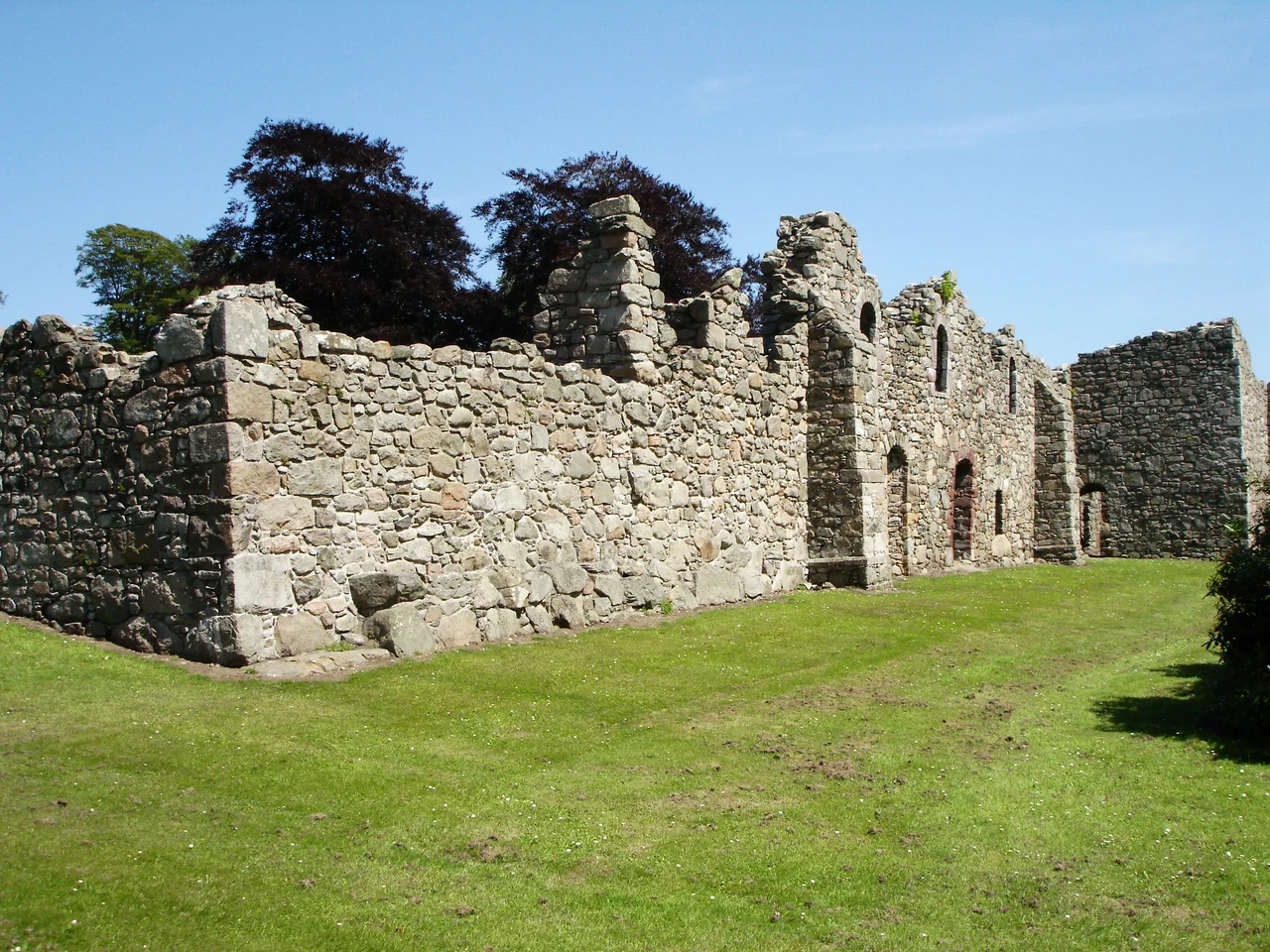

Deer Abbey
Somewhere on this quiet patch of Buchan farmland in the twelfth century, a Scottish monk wrote in the margin of a Latin gospel book. He used a language nobody had bothered to write down before: the everyday Gaelic of north-east Scotland, the speech the locals around him used in the kitchen and the barn. The book he wrote in is now in Cambridge University Library and is called the Book of Deer. The marginal notes are the oldest surviving prose in Scottish Gaelic. The monastery that produced them is gone. What remains here are the low walls and burial slabs of the Cistercian abbey that absorbed and replaced it - Deer Abbey, founded in 1219.
Columba, Drostan and a Marginal Note
The older religious community at Deer was small - never more than fifteen souls - and Scottish to its core. Tradition, recorded in the margins of the Book of Deer itself, claimed it had been founded centuries earlier by Saint Columba and his disciple Saint Drostan. The marginal notitiae list grants of land made to the Deer monks through the twelfth century by local lords, in a Gaelic prose that has since become the oldest substantial witness to the spoken language of the period. When the Cistercians arrived in 1219 to found a new abbey two miles westward, on lands granted by William Comyn, jure uxoris Earl of Buchan, the old Scottish community was absorbed into the new foundation. The book travelled with them, or was left behind, and eventually found its way south to Cambridge.
The Cistercian Way
William Comyn brought his Cistercian monks from Kinloss Abbey, near Elgin on the Moray coast, to staff the new abbey at Deer. The Cistercians were the reformers of European monasticism - white-habited, austere, agricultural, the order of Bernard of Clairvaux that had reshaped western Christianity in the previous century. They specialised in settling marginal land and bringing it into careful cultivation. Buchan in 1219 was that kind of land: under-farmed, forested in patches, far from royal centres. Deer Abbey was dedicated to the Blessed Virgin and never grew large - the community stayed at fifteen monks or fewer through most of its history. William Comyn himself was buried in the abbey he had founded, and his son Alexander Comyn, Earl of Buchan, lies here too, along with a younger Alexander who died in 1308 at Inverurie fighting against Robert the Bruce.
From Abbey to Lordship to Orchard
The Reformation took the Cistercians out of Deer. The abbey was turned into a secular lordship in 1587 for Commendator Robert Keith II, who became Lord Altrie, and the religious community ended. Two centuries later, in 1766, the abbey lands passed to James Ferguson, Lord Pitfour, advocate and judge. His son the third laird built a five-metre enclosing wall around the ruins in 1809 and used the abbey grounds as an orchard - apples and pears trained against medieval stone. A four-columned Doric portico was salvaged from an earlier family mausoleum and grafted onto the site. The mausoleum itself was removed in the 1930s and parts of it repurposed as an entrance, though the graves of Lady Langford and Eliza Ferguson within were carefully left undisturbed.
What Remains, and What Travelled
The Pitfour mansion house that once oversaw the abbey ruins was in such poor repair by the early twentieth century that it was demolished. Much of its stone, by local tradition, was carted off to build council housing in Aberdeen, twenty-eight miles to the south. The abbey itself is now in the care of Historic Environment Scotland and is open to visitors free of charge. The footings of the church and cloister can be traced through the grass. There is considerable evidence of much earlier human presence in the area: the Catto Long Barrow and clusters of tumuli lie to the south, marking burials from millennia before the Cistercians ever arrived. And in Cambridge, the Book of Deer sits in a climate-controlled case, with its eleventh-century Latin gospels and its twelfth-century marginal Gaelic, written by monks in this windy patch of Buchan when the Cistercians were a Continental rumour and Deer was still its own kind of Scottish house.
From the Air
Deer Abbey lies at 57.52 degrees north, 2.05 degrees west, about a mile west of Old Deer village and two miles south-west of Mintlaw in the Buchan country. The ruins sit in walled grounds beside the River Ugie. From altitude the abbey shows as a rectangular enclosure with stone footings visible in the grass, framed by James Ferguson's 1809 stone wall and surrounding pasture. Aberdeen Dyce Airport (ICAO EGPD) is about twenty-five nautical miles south-south-west. Best viewed at 800-1500 feet AGL in good light.
Nearby Stories
- Mither Tap Hillfort 4.3 km away
- Banff and Macduff Lifeboat Station 11 km away
- SS St Petersburg 12 km away
- River Don, Aberdeenshire 17 km away
- HMS Exmouth (H02) 53 km away
- Piper Alpha 120 km away
- German submarine U-1274 190 km away
- HMS Nottingham (1913) 231 km away