
Claypotts Castle
A castle that took nearly twenty years to finish - 1569 to 1588 - is an unusual thing. Most lairds wanted their towers up and roofed within five. Whatever John Strachan was building at Claypotts, he was in no hurry. The dates carved into the stones tell the story, and what they describe is now one of the best-preserved Z-plan tower houses in Scotland: a building that survived its abandonment, its irrelevance, its absorption into suburban Dundee, and the long battle in the law courts that decided who owned it. Around it, modern bungalows. Inside it, the 16th century, preserved like a fly in amber.
A Z-Plan in West Ferry
Claypotts is what historians of Scottish architecture call a Z-plan tower house: a rectangular main block with two projecting circular towers at opposite corners, allowing defenders to fire along the building's main faces from either tower. It was a popular layout in the 16th century, although, as historians dryly note, a castle of Claypotts's modest domestic scale would not have had much of a real defensive role. The Z-plan here was as much about prestige and the visual signalling of status as it was about practical defence. The Strachan family had leased the land from the Tironensian Abbey of Lindores since the early 16th century; John Strachan finally built his castle on it. The slow construction may simply reflect a small landowner building when he could afford to.
Owners, Heirs, and a Killiecrankie Death
In 1601 the Strachans sold Claypotts to Sir William Graham of Ballunie, who later passed it to Sir William Graham of Claverhouse. Through that line, the castle eventually came into the possession of John Graham of Claverhouse, Viscount Dundee - the soldier romanticised as "Bonnie Dundee" who led the first Jacobite rising of 1689. Graham died at the Battle of Killiecrankie on 27 July 1689, struck by a musket ball at the moment of his victory over government forces. With his death the castle reverted to the Crown. In 1694 it was granted to James Douglas, 2nd Marquess of Douglas, beginning a long Douglas tenure. After the Duke of Douglas died in 1761, an eight-year legal battle - the famous Douglas Cause - decided that Archibald Douglas was the rightful heir. The castle passed by marriage to the 13th Earl of Home, who gave it to the state in 1926.
The Brownie and the Lazy Maid
Every old Scottish house collects its legends, and Claypotts has at least one good one. The tale tells of a brownie - one of the household spirits of Scottish folklore - who lived in the castle and helped the servants with their work. Brownies were notoriously particular about being valued; they did not take kindly to being mocked, paid, or shown disrespect. According to the legend, this particular brownie left Claypotts in disgust because of a lazy kitchen maid whose work he was tired of doing for her. Once a brownie departs, the folklore says, he does not return. The story is the kind of small domestic mythology that anchors a place in local memory longer than any battle would.
Surrounded by the Modern World
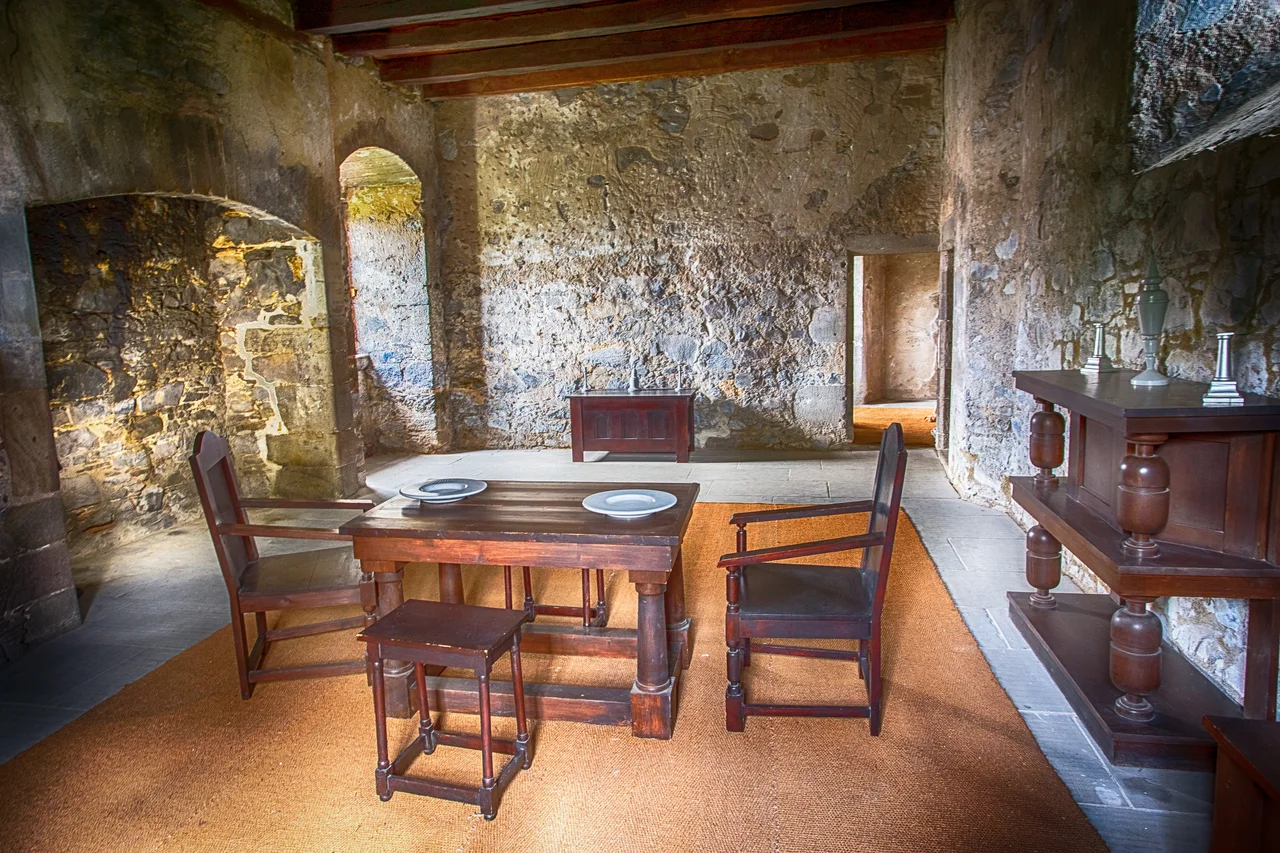
What makes Claypotts unusual today is its setting. The castle stands in the West Ferry suburb of Dundee, surrounded by 20th-century housing - bungalows and post-war estates pressing up against the medieval walls. There is no traditional castle landscape: no surrounding parkland, no wooded approach, no defensive moat. Just a 16th-century tower house at a junction of suburban streets, looking exactly as it did when John Strachan finished it in 1588. Historic Environment Scotland maintains it as a Scheduled Ancient Monument. Inside, the towers and rooms remain remarkably intact, giving visitors a clearer sense of how a small Scottish laird actually lived than almost any other tower house of the period.
From the Air
Claypotts Castle sits at 56.4764 degrees north, 2.89 degrees west, in the West Ferry suburb of Dundee, about 2 nautical miles north-northwest of Broughty Castle and the Tay estuary mouth. EGPN (Dundee) lies 4 nautical miles to the west-southwest. From the air, Claypotts is a small but distinctive Z-plan tower house at a road junction in the middle of dense suburban housing - look for the characteristic square main block with two diagonally opposed circular towers. Best viewed at 1500-2500 feet AGL. The contrast between the medieval form and the surrounding 20th-century street grid makes it easy to identify.
Nearby Stories
- Battle of Dunkeld 7.2 km away
- Balgonie Castle 9.8 km away
- Bell Rock Lighthouse 10 km away
- Inverbervie 13 km away
- Battle of Dollar 14 km away
- Battle of Mons Graupius 16 km away
- HMS Pathfinder (1904) 23 km away