
Farne Islands
On 28 May 1979, a tern with a black cap and grey wings appeared on Inner Farne. Birdwatchers identified it as an Aleutian tern - a species that breeds on rocky islets in the North Pacific and winters off the Philippines. It had no business being in the North Sea. It stayed for two days, was photographed and identified beyond doubt, and then vanished. It remains the only Aleutian tern ever recorded anywhere in Europe. The Farnes are like that. They are small islands, only about twenty of them depending on the tide, mostly bare rock, and yet they have been collecting unlikely visitors - saints, birds, divers, naturalists - for thirteen centuries.
Cuthbert's Hermitage
The earliest recorded inhabitants of the Farnes were Culdees - the wandering Celtic Christian hermits of the seventh century. In 651, Saint Aidan came here from Lindisfarne. In 676, Saint Cuthbert moved out from Lindisfarne to Inner Farne to live as a hermit, in a small stone cell, surrounded by the seabirds he is said to have protected by edict. The eider duck, which still breeds here in hundreds of pairs, is locally called the cuddy duck in his honour. Cuthbert returned to Lindisfarne briefly to serve as bishop, then came back to Inner Farne to die in 687. A formal Benedictine cell was established around 1255, dependent on Durham Abbey, usually housing only two monks. It survived until Henry VIII's dissolution in 1536. Prior Castell's Tower, built between 1494 and 1519, still stands on Inner Farne, now used by National Trust rangers who live on the islands nine months of the year.
A Spine of Dolerite
Geologically, the Farnes are the eroded edge of a great igneous intrusion called the Whin Sill, a sheet of resistant dolerite that runs underground across northern England and surfaces in spectacular places - Hadrian's Wall, High Cup Nick, Bamburgh Castle's rock, and here. Once they were connected to the mainland, surrounded by softer limestone. Sea-level rise after the last ice age, plus millennia of erosion picking off the weaker rock, left the dolerite as offshore stacks and islets. The columnar fracturing of the dolerite produces sheer cliffs up to 19 metres high on Inner Farne and 14 metres on Staple Island - perfect ledges for nesting seabirds, terrible obstacles for shipping. The islands divide into Inner and Outer groups, separated by Staple Sound.
The Wildlife Census
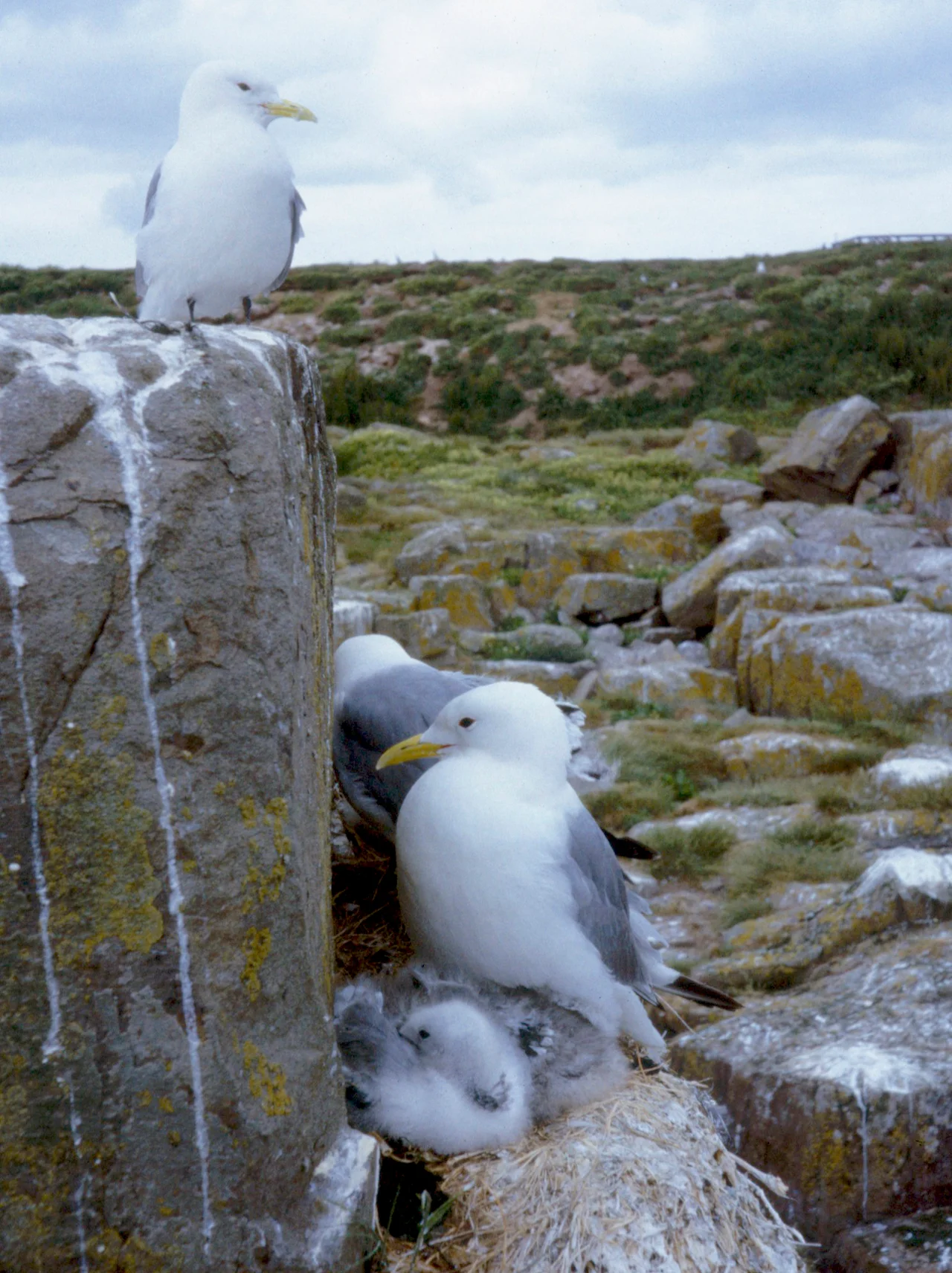
The 2021 count records 36,211 pairs of puffins, 59,168 individual guillemots, 4,772 pairs of kittiwakes, 882 pairs of Arctic terns, 417 pairs of common eider, and dozens of other species. Summer visitors to Inner Farne are warned to wear hats - Arctic terns dive-bomb anything passing their nests, drawing blood from the unwary. In autumn, a colony of around a thousand grey seals comes ashore to pup, the small white-coated babies lying among the rocks while the great bulls fight in the surf. A total of 303 bird species have been recorded on the Farnes, including, in the 1760s, one of the last great auks. One Arctic tern ringed as a flightless chick in summer 1982 was recovered in Melbourne, Australia three months later - over 22,000 kilometres from where it hatched, one of the longest documented bird journeys on record.
Lighthouses and Wrecks
The Farnes have killed ships for as long as ships have sailed past them. The first lighthouse was built on Inner Farne in 1673 but never lit. Captain John Blackett established working coal-burning beacons in 1778, replaced by Trinity House with the current Farne Lighthouse in 1811. Longstone Lighthouse, on the outermost island, was completed in 1826 after the loss of the George and Mary in 1823 with all 100 souls aboard. From Longstone, in September 1838, Grace Darling rowed out with her father to rescue survivors of the Forfarshire. Despite the lights, hundreds of ships have wrecked on the Farnes over the centuries. The Chris Christenson, a Danish steamer, went down off Longstone in February 1915. The Britannia, a British cargo-passenger steamship, struck the Callers in fog in September 1915. The wrecks now form one of the finest diving sites in Britain - cold, clear, swarming with seals who follow divers with curious eyes through the kelp.
From the Air
55.62N, 1.63W, an archipelago lying 1-3 mi off the Northumberland coast east of Seahouses and Bamburgh. From altitude, the islands appear as a scatter of dark dolerite outcrops in a pale sandy sea. Inner Group (closest, around Inner Farne) and Outer Group (around Longstone) are separated by Staple Sound. Three lighthouses are visible: Farne (Inner Farne), Longstone (the red-and-white striped tower on the outermost rock), and the ruins on Brownsman. Nearest ICAO: Newcastle (EGNT) 50 mi south. Best photographed at 2,000-4,000 ft AGL. Avoid low flight during seabird breeding season (April-July) to minimise disturbance.
Nearby Stories
- St Abbs Lifeboat Station 1.2 km away
- Etal Castle 1.6 km away
- Warkworth Castle 3.4 km away
- Otterburn Training Area 12 km away
- Eyemouth Disaster 28 km away
- German submarine U-2367 79 km away
- Saltburn Pier 117 km away
- Alexander L. Kielland (Platform) 265 km away