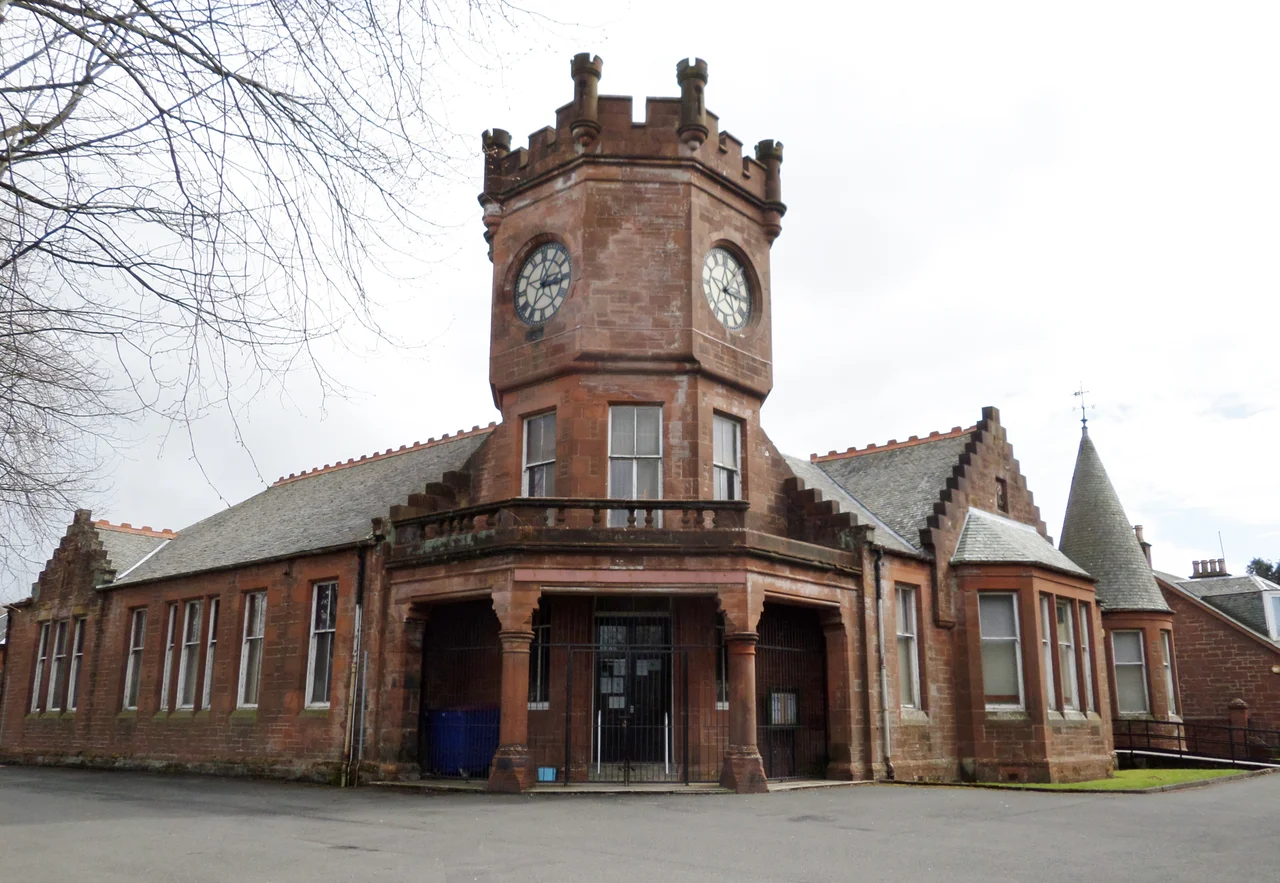

Catrine
Two iron wheels turned in the village of Catrine, and for over a century they were the largest of their kind in Britain. Each was fifty feet in diameter, a hundred and fifty-seven feet around, with one hundred and twenty wooden buckets bolted to its rim. The two together passed seven thousand nine hundred and twenty cubic feet of water every minute - two hundred and ten tons of water per minute drawn from artificial lochs in the hills above, channelled through tunnels, and dropped onto the wheels to drive the cotton-spinning machinery of one of Scotland's earliest industrial villages. People came on day-trips to see the wheels turn. They kept turning until the 1940s. Even after Catrine's mill closed, those iron wheels remained, in local memory, the thing that made the village what it had been.
Dark Place in the Woods
Catrine sits in East Ayrshire on the River Ayr, two miles southeast of Mauchline, in country that was once one of the longest-lasting Gaelic-speaking pockets in the Scottish Lowlands. The name itself appears to come from a Gaelic root ceit, meaning dark or gloomy place - probably referring to the thick woods that once covered the valley floor. Before the cotton mill, the place was almost nothing. A 1787 plan shows eleven buildings: a smithy, a corn mill, a few houses. That was the year Claud Alexander of Ballochmyle, who had made a substantial fortune as Commissary General in India, partnered with the industrialist David Dale to build one of the very first cotton mills in Scotland on this stretch of the Ayr. The river provided the water power. The village grew up around the mill. Catrine, in any meaningful sense, was created by the industrial revolution.
James Finlay and the Wheels
In 1801 the firm of Messrs James Finlay & Co. of Glasgow bought the Catrine mill, and a quarter-century of expansion followed. In 1802 they constructed two artificial lochs above Muirkirk - 120 acres of water storage - to guarantee the supply that kept the wheels turning year-round. By 1823 they had added extensive bleaching works on adjacent ground. The original wooden wheels, made from oak grown on the Drumlanrig estate, were replaced in 1828 with two enormous iron wheels - the largest in Britain when constructed. Five hundred horsepower steam engines were later added to assist. The numbers became their own kind of advertisement: each bucket held eleven cubic feet of water; three revolutions per minute meant three hundred and sixty buckets per minute passing the bottom of each wheel; together they handled the equivalent of a small river. The wheels were tourist attractions for over a hundred years. A new mill was completed in 1950, but textile work was leaving Britain. It closed about twenty years later. The old mill burned down during its 1963 demolition. The newer mill was used as a furniture warehouse for some years and then demolished in 1985.
Catrine Voes Today
The village of Catrine still holds about 2,500 inhabitants. Where the bleaching works of Messrs Finlay & Co. once stood, Glen Catrine Bond now bottles whisky and vodka under a range of brand names - the industrial site continues to have an industrial life, just a different one. In 2006 the Catrine Voes - the old reservoirs that fed the mill wheels - along with the Radical Brae and Chapel Brae were designated a Local Nature Reserve. The weir, the reservoirs, the lades and tunnels of the old water system together form a Scheduled Monument. Catrine Community Trust, formerly Catrine Voes Trust, owns and is restoring these structures. Around the village, woods, fields, and gently sloping hills still come down to the river. Ballochmyle golf course sits just outside Catrine, and Ballochmyle House - the eighteenth-century mansion of Claud Alexander, the man who built the mill - looks down over the valley.
Dugald Stewart and the Poet
Nether Catrine House, on the south bank of the River Ayr, was the country seat of Dugald Stewart - Professor of Moral Philosophy at the University of Edinburgh from 1785 and one of the central figures of the late Scottish Enlightenment. Stewart's lectures shaped a generation of British thinkers, and his hospitable country house was a gathering point for ideas. It was at Nether Catrine that Robert Burns, then in the early flush of his Edinburgh fame, famously dinner'd wi a lord - that is, took an evening meal at the table of someone he might have expected, given his rural Ayrshire origins, never to meet. The dinner was a small social moment in a poet's life, but it has lodged in local memory because it captured something about the place: a village built on the labour of mill workers also harboured one of Scotland's leading philosophers, and a tenant-farmer's son could find himself eating with both. Nearby Ballochmyle has another claim on ancient time entirely - Iron Age rock art in the form of cup and ring marks, carved into the local sandstone thousands of years before anyone had a name for the river.
From the Air
Catrine sits at 55.50 N, 4.34 W on the River Ayr in East Ayrshire, two miles southeast of Mauchline. The village fills a narrow valley between gently wooded hills. Recommended viewing altitude: 2,000-3,500 ft AGL. Visual landmarks include the River Ayr running through the village, the Catrine Voes (former mill reservoirs) on higher ground above, Ballochmyle Golf Course to the north, and Ballochmyle House visible on the slopes overlooking the valley. The A76 road from Kilmarnock to Dumfries passes a couple of miles southwest. Nearest airfield: Glasgow Prestwick (EGPK) approximately 16 miles west.
Nearby Stories
- HMS Ulysses (1917) 7.3 km away
- Greenbank Garden 9 km away
- Ballantrae Lifeboat Station 12 km away
- Shotts 12 km away
- Douglas Castle 12 km away
- Battle of Glen Trool 13 km away
- Ellisland Farm 14 km away
- Rothesay Castle 15 km away