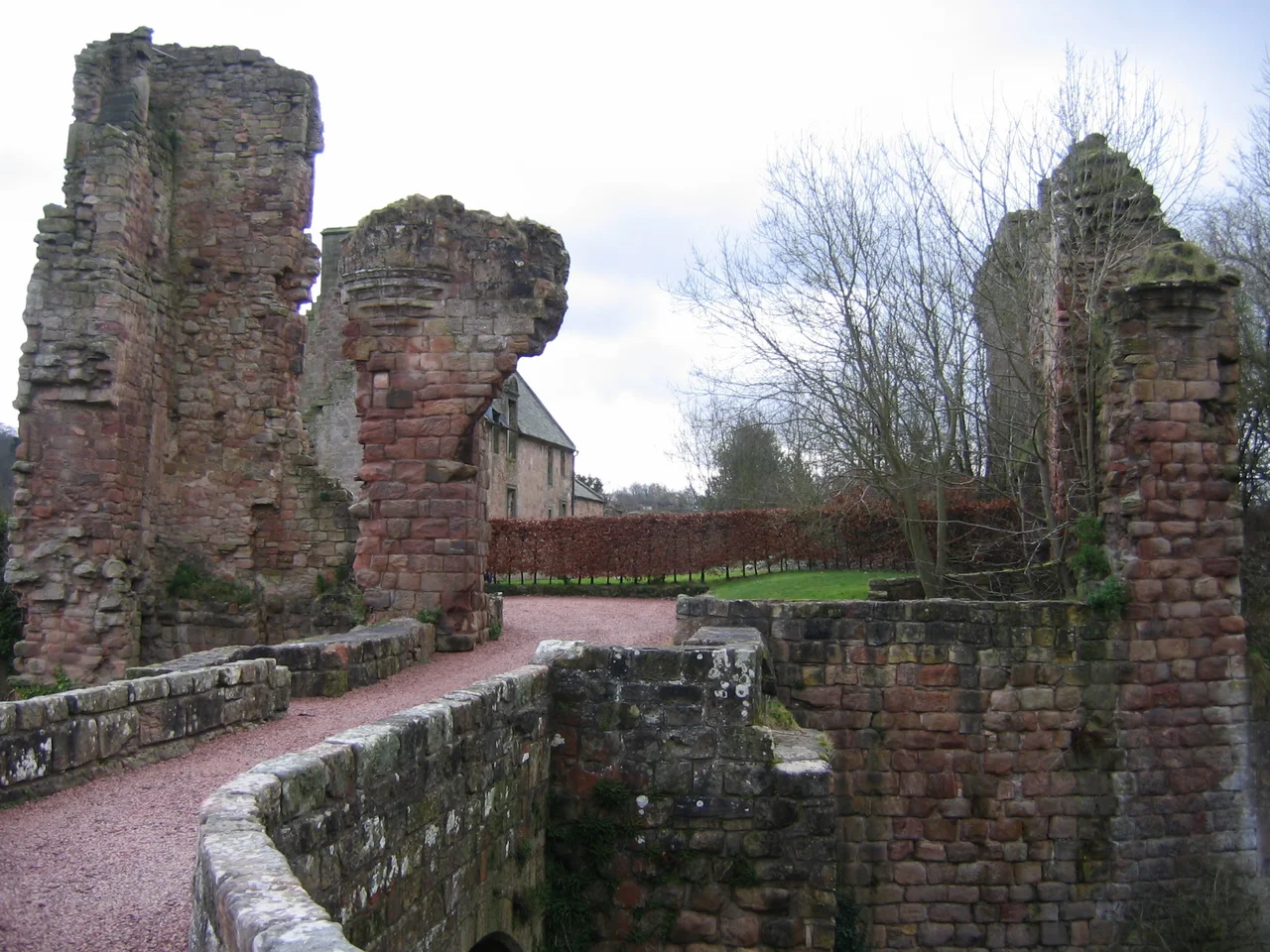

Roslin Castle
The story goes that during the great fire of 1452, the Earl of Orkney panicked - not for himself, not for his family, but for his books. The first Sinclair earls had built a scriptorium inside Roslin Castle, and in it they had accumulated a library of medieval manuscripts that any king might have envied. As the flames climbed the tower, the Earl's chaplain reportedly lowered the most precious volumes from a high window on ropes, one by one. Five of those St Clair manuscripts survive today in the National Library of Scotland. One, the Rosslyn-Hay manuscript, is believed to be the oldest extant work of Scots prose. The castle the chaplain saved them from is now a ruin you can rent for a holiday.
The Sinclairs Take Possession
The Sinclair family - originally St Clare, of Norman French stock - acquired Roslin in 1280, on the eve of Scotland's wars of independence. They built their first fortress here in the late 14th or early 15th century, perhaps begun by Henry Sinclair, Earl of Orkney, who died around 1400. The site was no accident. The rocky promontory above a loop of the North Esk was defended on three sides by the river itself, and a great ditch was cut across the fourth. A few hundred metres away lay the Sinclair foundation of Rosslyn Chapel, that strange and ornate church whose stone carvings have generated centuries of speculation. The chapel and the castle were always part of the same Sinclair statement: power, piety, and a taste for spectacle.
Fire and Renaissance
The 1452 fire is the most cinematic incident in the castle's medieval history, but it is far from the only one. In 1303 a Scottish army under Sir Simon Fraser and John Comyn defeated a much larger English force just outside the castle walls at the Battle of Roslin - one of the lesser-known Scottish victories of the First War of Independence. In 1544, during the Rough Wooing, Henry VIII's forces under the Earl of Hertford destroyed the castle. The Sinclairs rebuilt. A new five-storey east range was cut directly into the rock, and the gatehouse was replaced with a permanent stone bridge. In 1622 the upper floors were refashioned in Renaissance taste, with carved door and window surrounds initialled SWS for Sir William Sinclair. Then in 1650 Cromwell's General Monck dragged artillery up the glen and battered Roslin again. A Reforming mob did more damage in 1688. The Sinclairs kept rebuilding.
Ballads, Books and Da Vinci
The east range survived all of this, and survives still. Three lower floors are cut into the rock - kitchen, bakehouse, vaulted storerooms - with the principal rooms on the upper two floors reached through that 1622 doorway. Above the keep, a curtain wall of 15th-century stonework still stands tall, divided into six bays by rounded buttresses that once supported a wall-walk and bartizans. A ballad called Roslin Castle was composed in the 18th century by Richard Hewitt of Cumberland and recorded in volume one of the Scots Musical Museum. Sir Walter Scott featured the castle in his romantic imagination. In the early 21st century Ron Howard filmed parts of The Da Vinci Code here, drawn by the same Sinclair-Knights Templar mythology that has filled tour buses at Rosslyn Chapel for two decades. None of it has changed the rocks much.
Holiday in a Ruin
The current owner is Peter St Clair-Erskine, 7th Earl of Rosslyn - a direct Sinclair descendant who has spent his working life as a London police officer rather than as a baron. He leases the habitable east range through the Landmark Trust, which restored the building to high standards in the 1980s. You can book it. You sleep where Sir William Sinclair signed his renovations in 1622, look down on the precipitous bridge that replaced the medieval drawbridge, and wake up to the North Esk's white noise beneath the cliff. The castle is a Scheduled Ancient Monument and a Category A listed building - protected at the highest level. The keep is collapsed and probably will not rise again. The east range stands.
From the Air
Roslin Castle perches at 55.853 degrees N, 3.160 degrees W, on a rocky promontory above the North Esk, just southwest of Roslin village. Edinburgh Airport (EGPH) is about 10 nautical miles to the north-northwest; Edinburgh city centre lies 9 miles north. Look for the deep wooded gorge of Roslin Glen running roughly north-south, with the small village of Roslin on the plateau above. The castle's restored east range, with its crow-step gables and pitched roof, is easiest to spot. Best viewed at 2,000-4,000 ft AGL in clear conditions; the glen is heavily wooded and can swallow the castle in summer foliage.
Nearby Stories
- Burngrange Mining Disaster 5.9 km away
- Battle of Philiphaugh 6.5 km away
- Ravenscraig Castle 11 km away
- Crawford Castle 12 km away
- Battle of Nesbit Moor (1402) 12 km away
- Battle of Dollar 14 km away
- College Valley 18 km away
- HMS Pathfinder (1904) 19 km away