
Wishaw
In 1848, Frédéric Chopin came to Wishaw. The Polish composer was on his exhausting Scottish tour, dragging himself through the homes of aristocrats and merchants who had paid for the privilege of hearing him play, and one stop on his itinerary was Wishaw House, where he sat at the piano for the Hamiltons of Belhaven. He was already dying of tuberculosis. A year later he was dead. The visit is still remembered locally, but what makes it strange is the contrast: in 1848, Wishaw was a roaring industrial town — coal pits, iron foundries, railway-wagon works, gasworks, and the Caledonian Railway's main line just punched through — and somehow a chamber piece by Chopin floated above all of it for an evening. That contrast, between heavy industry and the lives lived alongside it, is the whole story of this town.
Roman Road, Norman Manor
Wishaw is older than the burgh that bears its name. The current Main Street follows the line of a Roman road that ran through the valleys of the Clyde and the South Calder Water, and another such road passed close to where Wishaw House once stood. In the 1960s a pagan Celtic figurine — a tricephalos, a three-faced head — was dug out of the woods near Netherton, evidence of pre-Christian settlement here long before the Christianisation of Scotland between 400 and 600 AD. By the eighth century a small church sat by a bend (cambo- in Cumbric) on the banks of the Clyde, giving the parish of Cambusnethan its name. A Norman lord put up a manor near Gowkthrapple in the twelfth century, and after the Wars of Independence Robert the Bruce transferred the barony to local lords. Wishaw House itself dates back to the fifteenth century, appearing as 'Wisha' on Timothy Pont's 1583 map of Scotland.
The Burgh of Iron and Coal
The transformation that made modern Wishaw came in the 1830s. Lord Belhaven set up a distillery. Railways and gasworks arrived. Collieries opened across the parish, and the Caledonian Railway's main line through Wishaw in 1848 turned a village into a junction. The Coltness Iron Company opened in 1837 under the Houldsworths, and a great Jacobean-style house went up to oversee the estate. By 1855 the burgh was formed by amalgamating Wishaw with Coltness and Stewarton, and the population stood at five thousand — up from four hundred just five decades earlier. By 1882 there were five schools, and the town anchored what Scotland's industrial heartland built itself from: steel, iron, coal, foundry work, fire-clay, railway wagons. The names of the streets still trace the layout of the old works. The Coltness House was demolished in 1970, but its Category B-listed Gate House on Main Street survives — for most of the late twentieth century it served, somewhat unceremoniously, as a public toilet.
After the Mills
Deindustrialisation hit hard. The Coltness Iron Company wound up in 1950, the steelworks and pits closed through the 1980s and 1990s, the Courtauld textile factory shut in 2000. The town that had once exported iron now exported its young people. What is left is a mixed economy of supermarkets, the Royal Mail's main Scottish distribution centre at Shieldmuir, and University Hospital Wishaw — formerly Wishaw General Hospital — which serves the whole stretch from here down through Motherwell, Newmains, and Shotts as the A&E for Lanarkshire's industrial belt. The town has a large Catholic population, mostly descended from Irish families who fled the Famine and settled in Glasgow and Lanarkshire, joined later by Italians and Poles. St. Ignatius Church, a Category A-listed Gothic-revival church designed largely by George Goldie in 1865, is the most architecturally significant building in the centre.
What the Town Made
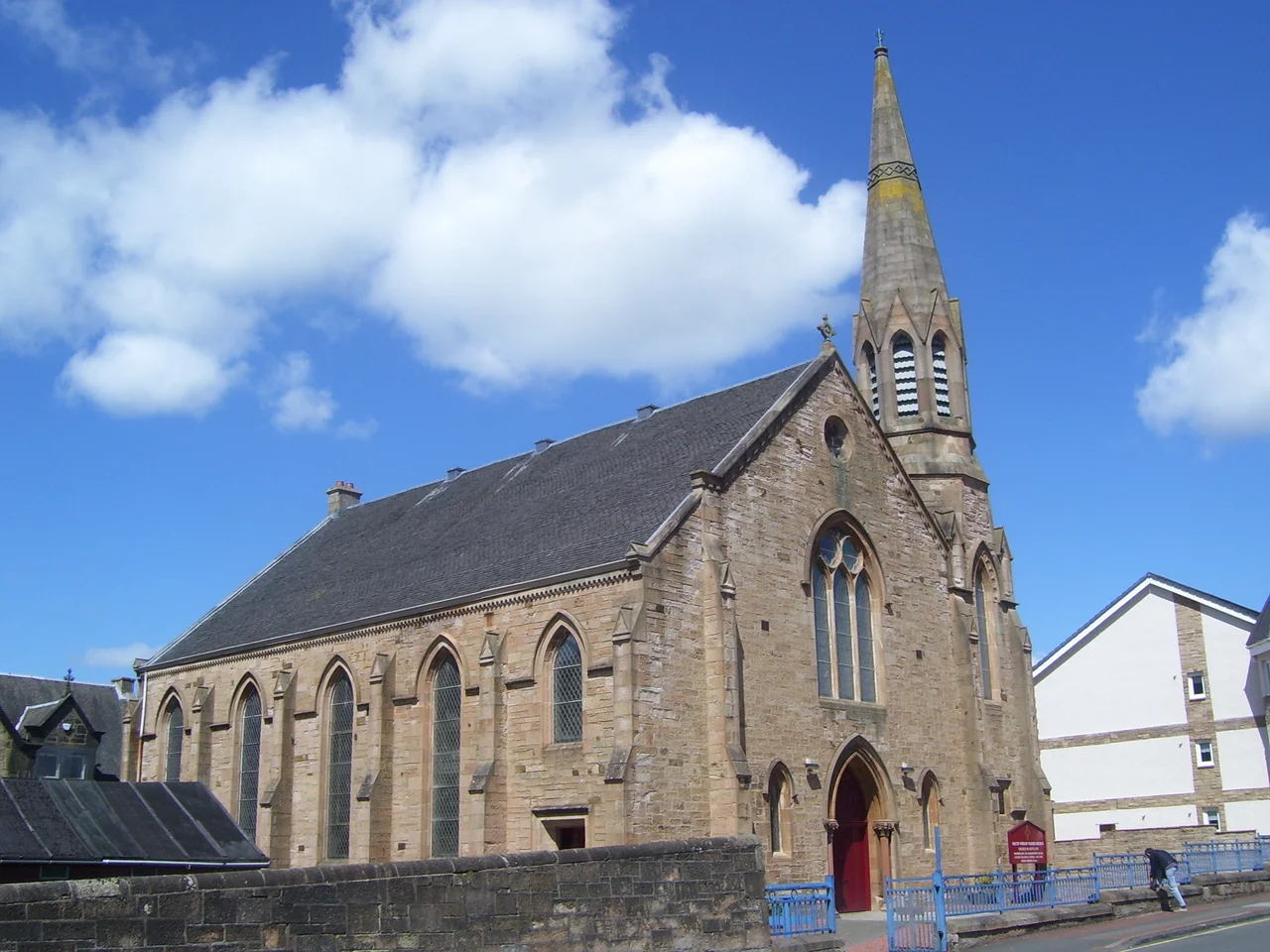
Wishaw has sent a surprising number of people out into the world. Kieran Tierney, who grew up in Wishaw, has played for Celtic, Arsenal, and Scotland. John Higgins has won the world snooker championship four times. Sir Samuel Curran, who grew up here and attended Wishaw High School, invented the scintillation counter — a device that detects radiation by counting tiny flashes of light — and led the Royal College of Science and Technology to full university status as the University of Strathclyde. Cardinal Thomas Winning, Archbishop of Glasgow, came from Wishaw. So did the opera singers Marie McLaughlin and Anne Sharp, and the journalist Deborah Orr. The town still has its Old Parish Church from 1840, with the town clock in the steeple as its principal landmark, though declining attendance forced it to close at the end of 2024. A wisp of the old confidence remains in the Wishaw Golf Club, founded 1894, with a course laid out in 1935 by James Braid — the five-time Open Champion who designed half the great golf courses in Scotland.
From the Air
Wishaw sits at 55.77°N, 3.92°W in North Lanarkshire, fifteen miles southeast of Glasgow city centre. From cruising altitude around 4,000 feet AGL, the town shows as part of the southeast extension of Greater Glasgow's industrial belt, running into Motherwell to the west and toward Carluke and the Clyde Valley to the southeast. The South Calder Water and Clyde tributaries thread through. Nearest airports: Glasgow (EGPF) 20 nm west-northwest, Edinburgh (EGPH) 26 nm east-northeast. The M74 runs to the southwest, the M8 to the north. The University Hospital Wishaw in Craigneuk is a useful landmark — a large modern complex visible from altitude — and the Old Parish Church's town-clock steeple anchors the historic centre.
Nearby Stories
- HMS Gannet 3.6 km away
- Luss 5.3 km away
- Oliver Castle 6.8 km away
- Battle of Bannockburn 6.9 km away
- Beith 7.9 km away
- Pentland Hills 7.9 km away
- Lochleven Castle 16 km away
- Cumnock 17 km away