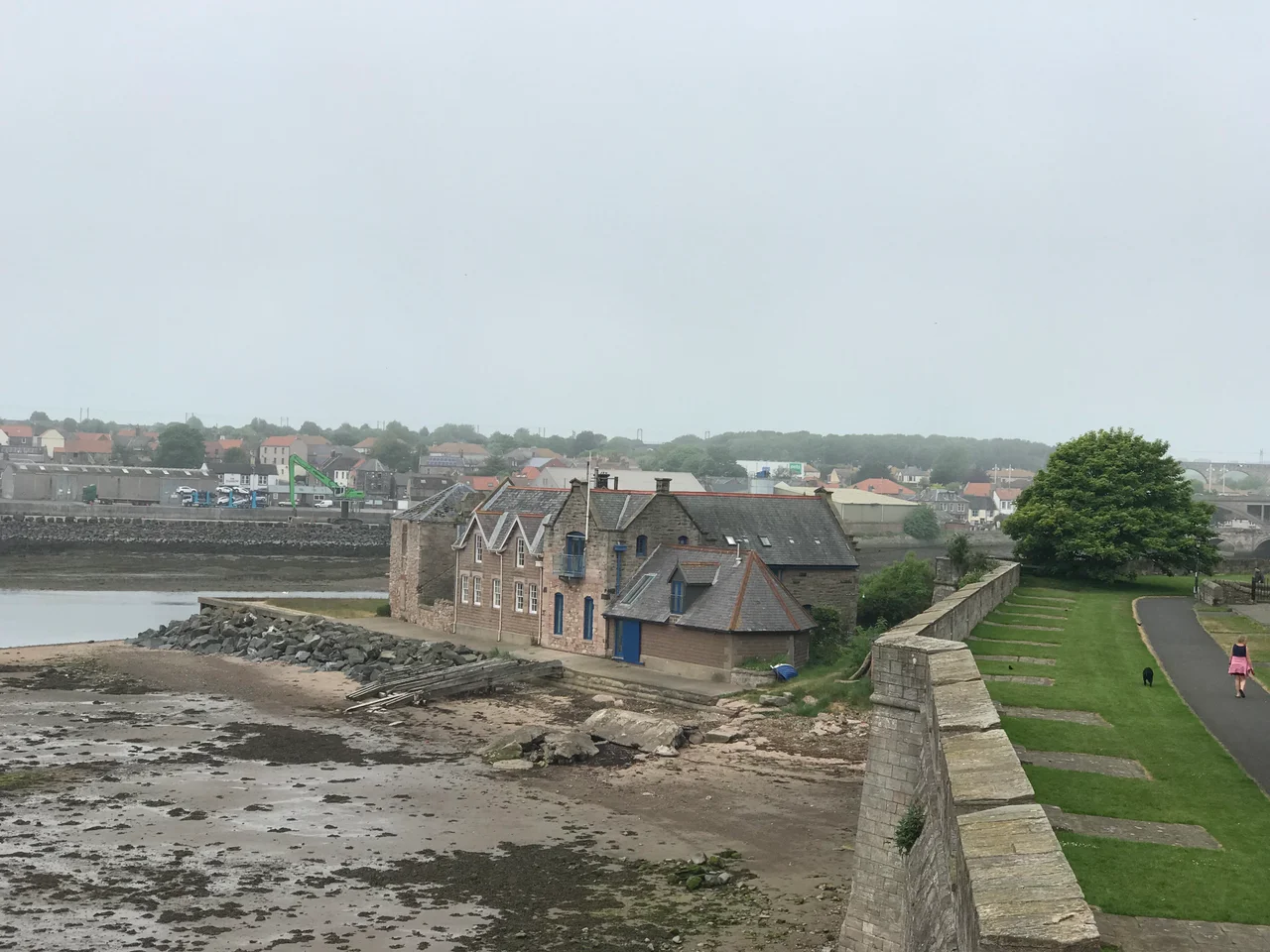

Berwick-upon-Tweed Lifeboat Station
On 9 November 1834 the vessel Christiana came in from Stockholm, capsized off Berwick-upon-Tweed in heavy weather, and went down with everyone aboard. A few days later Captain Hay of the Coastguard sat down and wrote a letter. So did the town clerk and a Berwick solicitor. They wanted a lifeboat. Within a year there was one. Nearly two hundred years on, the boathouse at Tweedmouth still stands on concrete pilings above the river, and a modern Atlantic 85 inshore lifeboat called Penny J launches when the call comes.
After the Christiana
The Royal National Institution for the Preservation of Life from Shipwreck - which would become the RNLI two decades later - placed the first Berwick lifeboat at Spittal in 1835. The site made sense for the south bank of the Tweed, where the harbour entrance opens to the North Sea, and the Berwick Lifeboat Association managed it on the ground. By the early 1850s the boat was tired and the association was broke. On 2 November 1854 the RNLI agreed to take over, and a new 30-foot lifeboat from Forrestt's yard arrived at Berwick in October 1855. A proper boathouse went up at Spittal in 1859 for £149 5s 5d - a sum that captures both Victorian precision and the small economics of saving lives at sea.
The Capsize and the Prince
On 29 March 1863 the Berwick lifeboat was out on routine exercise when it capsized. Nobody was killed, but the message was clear: the boat was too small for the seas it had to fight. A new 33-foot lifeboat arrived in April 1864 and, with the personal approval of the Prince of Wales - the future Edward VII - was named Albert Victor after his newborn son. Prince Albert Victor, the Duke of Clarence and Avondale, would live just twenty-eight years before dying of influenza in 1892. The lifeboat that carried his name served Berwick until 1888.
The Long Move
By 1900 the Spittal crew was hard to muster, and the RNLI moved the boat across the river to the Berwick side at Ferry Landing in 1901. The new boathouse cost £867 2s 11d and had doors at both ends - launch into the river one way, onto a beach carriage the other way for coastal callouts. When the motor age arrived in 1927 a new station was needed back at Spittal for the heavier boats, and was built in 1928 for £4,600. Then nine years later the RNLI decided the boat needed to be bigger again, so the entire 1928 boathouse was dismantled and reconstructed upriver at Tweedmouth on concrete pilings with a deep-water slipway. That building is still in use today. The 40-foot 6-inch Watson motor lifeboat J. and W. arrived in 1940.
Modern Service
In 1976 the RNLI swapped Berwick to inshore operations only. In 1993 they reversed course and brought back an all-weather lifeboat - the 12-metre Mersey-class Joy and Charles Beeby, named on 23 March 1993 at Carr Rock Pier by the Duchess of Kent. The Joy and Charles Beeby served Berwick for thirty years, departing for the relief fleet on 15 April 2023. The all-weather provision ended in 2024, and today Berwick operates two inshore lifeboats: the Atlantic 85 Penny J, on station since 2024, and the smaller D-class Glenis Joan Felstead, on station since 2025. The estuary they serve has not changed. The North Sea has not gotten kinder. The crew still come when the pager sounds.
What the Boathouse Sees
From Tweedmouth boathouse the view stretches across one of the most photographed river crossings in Britain. The Old Bridge of 1610 - fifteen sandstone arches commissioned by James VI and I - sits closest, downstream. The Royal Tweed Bridge, opened in 1928, carries the modernised A1167. Behind both rises the Royal Border Bridge, Robert Stephenson's 28-arch railway viaduct of 1850, carrying the East Coast Main Line 126 feet above the water. Mute swans glide on the tidal river; salmon run upstream past the lifeboat slip. When the orange boat comes off its mooring and heads east toward the harbour mouth, it passes under all of them in order. Three centuries of bridges and one purpose.
From the Air
Lifeboat station at Tweedmouth, 55.76°N, 2.00°W, on the south bank of the River Tweed in Berwick-upon-Tweed. Recommended viewing altitude 1,500-2,500 ft AGL to see the three bridges and the harbour mouth. The boathouse sits just downstream of the Old Bridge on concrete pilings. Nearest ICAO airport: EGNT (Newcastle) 55 nm south; EGPH (Edinburgh) 45 nm north-west. The North Sea is 1 nm east, with the harbour entrance and the long Victorian breakwater visible. Holy Island lies 8 nm south.
Nearby Stories
- Chillingham Castle 3 km away
- Battle of Ancrum Moor 9.3 km away
- Bass Rock 11 km away
- HMS Nottingham (1913) 12 km away
- HMS Pathfinder (1904) 15 km away
- Yester Castle 18 km away
- German submarine U-1274 23 km away
- Alexander L. Kielland (Platform) 282 km away