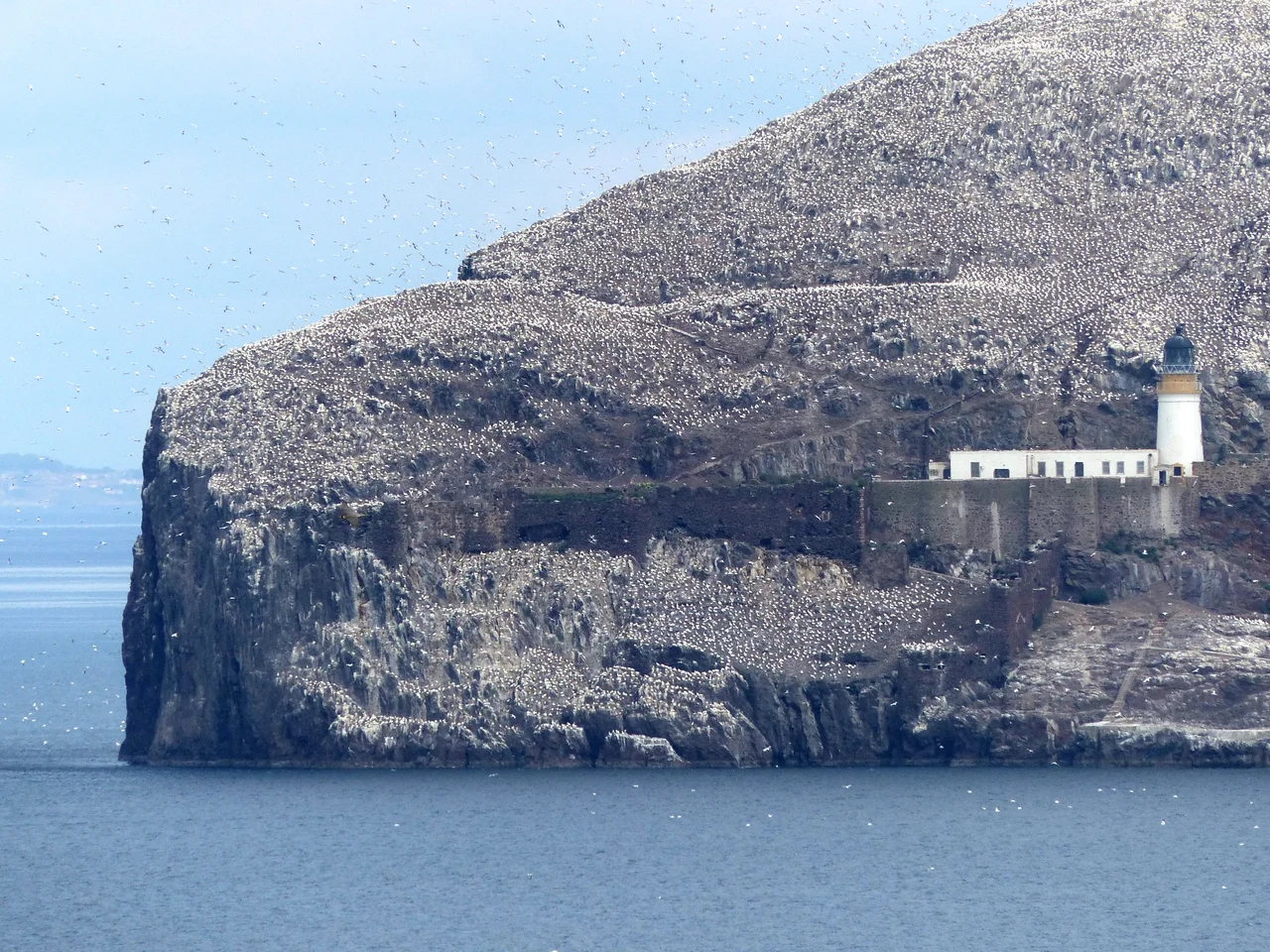

Bass Rock
From the mainland the rock looks white. That whiteness is not snow or rock colour. It is tens of thousands of northern gannets and their droppings, painting a 340-million-year-old volcanic plug with the residue of one of the world's largest seabird colonies. The species took its scientific name, Morus bassanus, from this single island, two miles off the East Lothian coast. David Attenborough has called the Bass one of the wildlife wonders of the world. Before it was that, it was a hermit's cell, a baron's stronghold, a king's offshore boarding-house for political prisoners, and a Jacobite fortress that held out against William III's navy for nearly three years.
Geology First
The Bass is a phonolitic trachyte plug of Carboniferous age. It is what remains of a volcano that erupted in the Dinantian, roughly 340 million years ago, when the rest of Scotland was somewhere near the equator. James Hutton, the Edinburgh geologist who founded modern geology in the late 1700s, recognised it as an igneous intrusion. Hugh Miller, the self-taught stonemason who became Scotland's most-read geological writer, visited in 1847 and devoted a chapter to it. The same volcanic episode produced the Lamb, Craigleith, Fidra, and Eyebroughy nearby, and the bigger hill of North Berwick Law on the mainland. Together they trace a string of eroded volcanic remnants across the Firth of Forth, the bones of an ancient land.
Saint Baldred's Cell
An 8th-century Christian hermit named Baldred is said to have lived in a cell or cave halfway up the south face of the rock. Halfway up that same face still stands the ruin of a chapel dedicated to him, rebuilt several times by the Lauder family who held the Bass for almost six centuries from the early 1300s. A papal bull of 1493 refers to the chapel of Saint Baldred as noviter erecta, newly established. In 1542 Cardinal David Beaton's secretary, John Lauder, was present at a reconsecration. The cherry trees in the chapel's small garden are mentioned by James Fraser of Brea, who was later imprisoned on the rock. Saint Baldred himself is believed to have founded a monastery at Tyninghame on the mainland; whatever the actual history of the cave dwelling, the island carried his name and his memory for over a thousand years.
The Patmos of Scotland
After the Restoration, when Charles II's government tried to force episcopacy on Presbyterian Scotland, the Bass became a state prison for Covenanters, the Presbyterian field preachers and their supporters. From 1671 onwards, men were brought here in irons and held in the castle perched above the landing place. Forty-odd preachers and laymen are recorded by name. Alexander Shields, who later wrote about his time on the rock, called it a dry and cold rock in the sea, where they had no fresh water nor any provision but what they had brought many miles from the country, and when they got it, it would not keep unspoiled. John Blackadder, who died here in 1685, is buried in North Berwick. Thomas Hog, John Rae, Alexander Peden, James Fraser of Brea: each one a man who would not stop preaching, each one taken from his parish and held on this rock until his health gave way or his sentence expired. They called the Bass the Patmos of Scotland, after the island where Saint John was exiled to write Revelation. The comparison was made with full Biblical seriousness.
The Jacobite Holdout
In 1689, when William III's government took over the country after the Glorious Revolution, four Catholic Jacobite officers were imprisoned in the same castle that had once held the Covenanters. On 18 June 1691 they made their move. The garrison was outside the walls, working a coal ship at the difficult landing. The four prisoners locked them out. The garrison rowed away on the coal ship; the Jacobites held the rock. For nearly three years, until April 1694, they kept it. King James VII, exiled in France, sent supplies by sea. Local Jacobite sympathisers ran the blockade with covert boats. William's two warships could not get close enough to bombard the cliffs effectively, and the rock's height made it impregnable. In the end Captain Michael Middleton, the prisoners' leader, bluffed the government into generous terms: free transport to France, release for those who had helped them. It was probably the longest siege of a single small fortress in Scottish history.
The Gannetry
The Lauders sold up to Sir Hew Dalrymple, Lord North Berwick, in 1706. His descendants still own the rock. The castle keep came down in 1902 to provide stone for David Stevenson's new lighthouse. What endured was the bird colony. By the 19th century around two thousand young gannets, called solan geese in the Scots vernacular, were being harvested annually for their flesh and fat, the same harvest that nearly emptied St Kilda. The colony recovered. Today around 150,000 gannets nest on the rock each summer, the world's largest single population of Morus bassanus. Then came the avian-flu epidemic of 2022. Over 5,000 birds were counted dead in a single day's drone survey by the University of Edinburgh. The chief executive of the Scottish Seabird Centre said the scale was heartbreaking. The colony is recovering slowly. The white blaze on the rock, viewable in real time from cameras at the seabird centre, is one of the more compressed natural spectacles in Britain.
From the Air
Bass Rock: 56.080 N, 2.640 W, an isolated volcanic plug rising 107 m above the outer Firth of Forth, two miles north-east of North Berwick. Best viewed at 1,500-3,000 ft AGL on a circular pattern; the rock is small enough to fully overfly without disrupting the colony but the seabird colony makes low overflight inadvisable during nesting season (April-August). White-streaked rock contrasts sharply against the dark Firth. Tantallon Castle visible on the mainland headland directly south. Nearest airport is Edinburgh (EGPH), 38 nm west. Coastal haar can hide the rock entirely on summer mornings.
Nearby Stories
- Edinburgh City Bypass 1.4 km away
- Eyemouth Lifeboat Station 3.3 km away
- Yester Castle 4.7 km away
- Fingask Castle 5.6 km away
- Kirkcaldy 5.7 km away
- Carnoustie Golf Links 9.3 km away
- Eyemouth Disaster 30 km away
- River Dee Ferryboat Disaster 79 km away