
Battle of Kilsyth
The bodies came up out of the bog with the canal builders. When workmen cut the Forth and Clyde Canal through Dullatur Bog in the 1770s, they uncovered the remains of several troopers from the rout of August 1645 — one of them still seated on his horse, both perfectly preserved by 130 years in the peat. The battle that put them there had been the largest engagement of the Wars of the Three Kingdoms in Scotland, fought near Kilsyth on 15 August. The Royalist general Montrose, with about 3,000 foot and 600 horse — a force built around Irish Confederate infantry, Highland clansmen, and Lowland Gordon levies — destroyed a numerically superior Covenanter army under William Baillie. Approximately three-quarters of Baillie's troops perished. The decision that doomed them was not made on the battlefield. It was made by a committee.
What Montrose Had Won, and What Was Coming
By August 1645 Montrose had spent thirteen months running circles around the Scottish government forces. With an army built around an Irish Confederate brigade under Alasdair Mac Colla — a brilliant tactician whose 'Highland Charge' would terrify Lowland infantry for the next century — he had beaten the Covenanters at Tippermuir, Aberdeen, Inverlochy, Auldearn, and Alford. The point of this campaign was strategic: to tie down Scottish troops in Scotland so they could not reinforce the Parliamentarian side in the First English Civil War. After the bloody Royalist victory at Alford on 2 July, only one intact government army remained — under William Baillie, a professional soldier with regular regiments stiffened by recent untrained levies from Fife. The Earl of Lanark was raising another thousand infantry and 500 cavalry from his brother the Duke of Hamilton's Clydesdale estates and marching north to join Baillie. Montrose, hearing of this, decided to destroy both forces before they could combine.
The March Through the Night
From Dunkeld, Montrose's army skirted Baillie at Perth and travelled via Kinross, Glenfarg, and Alloa, crossing the Forth near Stirling and looping around the castle. By nightfall on 14 August they were camped in a meadow at Colzium, by Kilsyth — an area still called Cavalry Park in memory of the encampment. Baillie had moved south through Stirling on the line of the modern A9, reaching Hollinbush, only three miles off. His men had had little sleep. At dawn his scouts located the Royalist camp, and he marched cross-country to the village of Banton, which gave the Covenanters the higher ground around the eastern rim of the hollow where Montrose's infantry waited. Baillie looked at the ground. He had a healthy respect for Montrose. His own men had marched all night in full kit. He decided to take a defensive position and wait for Lanark's reinforcements — at which point Montrose would be trapped between two armies, with the high ground held by the Covenanters.
The Committee Overrules
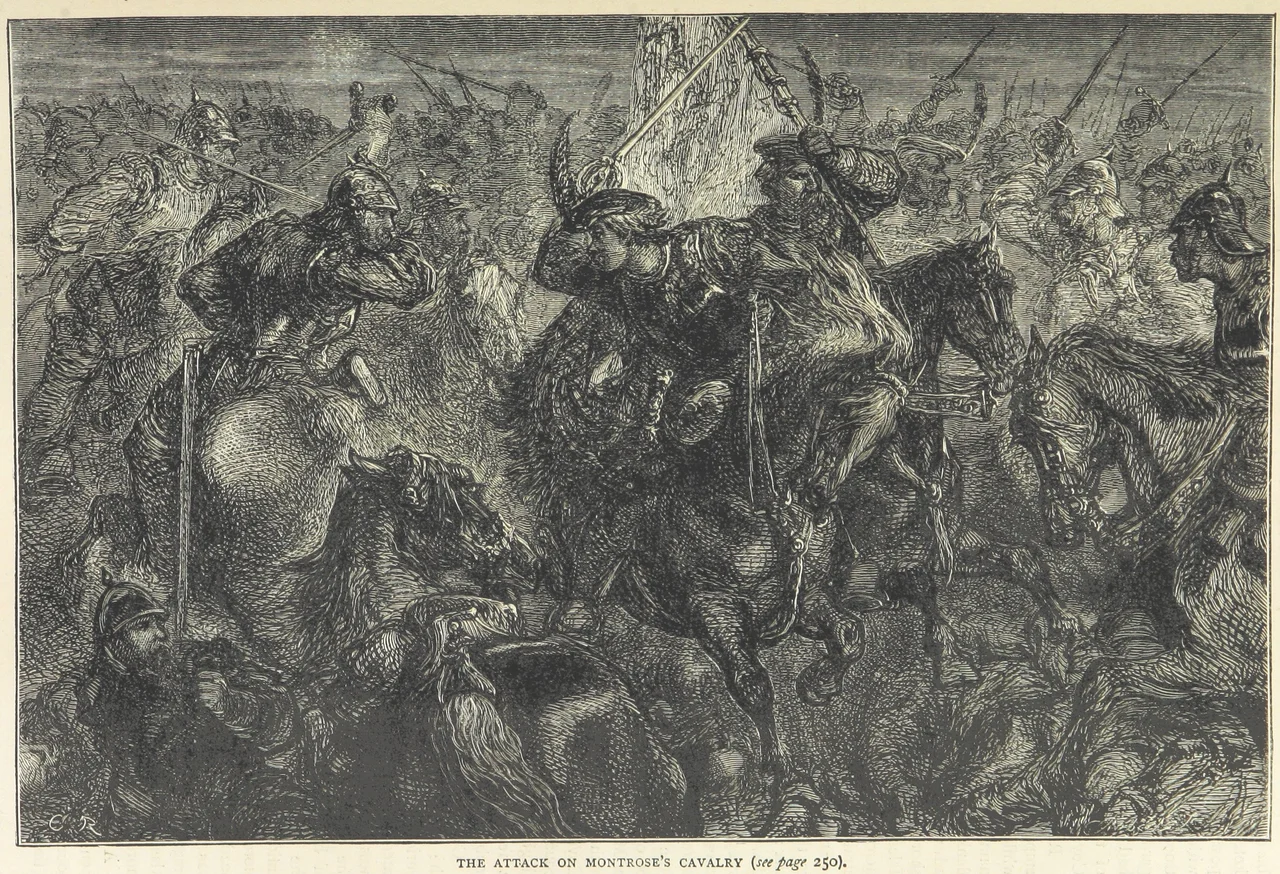
It was a sound decision. But Baillie's orders were subject to the approval of the 'Committee of Estates' — a group of earls and Calvinist clergymen accompanying the army to ensure political and religious orthodoxy. The committee consisted of the Earls of Argyll, Crawford, and Tullibardine; the Lords Elcho and Balfour of Burleigh; and a number of ministers. They were worried that if the battle was delayed Montrose might escape to fight another day. They ordered Baillie to make a flank march around the Royalist position. Baillie protested. He was overruled. As the Covenanter army began its flank march, the column became strung out and disordered. Skirmishes broke out — the rear of the column attacked MacLean infantry in cottages on Montrose's left flank, and on the other end the cavalry of the Covenanter van clashed with Royalist horse. Other units joined the fighting without orders. Montrose recognised the chaos for what it was. He launched his cavalry and Highlanders into the disorganised column. The Royalist infantry followed.
What the Bog Held
Approximately three-quarters of the Covenanter troops perished. The Highland Charge — that terrifying combination of musket volley, dropped firearms, and headlong rush with broadswords and Lochaber axes — broke Baillie's men, and what had been an army became a fleeing crowd. Baillie himself escaped south with a cavalry escort, but was caught in Dullatur Bog, the marshy ground between the head waters of the Kelvin and the Bonny. He got out, but most of his escort did not. The bog held what it caught for over a century, until the canal builders came. Montrose, briefly, was master of Scotland. He marched to Glasgow and summoned a parliament in the King's name. Unknown to him, the Battle of Naseby had already been lost in June — the Royalist cause in England was finished. News of his Scottish victory forced the main Covenanter army under Leven to abandon the Siege of Hereford and retreat, but Montrose's own attempt to move south in support of the king ended at Philiphaugh on 13 September, where he was decisively defeated. The battlefield at Kilsyth is now inventoried and protected under Historic Scotland's Scottish Historical Environment Policy. The bog still drains slowly into Banton Loch.
From the Air
The Kilsyth battlefield is at 55.98°N, 4.02°W, near Kilsyth in North Lanarkshire, about 12 miles northeast of Glasgow city centre. Ordnance Survey maps place the battle in the vicinity of Banton Loch, which was expanded in the 18th century when the Forth and Clyde Canal was built — the canal cuts across the historic Dullatur Bog where Baillie's escort was caught and where bodies surfaced during construction. From altitude the Campsie Fells rise to the north, and the long ribbon of the canal threads east-west across the landscape. Glasgow Airport (EGPF) is 14 nm west-southwest; Edinburgh (EGPH) is 24 nm east. The town of Kilsyth itself sits at the base of the Campsies; Cavalry Park, where Montrose camped, lies near Colzium Castle on the eastern edge of town.
Nearby Stories
- Midhope Castle 1.8 km away
- Balloch Castle 3.1 km away
- Strathaven 5 km away
- West Highland Way 9.2 km away
- Dalgarven Mill – Museum of Ayrshire Country Life and Costume 10 km away
- Ardoch Roman Fort 11 km away
- Balvaird Castle 12 km away
- Neidpath Castle 20 km away