
Dalgarven Mill – Museum of Ayrshire Country Life and Costume
There is an owl hole in the back wall of Dalgarven Mill. Not a quirk of restoration, not a Victorian flourish - a working architectural feature, a deliberate alcove built to attract nesting owls, which would then control the rats and mice that any mill full of grain inevitably attracts. The monks of Kilwinning Abbey, who set up the first mill on this site in the 14th century, knew what they were doing. So did the Ferguson family, who ran the mill in its final working years and whose descendants now sit on the board of the trust that keeps it alive. Few mills survive in Ayrshire. Dalgarven survives because one miller's family saw that an ancient industrial site could become a different kind of community space - a museum, an archive, a place where people remember how to do things they no longer need to do.
Six Centuries of Grinding
There has been a mill on this site - Groatholm, on the River Garnock - since the 14th century. The monks of Kilwinning Abbey built the first one as a waulk or fulling mill, processing woollen cloth. Ponds beside the river were used for retting, the slow soaking that loosens fibres in flax, jute, and hemp - the first step toward making linen, rope, and the banknote paper that the British economy would later run on. The present stone building dates from 1614, rebuilt after a fire in 1869 that the Fire Assurance company compensated at £2,300. Its waterwheel - 6 metres in diameter, breastshot, with the water striking it at a quarter of its height - drives French burr millstones through cast-iron gearing. The mill machinery was almost entirely renewed during the long restoration; the wooden components of wheel and sluice were replaced again between 2006 and 2009. The wheel still turns when conditions allow, the leat still carries water from a weir of carefully locked boulders on a natural dyke of hard rock that crosses the Garnock at this point - a feature the monks identified centuries ago as the perfect site for a dam.
Thirlage, Owls, and the Window Tax
Mills were not just industrial sites; they were social and legal institutions. Under the feudal law of thirlage - repealed only in 1779 - every farmer on the laird's lands was bound to bring his grain to the laird's mill. The tenants also had to maintain the mill, the lade, and the weir, and even haul new millstones to the site. The width of some of Ayrshire's earliest roads was set by the needs of two people walking on either side of a millstone rolled on a wooden axle called a mill-wand. The mill building has clues to other taxes too. The relatively small number of windows may be a practical choice or it may be a dodge around the window tax - first levied in England in 1696 to fund recoinage after Williamite-era clipping, and not repealed until 1851. Mansions across Britain blocked up windows to reduce their tax bills. Loudoun Castle, not far from here, had a whole side bricked up. Dalgarven's owl alcove and its modest fenestration speak to a pre-industrial economy where every wall served a purpose.
The Museum of Country Life
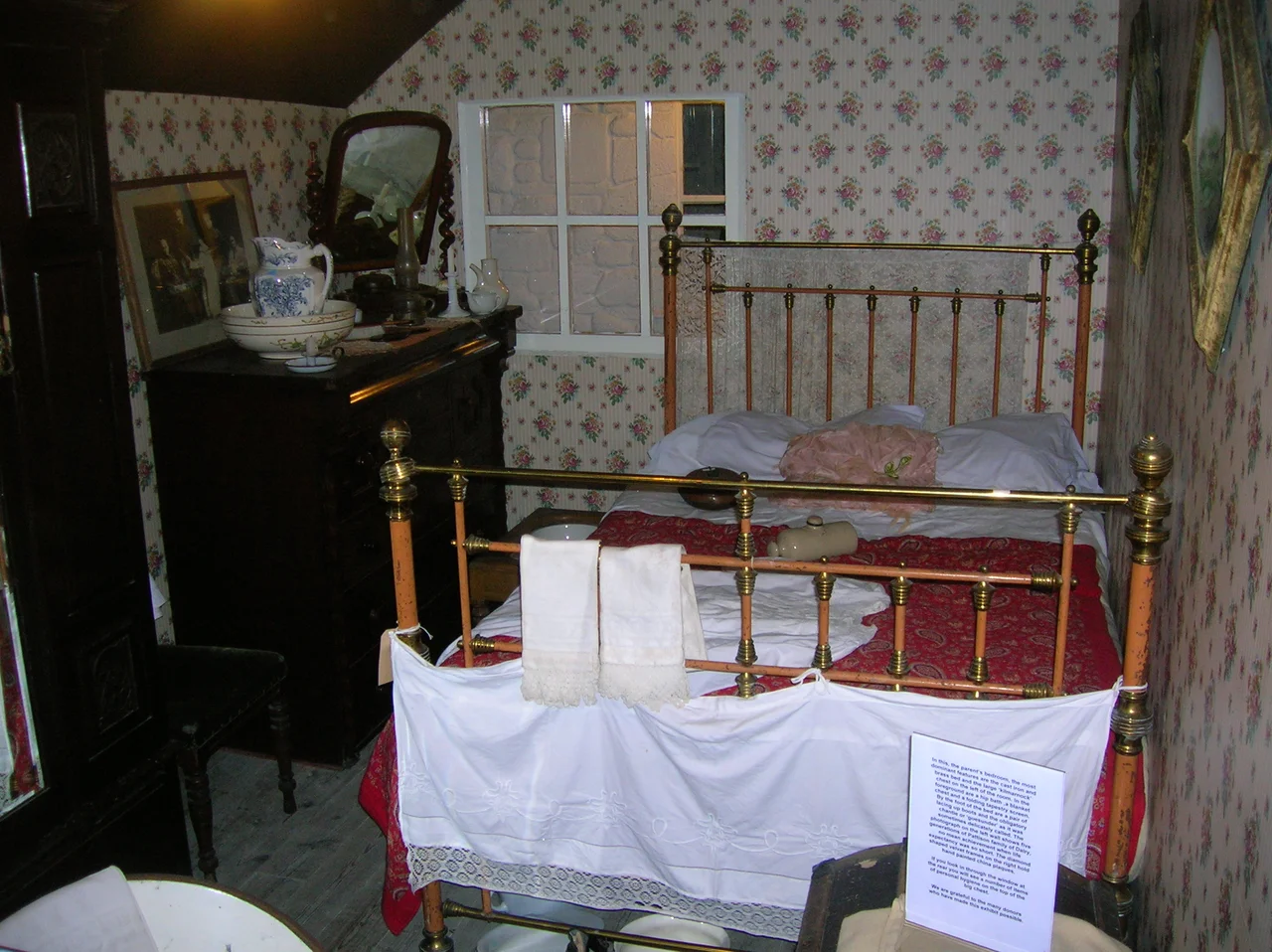
The three-storey grain store was converted between 1985 and 1987 into an extensive museum of Ayrshire rural life. The displays cover ploughing, threshing, harvesting, the village smithy, dairy work, and the recreated single-room cottars' house complete with box-bed, girnal, and swee - the swinging arm over the open hearth from which a cooking pot would hang. Upstairs, visitors find Victorian recreations of middle-class and working-class interiors: the bedroom, the kitchen, the miller's sitting room, the Blair Estate sawmill. The costume collection - the *Museum of Ayrshire Country Life and Costume* in full - holds garments from every walk of nineteenth- and twentieth-century life, rotated regularly through ground-floor displays and lent out for educational visits and special events. It is not part of the National Trust for Scotland or the National Museum of Scotland. It is an independent four-star accredited Ayrshire attraction, run by volunteers, kept alive by community goodwill and the entrance fees of curious visitors.
A Riverside Walk Through Living History
Outside the mill, the grounds are as much an exhibit as the building. The river meadow is rich in pignut, a relative of parsley with a small potato-like tuber that children used to eat raw as a break-time snack. The butterbur grows along the wetter ground, its huge leaves once used to wrap butter for market - hence the name. Coppicing of the riverside alders is still practiced; the trees enrich the wet soil through nitrogen-fixing root nodules, the same biological trick that clover uses in pasture. There is a cup-and-ring marked stone on display, a copy of one of Ayrshire's lost Neolithic or Bronze Age petroglyphs - up to 6,000 years old, recorded here by the antiquarian John Smith but its location now unknown. Fossil-bearing limestone boulders sometimes appear in the river, carrying impressions of long-vanished tree ferns that thrived in the warm climate of the Carboniferous and laid down the Scottish coal seams. In the 1940s, the miller at Dalgarven hooked up the wheel to generate electricity, stored in acid batteries. The trust has thought about doing the same thing again, in the name of "think global, act local." The wheel has been turning, in one form or another, for six hundred years.
From the Air
Coordinates 55.6761°N, 4.7104°W. Dalgarven Mill sits on the River Garnock in the Garnock Valley, just north of Kilwinning in North Ayrshire. Recommended viewing altitude 1,500 to 2,500 feet AGL to make out the mill complex, the river course, and the Sustrans cyclepath running nearby. Nearest ICAO airports: Glasgow Prestwick (EGPK) about 16 nm south-east, Glasgow International (EGPF) about 21 nm north-east. The Garnock Valley sits in a relatively sheltered low-lying area, but Atlantic weather systems sweeping in from the Firth of Clyde to the west can bring rapid changes in cloud and rain.
Nearby Stories
- Battle of Drumclog 2.2 km away
- Culzean Castle 3.3 km away
- Greenock 5.9 km away
- Lochranza 7.9 km away
- Battle of Kilsyth 16 km away
- Loch Fyne 19 km away
- Dunaverty Castle 25 km away
- Moniaive 27 km away