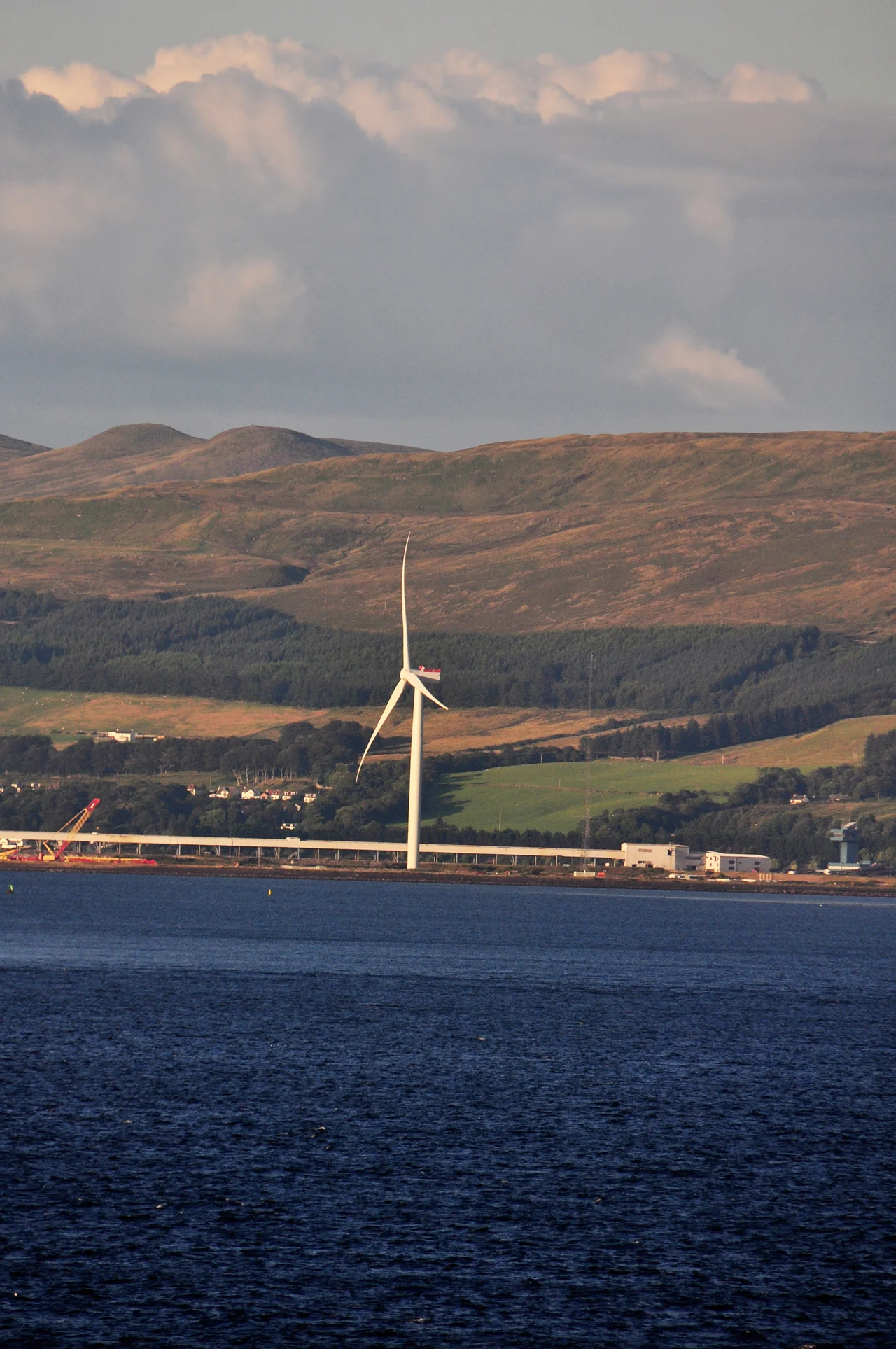

Greenock
Say it green-OCK, never GREN-ock. The locals will correct you, gently or otherwise, because the name carries weight here. It might come from greannach, meaning gravelly in Gaelic, the residue glaciers left along this stretch of shore. It might come from grianaig, a sunny knoll. What it does not come from, despite a stubborn 18th-century misspelling and a shopping centre called Oak Mall, is any green oak tree. That is folk etymology dressed up as history, and Greenock has too much real history to bother with the invented kind.
Where the River Becomes the Sea
Glasgow grew rich on tobacco, cotton, sugar, liquor, and the slave trade, but the River Clyde upstream of the city was simply too shallow for ocean-going ships. Something had to give. What gave was a string of ports along the Tail of the Bank, the stretch where the Clyde finally broadens into a proper firth. Port Glasgow first, then Greenock, then Gourock farther west — deep water, shelter from the prevailing south-westerlies, and easy onward transport up to the city by road and later by rail. After the 1707 union with England opened England's far-flung colonies to Scottish trade, the fishing village that had drowsed here for centuries began to wake. By the 1880s, when engineers finally finished deepening the Clyde itself, shipbuilding moved upriver to Glasgow. But marine engineering and sugar refining stayed on at Greenock, and the yards kept building until Far East competition closed them down in the 1970s.
The Engineer and the Explorer
Greenock's roll call of famous sons reads like a peculiarly Scottish anthology. James Watt was born here in 1736, the engineer whose improvements to the steam engine effectively powered the Industrial Revolution. Antarctic explorer Henry Robertson "Birdie" Bowers, who died with Robert Falcon Scott on the way back from the South Pole in 1912, came from Greenock too. So did novelist John Galt, comedian Chic Murray, and playwrights Bill Bryden and Neil Paterson. Captain Kidd, the famous pirate, claimed at his trial that he was from Greenock — though most historians think he was actually from Dundee and was simply trying for a more sympathetic jury. The town centre still carries the architecture of those prosperous trading years: the 1818 Custom House, the 1886 Victoria Tower, the plush Esplanade villas built by ship-owners and merchants who had made their fortunes on the water below.
Lyle Hill and the Free French
Walk up to Lyle Hill, west of town, and you reach a panorama that takes in the entire Firth of Clyde, the Highlands beyond, Helensburgh across the water, the cloud-wrapped mountains to the north. At the summit stands a large Cross of Lorraine. Officially, it commemorates the Free French Naval Forces of the Second World War, who used the Clyde anchorage as their base. Unofficially, locals also read it as a memorial to the 37 sailors killed in April 1940, when the French destroyer Maillé Brézé suffered an explosion and fire from one of her own torpedoes off Greenock. She was flooded to prevent the magazine going up, and she sank with those 37 men still trapped below. Standing at the cross on a clear day, with the long water of the firth opening below, it is easy to imagine the convoy assemblies that gathered here through the war years.
The Cut and the Aqueduct
When 19th-century Greenock outgrew its nearby water supply, the engineers got creative. A small loch on the south side of the hills was dammed to create Loch Thom, named for Robert Thom, the Rothesay engineer who designed the scheme. From there, water cascades into an aqueduct called The Cut, which winds along the contour line of the hills above town, capturing other streams as it goes through a system of sluices and buckets that regulates flow like something dreamed up between Heath Robinson and the Sunday Post cartoonist Oor Wullie. It still was not enough. Mill wheels, not people, were the real demand, so Gryffe Reservoir was built above Loch Thom to feed the whole system. The footpath along The Cut remains one of the finer walks in Inverclyde.
Newark Castle and the Old Town
Three miles east at Port Glasgow stands Newark Castle, a 15th-century tower house that was converted into a Renaissance mansion. One early owner kept bears and lions in the cellars, which says something about the imagination of 16th-century Clydeside aristocracy. Back in Greenock itself, the Old West Kirk stands by the Esplanade. Completed in 1591, it was the first Protestant church built in Scotland after the Reformation. It is not on its original site — it was carefully moved in 1926 to make way for the Harland & Wolff shipyard expansion. The Pre-Raphaelite stained glass inside, by Dante Gabriel Rossetti and Sir Edward Burne-Jones, is the kind of unexpected treasure that survives in working towns when nobody is paying attention.
From the Air
Greenock sits at approximately 55.95°N, 4.77°W on the south bank of the Firth of Clyde at the Tail of the Bank. Recommended viewing altitude 2,500-5,000 ft for the full sweep of the firth from Gourock east to Port Glasgow. Nearest airport: Glasgow International (EGPF) about 15 nm east. Prestwick (EGPK) lies 30 nm south. Look for the long Esplanade curving along the shore, the Ocean Terminal cruise berth, and Lyle Hill rising west of town with its distinctive Cross of Lorraine memorial.
Nearby Stories
- Loch Sloy Hydro-Electric Scheme 1.7 km away
- Lochranza Castle 2.2 km away
- Dalgarven Mill – Museum of Ayrshire Country Life and Costume 5.6 km away
- Loch Fyne 8.9 km away
- Battle of Drumclog 10 km away
- Battle of Kilsyth 12 km away
- Battle of Lagganmore 15 km away
- Comrie 20 km away