
Loch Sloy Hydro-Electric Scheme
Margaret Johnston cut the first sod on 11 June 1945 using an 18-ton bulldozer instead of the traditional polished spade, which seemed about right for the scale of what was beginning. Six weeks earlier the war in Europe had ended. Britain had a power crisis, a labour shortage, and an Act of Parliament authorising the new North of Scotland Hydro-Electric Board to make electricity from rainfall. Loch Sloy was their first project. Over the next five years, in incessant rain, with workers fleeing the cold and inedible camp food, with 398 German prisoners of war hauling cement up the mountain, the Board built a 184-foot buttress dam, drove tunnels through the Arrochar Alps, and installed the largest generator sets in Britain. Twenty-one men died during construction. The plaque in the power station bears their names.
The Engineer With 102 Ideas
Edward MacColl had been thinking about Loch Sloy since 1936. Working for the Central Electricity Board, he proposed something radical: a pumped-storage scheme that would push water uphill from Loch Lomond into Loch Sloy at night, when demand was low, and let it fall back through turbines at peak hours. He called it a reversible hydraulic station. The 1937 review committee whittled his eight turbines down to four, then rejected the whole project as uneconomic. But MacColl kept the file open. When the Hydro-Electric Development (Scotland) Act of 1943 created the North of Scotland Hydro-Electric Board, MacColl became its deputy chairman and produced a list of 102 potential schemes across the Highlands. Loch Sloy moved to the top. The pumping was dropped. A simpler 130-megawatt conventional design was approved on 28 March 1945, six weeks before VE Day.
Building in the Rain
The post-war labour shortage hit construction immediately. Within months, 398 German prisoners of war joined 45 British workers on the project. They built access roads, camps, and a railway bridge for the West Highland Line. Aggregate came from a quarry at Coiregrogain, moved by a 1.75-mile conveyor belt. Sand came up Loch Lomond from Balloch on tugs pulling dumb barges loaded fifty tons at a time. Portland cement was scarce. An aerial cableway over the dam site allowed concrete to be placed anywhere, and a 3.6-megawatt diesel station was built just to power construction. The weather was savage: continuous rain through 1947 and 1948, regular flooding, mass walkouts of British workers protesting cold huts and inedible food. The cold killed and the wet weakened, but the work continued. Twenty-one men died before the dam was finished. Their plaque is mounted inside the power station they helped build.
The Buttress Dam
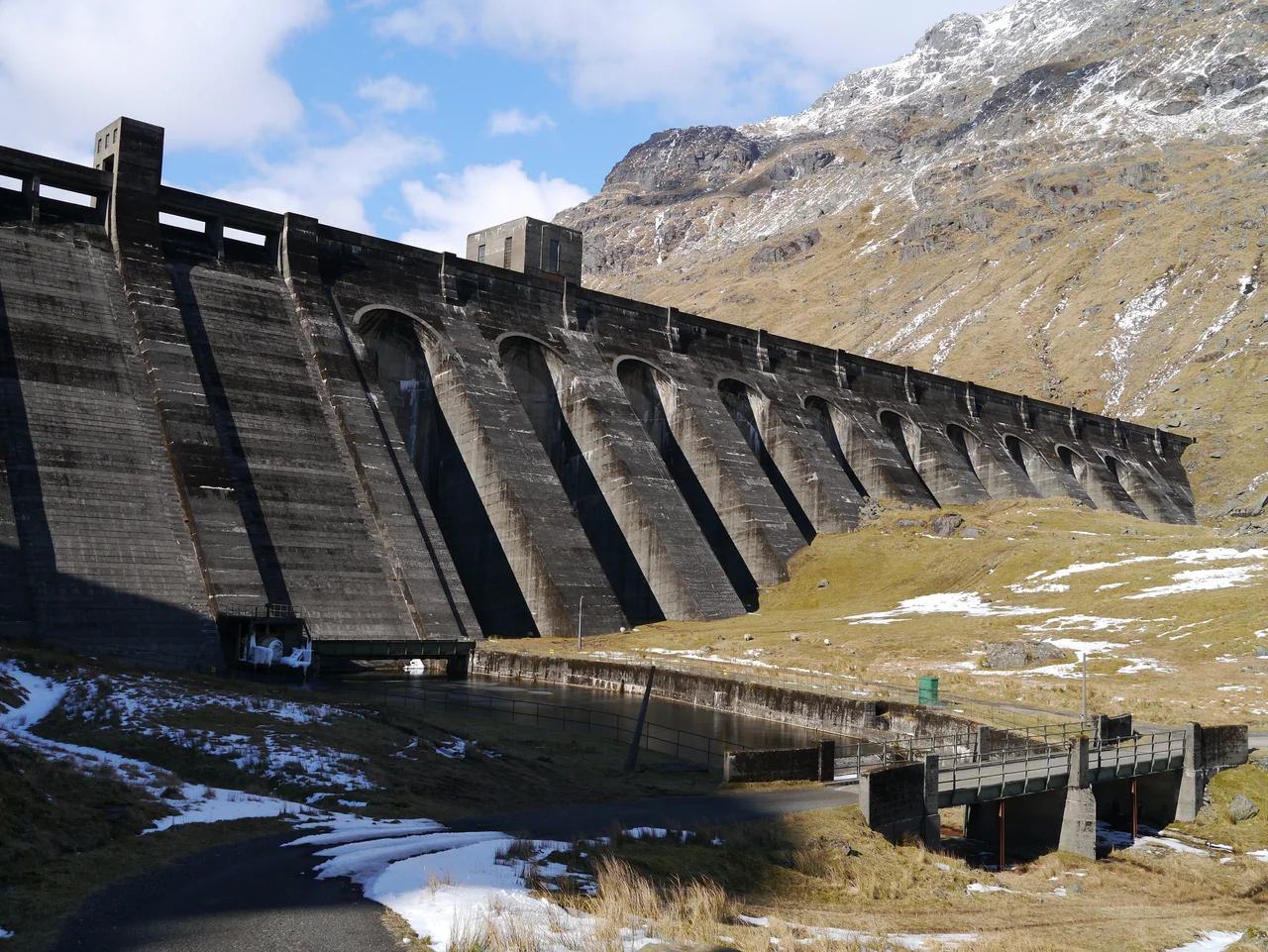
James Williamson, one of the Board's panel engineers, designed the dam as a buttress rather than a solid gravity wall. The decision saved roughly twenty percent of the concrete that would otherwise have been needed, a serious benefit when cement was being rationed. The completed structure is 1,171 feet long, 184 feet high, and curves slightly across the valley below Loch Sloy. It raised the loch's surface by 155 feet at full pool and provided a head of 909 feet down to the turbines at Inveruglas on the shore of Loch Lomond. The turbines came from English Electric. The spiral casings weighed 42 tons each, larger than road regulations normally permitted. The alternator rotors weighed 85 tons and required specially adapted railway wagons. When they arrived at the power station, no crane was big enough to unload them and they had to be jacked off the rails.
Catchments, Tunnels, and Five-Minute Standby
Loch Sloy's natural catchment was too small for the project. The engineers extended it westward and southward by capturing burns that would otherwise have run to Loch Long, Loch Fyne, and Loch Lomond directly. Tunnels and pipelines now thread through the Arrochar Alps from Eas Riachain and Garbh-allt in the west, to Allt a' Bhalachain and Allt Sugach in the south, to Allt Coiregrogain and Allt Ardvorlich in the east. All of it ends up in Loch Sloy, then drops through pipelines into the powerhouse beside Loch Lomond. The four turbines installed by 1950 were the largest generator sets in Britain at the time, three rated at 40 megawatts and one at 32.5, total capacity 152.5 megawatts. Today the station is operated by Scottish and Southern Energy in standby mode, holding water in the loch and waiting. From a cold start it can reach full output in five minutes, responding to surges anywhere on the British grid.
From the Air
Loch Sloy and the dam sit at 56.262 degrees North, 4.764 degrees West, in the Arrochar Alps west of Loch Lomond. The powerhouse is at Inveruglas on the west shore of Loch Lomond, about a mile and a half east and 900 feet below the dam. The four black penstocks descending the hillside are unmistakable from the air. The nearest airport is Glasgow (EGPF) about 30 nautical miles south-southeast, the main commercial gateway for the region. Edinburgh (EGPH) is 60 nautical miles east. Best viewed at 3,000 to 5,000 feet AGL to see the dam, the loch, the penstocks descending to Loch Lomond, and the surrounding peaks of the Arrochar Alps including Ben Vorlich. Western Highland weather is famously wet; this site receives roughly 120 inches of rain a year.
Nearby Stories
- Loch Fyne 1.1 km away
- Battle of Glen Fruin 1.7 km away
- Rannoch Moor 4.8 km away
- Callander 10 km away
- Battle of Lagganmore 13 km away
- Croft Moraig Stone Circle 16 km away
- Battle of Kilsyth 16 km away
- Strontian 21 km away