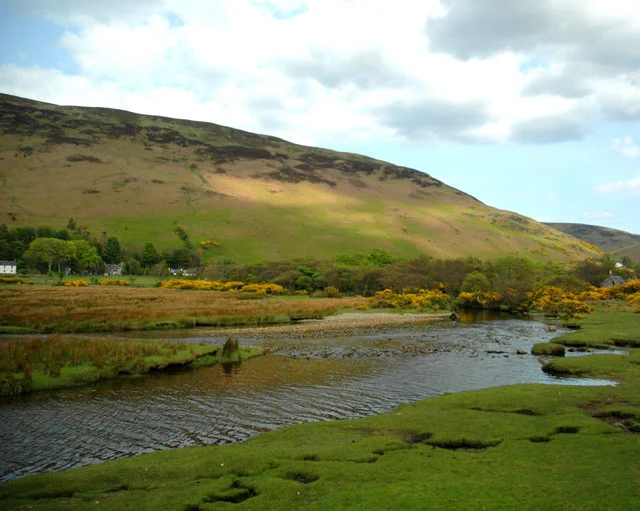

Lochranza
Lochranza is said to have fewer hours of sunshine than any other village in the United Kingdom. The reason is geometric: the village sits in a north-facing glen on an island with very heavy rainfall, hemmed in by the hill Torr Meadhonach to the northeast and the ridge running up to Goat Fell to the south. The sun has to climb high to reach the houses, and for much of the year it does not bother. The streets have no street lights. In winter, dusk arrives early and stays. About two hundred people live here, on the shore of a sea loch that opens north toward Kintyre, and red deer come down off the slopes to graze on the golf course in the long evenings.
Where Geology Began
Just north of the village, at Newton Point, the Scottish naturalist James Hutton found his first example of an angular unconformity in 1787. The discovery was central to his Plutonist theory of how the Earth was made, which proposed that the planet was vastly older than anyone had supposed and that its rocks had been shaped by slow internal heat rather than by a biblical flood. Hutton's Unconformity at Lochranza is one of the most important sites in the history of geology - a place where two sets of rocks meet at angles to each other, with hundreds of millions of years of erosion in between. Lochranza has a field study centre, and school groups still come from across the United Kingdom to walk the same shore and put their hands on the same junction. Arran has been called a 'geologist's paradise.' The case for it begins at Newton Point.
Bruce, Whisky, Deer
Tradition holds that Robert the Bruce landed at Lochranza in 1306 on his return from exile, on his way to claim the Scottish throne. The natural anchorage at the head of the loch makes the story plausible even if the documentation is uneven. The 16th-century Lochranza Castle, an L-plan tower house ruin, sits on a flat promontory at the loch's head, across the road from the youth hostel. The hostel building was originally a hotel, designed by the Glasgow architect John Burnet in 1893-94. The Arran Distillery opened in 1995 at the south end of the village and produces the Arran Single Malt - one of Arran's larger employers and a frequent stop on whisky tours. The bar of the Lochranza Hotel keeps over 350 different Scotch whiskies. The local red deer herd is so settled that they treat the eleven-hole golf course as common ground.
The Ferries and the Pier
Lochranza was once a herring fishing port. The herring went, and so did most of the boats, and the village turned to tourism. A new pier opened in 2003, large enough to take the paddle steamer Waverley and the small cruise ship Lord of the Glens. Caledonian MacBrayne runs ferries from Lochranza to Claonaig on Kintyre between March and October - seven daily crossings at roughly 90-minute intervals. In winter, a single daily service runs instead to Tarbert on Loch Fyne, departing at 1345. From Brodick, the 324 bus comes north to meet the boats; from Claonaig, a road runs across Kintyre to Tarbert, opening up the route to Argyll and the western Highlands. The pier sits a short walk from the war memorial to HMS Vandal, the submarine lost in February 1943 with all thirty-seven of her crew, just up the coast in waters off Inchmarnock.
The Worst Football Team in Europe
Lochranza is home to Northend Thistle Football Club. They were once labelled - by ESPN Asia, BBC Sport Scotland, and Soccer Saturday - the worst football team in Europe, with a winless streak that lasted nineteen years. They play in a field called the Ewe Camp, voted one of the top grounds to visit in the country. Lochranza is also celebrated in verse and in folklore: it is said that a local midwife once had an encounter with the Queen of the Fairies, called out from her cottage in the small hours to deliver a child she did not realise was royal until afterwards. The actress Katharine O'Donnelly grew up here. Otters work the loch shore. Grey seals are present year-round on the northern beach. Golden eagles cross the ridges. For a village of two hundred people on the least sunny strip of coastline in the country, Lochranza carries more story than seems quite fair.
From the Air
Located at 55.7048°N, 5.2947°W on the northern tip of the Isle of Arran. The village shows as a small cluster of buildings at the head of a narrow north-facing sea loch, with the steep glen rising sharply to the south toward the Goat Fell ridge. The Arran Distillery is the largest building at the south end of the settlement. Best viewed from 1,500-3,500 ft. Nearest aerodromes: Campbeltown (EGEC) approximately 25 nm southwest on Kintyre, Glasgow Prestwick (EGPK) about 35 nm to the east-southeast. The Kintyre peninsula lies 6 nm to the northwest across the Kilbrannan Sound.
Nearby Stories
- Inverkip 3.4 km away
- Ardrossan Lifeboat Station 6.1 km away
- Turnberry Castle 7 km away
- Ardbeg Distillery 8.3 km away
- Tighnabruaich 13 km away
- Dunaverty Castle 14 km away
- Rathlin Island 16 km away
- Oronsay 21 km away