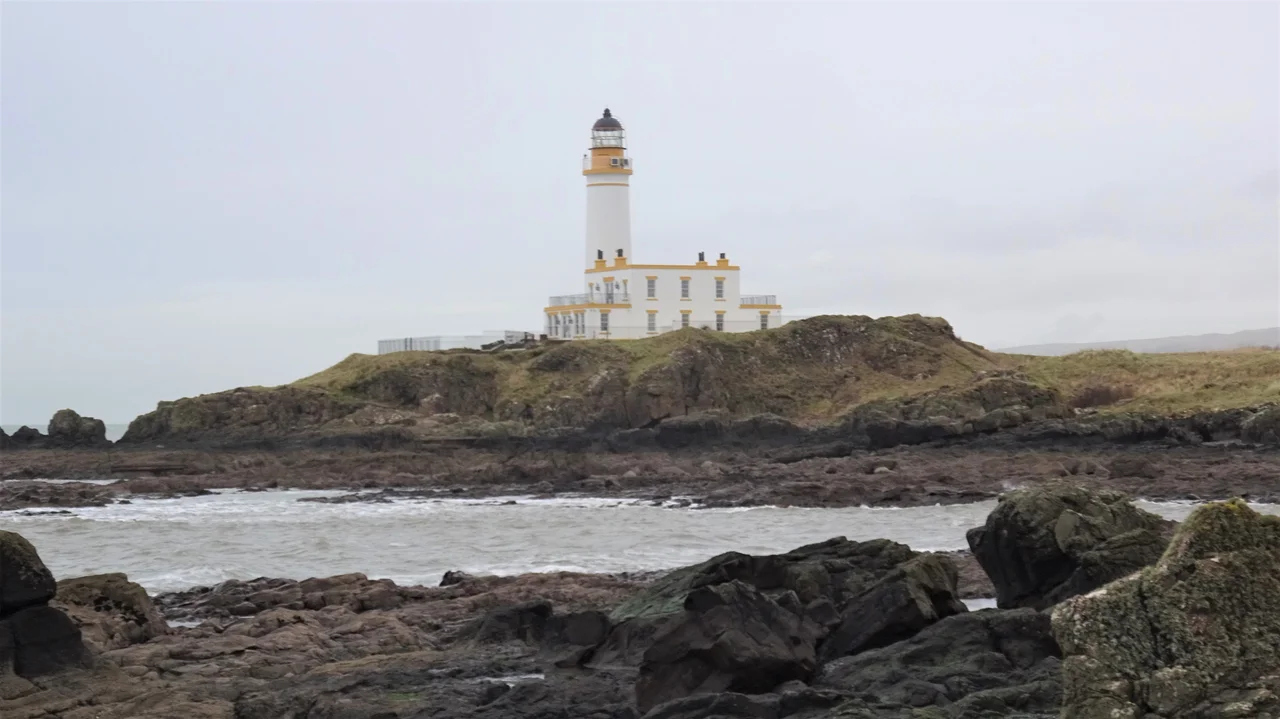

Turnberry Castle
Robert the Bruce ordered Turnberry Castle destroyed in 1310. He had grown up here; this was the seat of his earldom; his mother Marjorie had been Countess of Carrick of this place. None of that mattered against the calculation that the English might take it back. He had it pulled down. What you see today on the cliff above the Firth of Clyde - lower vaults, fragments of wall, vestiges of a drawbridge, an old portcullis - is what survives of a fortress its own king sacrificed.
A Reluctant Marriage
Turnberry was originally a stronghold of the Lords of Galloway, and passed into the hands of the Earls of Carrick around the start of the thirteenth century. By the late 1200s it belonged to Marjorie, the widowed Countess of Carrick. Medieval legend says that Marjorie held the visiting knight Robert de Brus captive until he agreed to marry her - a story we should treat with appropriate scepticism, but which suggests something about how the marriage was viewed at the time. They married in 1271. The marriage conveyed the castle and the earldom of Carrick to Robert. Their first son, also Robert, would grow up to become Robert the Bruce, King of Scots. Whether Turnberry was actually his birthplace is unknown; that he spent his boyhood here is not in doubt.
A Secret Meeting in 1286
Two events tie the castle directly to the Bruce story. On 20 September 1286, several Scottish barons who backed the Bruce family's claim to the crown met secretly at Turnberry Castle. The boy who would become King of Scots was twelve years old at the time, almost certainly under that roof while the meeting happened. The second event came in the spring of 1307, after Bruce had been crowned and then chased into the hills by Edward I's forces. From his hiding places in Galloway and Carrick - the campaign that included the ambush at Glen Trool - Bruce tried to recover Turnberry from the English garrison occupying it. The attempt was only partially successful. But the English eventually withdrew, and the castle was back in Scottish hands.
Pulled Down by Its Own King
Then Bruce had it destroyed. In 1310, having retaken the castle, he ordered it slighted - reduced to a state in which the English could not use it again as a base in Carrick. It was a calculated strategic move, repeated by Bruce at other Scottish castles for the same reason: deny the enemy the strongpoints. The castle was nearly demolished, and what was left was never rebuilt. The road from Turnberry to Bannockburn in 1314 ran straight through this decision. What survives on the headland today are the lower vaults and cellars, traces of a drawbridge, an old portcullis that may have served as a gate. The footprint of the rock suggests the castle was once a fortress of considerable size and strength. Caves under the cliff may have served as a harbour.
The Lighthouse on the Foundation
In 1873, Turnberry Lighthouse was built on part of the castle's site, and it still stands. The juxtaposition is odd and rather beautiful: a Victorian navigational aid grafted onto the foundations of a medieval Scottish fortress, both of them perched on the same cliff above the same sea. The lighthouse marks a coastline that ships have been threading for centuries. The vaults beside it remember a boy who grew up watching that same sea, who came back to retake his birthplace, and who then ordered it pulled down because his judgement told him that no fortress was worth more than the kingdom he was trying to put back together. Today the landward side of the headland is occupied by the Trump Turnberry golf resort. Golfers walking past the ruins are walking past the foundation stones of Scottish independence.
From the Air
Turnberry Castle sits at 55.33 degrees north, 4.84 degrees west, on a coastal headland in South Ayrshire, surrounded on three sides by the Firth of Clyde. Turnberry Lighthouse, built on the castle's foundations in 1873, is the most visible landmark. Ailsa Craig - the 338-metre volcanic dome - rises about 10 miles offshore to the south-west. The Isle of Arran's mountains are visible to the north-west. Glasgow Prestwick (EGPK) lies approximately 15 nautical miles north along the same coast. Ronaldsway (EGNS) on the Isle of Man is about 80 nautical miles to the south.
Nearby Stories
- Troon Lifeboat Station 4.1 km away
- Battle of Drumclog 9.7 km away
- Knockshinnoch Disaster 13 km away
- Lochranza 18 km away
- Threave Castle 18 km away
- Wigtownshire 21 km away
- Dunaverty Castle 24 km away
- SM UB-85 27 km away