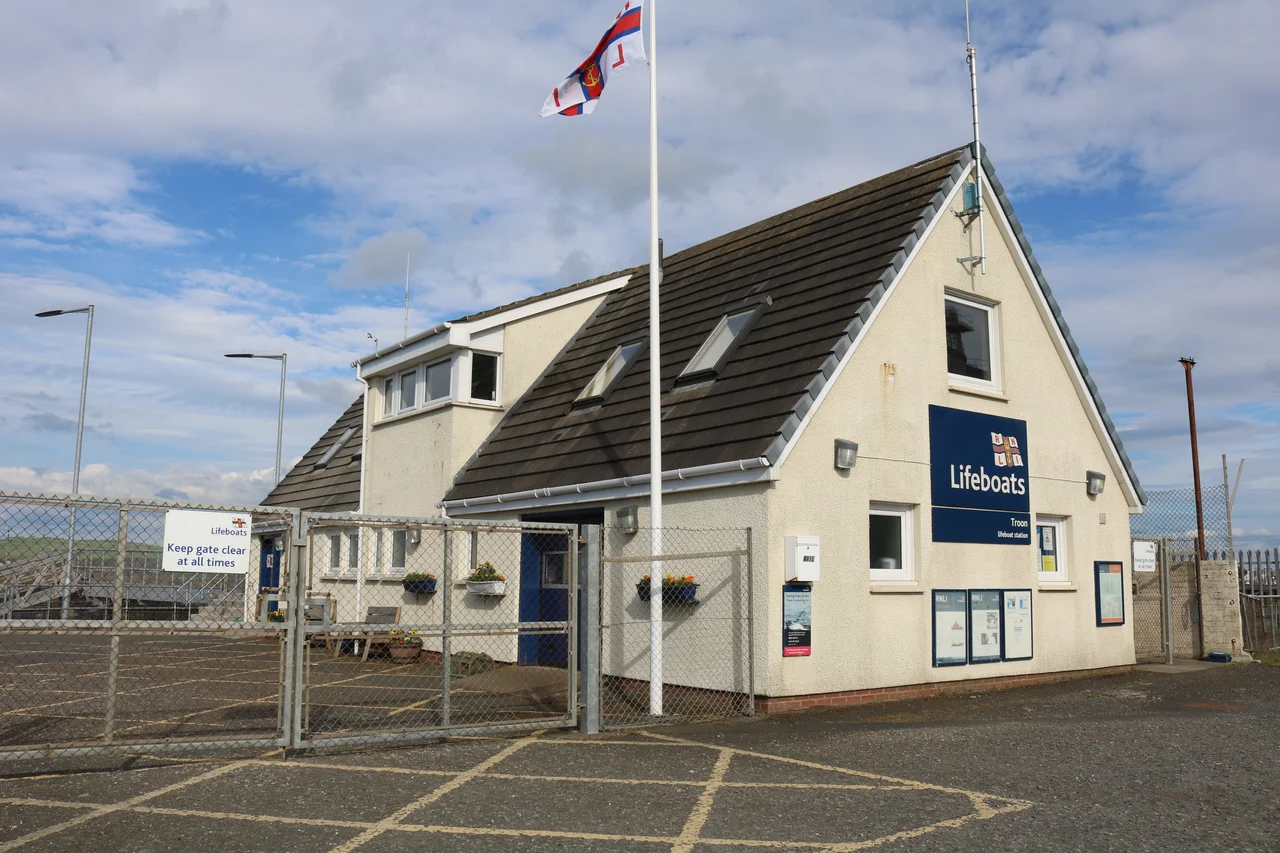

Troon Lifeboat Station
On 6 December 1940, with the war raging and the Belfast steamer Moyallon in serious trouble off the Ayrshire coast, the Troon lifeboat went out into a gale and a driving rain. The crew brought seven people back alive. Coxswain William McAuslane received a silver RNLI medal for it. Albert J Ferguson received bronze. The medals are physical objects, kept where such things are kept, but the meaning lives in the count: seven lives, on a night when most people would have stayed indoors. The Troon Lifeboat Station has been doing this kind of arithmetic since 1871.
How the Station Began
Lifeboat stations had already been established on the Ayrshire coast by 1859. The people of Troon, watching this and thinking about their own town's exposure to Atlantic weather, asked the Royal National Lifeboat Institution to give them one of their own. The RNLI agreed in 1871. £250 paid for a boathouse at the harbour, and the Duke of Portland donated the land. For decades, that small building was enough. The first lifeboats here were Standard Self-Righters and similar pulling-and-sailing craft, hauled out across the slipway when a casualty was reported. In 1905 a larger boat arrived, too big for the old house, and the boathouse was sold to the county council. From that point onward the lifeboat has been kept afloat in the harbour rather than launched from a shed. The present crew accommodation and workshop dates from 1987, extended in 1996, and in January 2004 an Inshore lifeboat was stationed at Troon for the first time, with its own boathouse and a davit to lower it into the water.
The Three Medals
Three RNLI medals have come to Troon crews over the station's history. The first two were for the Moyallon rescue in 1940. The third went to coxswain-mechanic Ian Johnson, who took the lifeboat out on 12 September 1980 to rescue five people from a dredger in danger of breaking its moorings outside the harbour in a Force 10 storm. Force 10 is whole-gale weather: tree-uprooting wind, breaking sea, no margin at all. Beyond the medals, the Thanks of the Institution Inscribed on Vellum has been presented to several Troon crew members. Thomas Devenny earned it for leading a mission to a small fishing boat in a storm on 18 October 1984. David Seaward and Paul Aspin received it for taking the all-weather lifeboat's dinghy out to rescue ten people from the Mountbatten, which had run aground at Ayr on 14 July 1988. Ian Johnson, that day's all-weather lifeboat coxswain, received a Framed Letter of Thanks from the chairman. The Vellum award returned in 2015, to Colin Millar and Gary McGarvie, for a difficult trawler rescue on 14 January.
The Boats That Have Served Here
Each lifeboat carries a name, and most carry a story past their Troon service. The Watson-class motor lifeboat Sir David Richmond was the first motor lifeboat at Troon, in service from 1929 to 1955; when she was sold she became a fishing boat at Aberystwyth under the name Aber Girl. James and Barbara Aitken followed her from 1955 to 1967 and went on to a later life as a pleasure boat overseas. The Waveney-class boat that served from 1968 to 1985 was later sent to Ireland, sold in 1999 for continued lifeboat service in Australia, and is now reportedly a houseboat. Augustine Courtauld came from another station in 1985, served Troon briefly, and was later sold to Australia for further lifeboat work. City of Glasgow III, on station from 1987 to 2004, was sold in 2006 for continued lifeboat service in Iceland. Jim Moffat, a Trent-class boat, served from 2004 to 2025. The current boat is Roy Barker VI, a Shannon-class lifeboat, on station from 2025 onward.
What a Lifeboat Station Actually Is
It is easy to read RNLI history as a sequence of medals and boats, but the substance of a station is something else. It is the crew on call at the back of every Christmas dinner and every routine working morning, men and women whose phones can go off at any hour. It is the long quiet work of maintenance, the training exercises in the firth, the moments when a boat returns to the harbour with everyone aboard and the relief is too large to put into words. The Troon station, on the harbour the Duke of Portland once helped donate land for, has been keeping that vigil for more than a hundred and fifty years. The medals mark the moments where the work became visible. The work is the rest.
From the Air
Located at 55.5481 degrees North, 4.6813 degrees West, at Troon Harbour in South Ayrshire on the Firth of Clyde. Glasgow Prestwick (EGPK) is the nearest active airport, about four miles east-southeast; Glasgow International (EGPF) lies about twenty-eight miles north. From the air, Troon's distinctive curved harbour and the long peninsula sheltering it are easy to identify, with the lifeboat berth tucked into the inner basin.
Nearby Stories
- Battle of Drumclog 2.2 km away
- Culzean Castle 3.3 km away
- Greenock 5.9 km away
- Lochranza 7.9 km away
- Battle of Kilsyth 16 km away
- Loch Fyne 19 km away
- Dunaverty Castle 25 km away
- Moniaive 27 km away