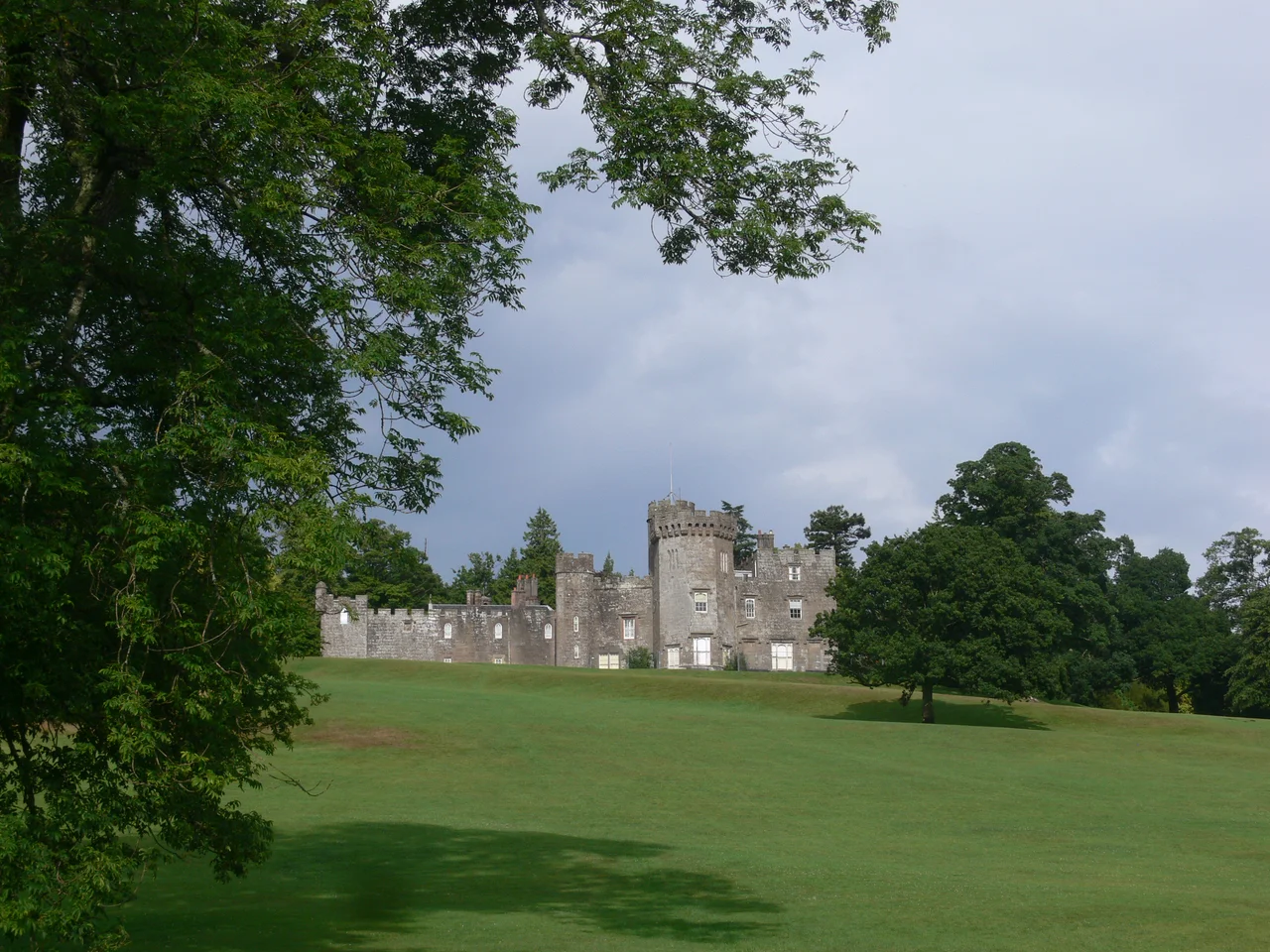

Balloch Castle
The turrets and battlements on Balloch Castle look medieval but never had to defend anything. They are decoration - the architect Robert Lugar's homage to a vanished 13th-century castle that once stood on the same ground. When John Buchanan of Ardoch bought the Balloch estate in 1800 and demolished the old ruins to build his new country house, he commissioned Lugar to design something that would honour what had been lost. The result, completed between 1808 and 1809, is one of the early examples of asymmetrical, picturesque castellated houses in Scotland. It stands at the southern tip of Loch Lomond, framed by the lochside parkland that has become Balloch Country Park.
Granted by Malcolm III
The lands of Balloch were granted to the Lennox family in 1072 by King Malcolm III, the Scottish king best remembered for his role in Shakespeare's Macbeth. The grant made Balloch part of the ancient earldom of Lennox - one of the great medieval territories of central Scotland, sweeping from Loch Lomond down to the Clyde. The Earls of Lennox built the original Balloch Castle around 1238, and they held it for roughly 150 years. By around 1390 they had moved their main base out into the loch itself, to the island of Inchmurrin, where the ruins of a late 14th-century castle still stand. The old Balloch site sat closer to the water than the present house. No standing remains survive, but the earthworks are still visible - an irregular mound about 50 metres across, surrounded by a ditch up to 5 metres wide.
From Lennox to Stewart to Colquhoun
In the 15th century the earldom of Lennox, including Balloch, passed to the Stewarts of Darnley - the same family that produced Lord Darnley, who would marry Mary Queen of Scots and father James VI. The Stewarts kept it until 1652, when the 4th Duke of Lennox sold the estate to John Colquhoun of Luss. The Colquhouns were lords of the western shore of Loch Lomond, with their seat at Rossdhu Castle. Their feud with the MacGregors in 1603 produced the Battle of Glen Fruin just up the valley. Balloch passed through several hands afterward, including the Buchanans of Ardoch.
Lugar's Picturesque Vision
John Buchanan of Ardoch (1761-1839) bought the estate in 1800 and demolished what remained of the medieval castle to make way for a new residence. The architect he chose was Robert Lugar, London-based and already known for the nearby Tullichewan Castle, which he had designed in 1792. Lugar gave Balloch turrets, crenellations, lancet windows, tracery, hoodmoulds, and blind arrow-slits - every feature borrowed from earlier military architecture and stripped of any defensive function. They were aesthetic, not strategic. What was new was the composition. Lugar arranged the elements asymmetrically, in what was then called the 'picturesque' style. At Balloch, he helped introduce that asymmetrical castellated house into Scottish architecture - a contrast with the rigid Palladian symmetry of the previous generation. The new castle may incorporate stone from the earlier ruins, recycling medieval fabric into a Romantic-era fantasy.
Parks and Gardens
The estate's grounds are part of the appeal. There are two main pleasure gardens. The one to the north of the house holds rhododendrons and azaleas that reach full bloom in late May and early June - waist-high in colour. To the south is a walled garden of flowers and shrubs, surrounded by ornamental planting. Between the two, sweeping down to the loch shore, runs an area of grassed parkland with specimen trees. The whole composition is framed by ornamental and semi-natural woodlands. In 1915 Glasgow City Corporation bought the estate. Since 1975 West Dunbartonshire Council has held the lease. In 1980 the estate was designated as a country park. Since 2002 it has formed part of the Loch Lomond and The Trossachs National Park.
A House at Risk
The castle itself has had a quieter life than its grounds. It has been used for visitor facilities and council offices, with past occupants including the Nature Conservancy Council and the Countryside Ranger Service. But the house is now on the Buildings at Risk Register - a Scottish list of important structures whose long-term survival is uncertain without serious intervention. In February 2014 West Dunbartonshire Council announced a programme of repairs. The estate is on the Inventory of Gardens and Designed Landscapes in Scotland; the house is a Category A listed building. From the south lawn you can look across the parkland to the loch - the same view that drew the Earls of Lennox here nearly 800 years before John Buchanan arrived with his architect.
From the Air
Located at 56.013°N, 4.583°W, at the southern tip of Loch Lomond in West Dunbartonshire. The castle stands in extensive parkland that sweeps down to the loch shore, with mature woodland around it. Glasgow Airport (EGPF) is 27 km south; Glasgow Prestwick (EGPK) lies 75 km south. Best viewed at 2,000-4,000 feet AGL approaching the loch from the south, with Ben Lomond visible to the north.
Nearby Stories
- Loch Sloy Hydro-Electric Scheme 1.7 km away
- Lochranza Castle 2.2 km away
- Dalgarven Mill – Museum of Ayrshire Country Life and Costume 5.6 km away
- Loch Fyne 8.9 km away
- Battle of Drumclog 10 km away
- Battle of Kilsyth 12 km away
- Battle of Lagganmore 15 km away
- Comrie 20 km away