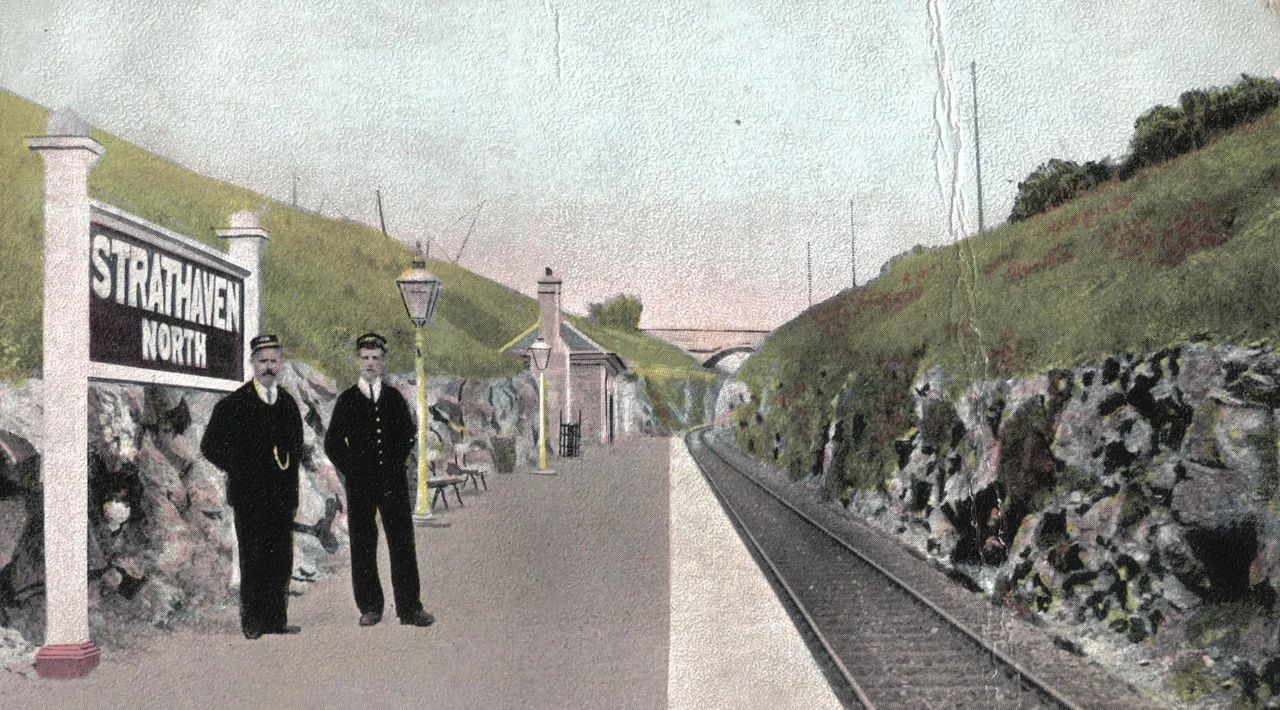

Strathaven
On the evening of 10 May 1941, Rudolf Hess parachuted out of a Messerschmitt over Scotland intending to land at Dungavel House on the outskirts of Strathaven and negotiate peace with the Duke of Hamilton. Bad weather and worse navigation sent him down at Floors Farm in Eaglesham instead. It was not Strathaven's strangest brush with history, only its most cinematic. This is the kind of market town where the Hamilton and Strathaven Railway once ran, where Sir Harry Lauder lived out the war years, where a Radical War martyr was hanged for treason in 1820, and where you can now buy bread from a bakery that has been operating since the same year, by the sixth generation of the same family.
A Charter on the Common Green
Strathaven sits in Avondale, 7.5 km south of Hamilton, with the Powmillon Burn running through its center to join the Avon Water. The Romans passed close by; their road on the south side of the Avon led to the fort at Loudoun Hill near Darvel. The town itself grew up around Strathaven Castle, held by the Baird family until after the Wars of Scottish Independence ended in 1357, then passed to William Douglas, 1st Earl of Douglas, in 1370. In 1450 the settlement was granted a royal charter as a burgh of barony, and the market square, formerly a grassed common, has been known as Common Green ever since. The 'Boo Backit Brig,' a small arched bridge whose name means 'bow-backed bridge' in Scots, still links the town to the castle ruin. Only one tower of the castle survives, a sandstone fragment that watches over modern Strathaven.
James Wilson and the Radical War
In April 1820 a band of Strathaven radicals led by James Wilson set out to march to Glasgow, where they believed a general uprising was about to erupt against the British government. The rising was a phantom, partly the work of government agents provocateurs spreading false rumors. The Glasgow rising did not happen. Wilson was arrested, convicted of treason, and hanged. He was 59 years old, a weaver and political reformer who had spent decades arguing for parliamentary representation for working men. His monument now stands in the town. The Radical War, as it came to be called, lasted barely a week, but it produced a martyr Strathaven has not forgotten. Scotland's industrial communities would not get genuine parliamentary representation for another century.
Lauder Ha' and the Music Hall Knight
Sir Harry Lauder, the most famous Scottish music hall entertainer of his generation, lived at Lauder Ha' in the Lethame neighborhood of Strathaven from 1907 until his death in 1950. He had performed for the troops in both world wars, had been the first British performer to sell a million records, and counted Winston Churchill among his frequent visitors. He spent the years of the Second World War quietly at his estate, just down the road from Dungavel House where Hess had hoped to land. He died in February 1950 at 79. Lauder Ha' still stands at the entrance to the Lethame estate, on the road toward Kilmarnock. A few miles up the same road, Strathaven Airfield was set up in 1964 by The Scottish Flying Club, which had been homeless since RAF Renfrew was nationalised in 1946. The airfield, with three grass runways and the main one oriented east-west at 530 meters, hosts microlights, light aircraft, and an annual music festival called HangarFest.
Balloons, Bread, and a Miniature Railway
Modern Strathaven has, against all odds, become a town of festivals and small wonders. Each August since 1999 it has hosted Scotland's only hot air balloon festival, drawing pilots from across Europe to drift over the Lanarkshire hills. In George Allan Park, an ornate cast-iron bandstand installed in 1902 still stands, and a miniature railway dating to 1949, the oldest of its kind in Scotland, still runs. The park is named for the son of a local Reverend Allan whose son George died in a sporting accident aged 13; the Reverend donated the funds to create the park as a memorial. Alexander Taylor, the bakery that opened in 1820, is Scotland's longest-established bakery and is run by the sixth generation of Taylors. In 2002, jointly with Aberfeldy, Strathaven became Scotland's first Fairtrade Town. Between the town and the village of Sandford, the Spectacle E'e Falls take their name from a local tale in which a spurned suitor placed an eyeglass in the thatched roof of a mill, igniting it with refracted sunlight. The ruins of the mill still lie around the waterfall.
From the Air
Coordinates 55.68N, 4.07W, in South Lanarkshire 7.5 km south of Hamilton. Cruise at 2,500 to 4,500 feet over rolling Lanarkshire farmland. Strathaven Airfield (no ICAO, EGS coordinates 5540'49N 0040654W) lies just outside town with three grass runways, the main 09/27 strip 530 m long; an excellent local visual landmark. Nearest controlled airports are Glasgow (EGPF), 16 nautical miles northwest, and Prestwick (EGPK), 18 nm west. Edinburgh (EGPH) is 35 nm northeast. The Avon Water valley runs east-west through the town center.
Nearby Stories
- Robert Burns and the Eglinton Estate 5.4 km away
- Maybole Castle 7.2 km away
- Winchburgh Rail Crash 8.5 km away
- Battle of Kilsyth 9.7 km away
- Balloch Castle 13 km away
- Oliver Castle 15 km away
- Drumlanrig Castle 18 km away
- Battle of Lochmaben Fair 27 km away