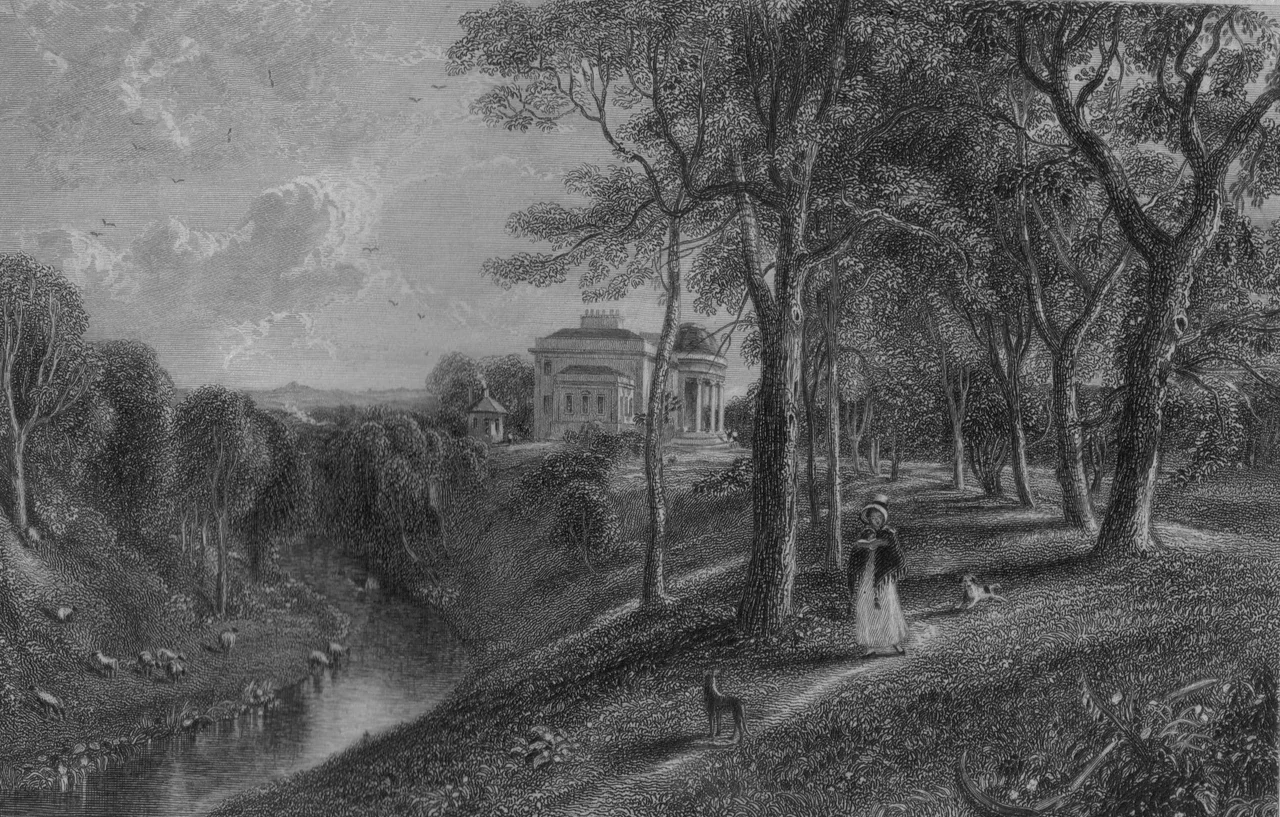

Robert Burns and the Eglinton Estate
In December 1787, the most famous poet Scotland would ever produce sat down to write a letter to a friend. Do you remember a Sunday we spent together in Eglinton Woods, he asked Richard Brown, the sea captain who had once fought for American independence. You told me, on my repeating some verses to you, that you wondered I could resist the temptation of sending verses of such merit to a magazine. Twas actually this, Robert Burns added, that gave me an idea of my own pieces. Without that walk in the beech woods south of Kilwinning, there might have been no Kilmarnock Edition. There might have been no Burns Night. There might have been a different shape to the Scottish imagination altogether.
Nine Months in Irvine
Burns came to Irvine, North Ayrshire, in 1781, at the age of twenty-three, to learn the unromantic craft of flax-dressing. He worked at the heckling shop in the Glasgow Vennel under Alexander Peacock, possibly his mother's half-brother. Dr John Cumming of Milgarholm, provost of Irvine, later claimed he had been the one to bring Burns to town. The poet lodged near the Hamiltons at the entry to the Vennel; their son John Hamilton would later become Dr Hamilton and, alongside the 11th Earl of Eglinton and John Goldie, stand as guarantor for the printing of the 1786 Kilmarnock Edition. Burns was unwell during much of his Irvine stay. The Royal Navy surgeon Charles Fleming treated him, and Fleming's day-book of those treatments still survives in the keeping of the Irvine Burns Club. The poet probably left in March 1782 with very little to show for the experiment, except a friend and an idea.
The Drukken Steps
The friend was Richard Brown, six years older, a sailor whose mind, Burns later wrote, was fraught with courage, independence, magnanimity, and every noble manly virtue. I loved him, I admired him to a degree of enthusiasm; and I strove to imitate him. The two walked, again and again, out of Irvine along the old 1774 toll road to Kilwinning, crossing the Red Burn at the Drukken Steps, a set of stepping-stones whose name described the swaying gait of anyone attempting them. The route led past Higgin's House, a cottage of which only ruins remain. The woodlands at Higgin's House are still carpeted in spring with snowdrops, bluebells, dog's mercury and pignut, indicator plants that betray the ancient, undisturbed character of the place. A commemorative cairn on Bank Street remembers the walks, though it does not stand precisely at the stones themselves. Steps Road in Irvine carries the name forward into the modern street grid.
A Patron, a Pony, and a Few Strong Women
Archibald Montgomerie, the 11th Earl of Eglinton, succeeded to the title in 1769. He had raised the 77th Regiment of Foot in 1757 and was known as General Montgomerie. Encouraged by Mrs Dunlop of Dunlop, who had described Burns to Doctor John Moore as a Miracle of Genius, the Earl sent ten guineas to the poet on his arrival in Edinburgh, ostensibly as subscription for two copies of the Edinburgh Edition. At five shillings a copy that was wildly generous, the gift dressed as an order. The Montgomerie connections multiplied. The 12th Earl, known as Sodger Hugh, had lived at Coilsfield House near Tarbolton, where Burns's Highland Mary, probably Mary Campbell, had worked as a byre woman. She inspired some of the poet's most enduring verses before her early death. Peggy Thompson, a housekeeper at Coilsfield, received billets doux from Burns at church. George Reid of Barquharry lent the poet his pony in November 1786 to carry him to Edinburgh; Reid's wife Agnes Tennant is the Nancy of Burns's Epistle to James Tennant. These were the threads, woven into one estate's network of farms, that the poet pulled on when he decided to publish.
The Statue That Was Thrown in the River
Eglinton Castle is now a ruin, but the Country Park around it remains, and the gardens established by the Clement Wilson Foundation once held a small Belgian bronze statue of Burns. R. Clement Wilson had found it at Deuchars of Perth, an antique dealer's, and had it cleaned of stove enamel by the Glasgow sculptor Lindsay Aitkenhead, who also built a plinth from stone reclaimed from Eglinton Castle itself. The statue stood for years between the old bowling green and the rhododendron maze. Then someone stole it. It was eventually recovered, dumped unceremoniously in the River Garnock, and brought home. In 2009 it was moved to the Visitor's Centre for safekeeping. In 1996, the Pobjoy Mint produced a set of four Isle of Man crowns marking the bicentennial of Burns's death; one of them shows the poet writing in the woods at Eglinton, taken from the murals by Ted and Elizabeth Odling at the Irvine Burns Club. Burns left a marker here that even iconoclasts have not been able to erase, and Auld Lang Syne is still sometimes sung in front of these woods on his birthday.
From the Air
Located at 55.6317 degrees North, 4.65592 degrees West, in the woodlands between Irvine and Kilwinning in North Ayrshire. The Eglinton Country Park surrounds the castle ruin and is bisected by the River Garnock. Glasgow Prestwick (EGPK) is about twelve miles south; Glasgow International (EGPF) lies about twenty miles northeast. From the air the estate appears as a wedge of mature woodland between the urban edges of Irvine and Kilwinning, with the A78 running just to the west.
Nearby Stories
- Battle of Drumclog 2.2 km away
- Culzean Castle 3.3 km away
- Greenock 5.9 km away
- Lochranza 7.9 km away
- Battle of Kilsyth 16 km away
- Loch Fyne 19 km away
- Dunaverty Castle 25 km away
- Moniaive 27 km away