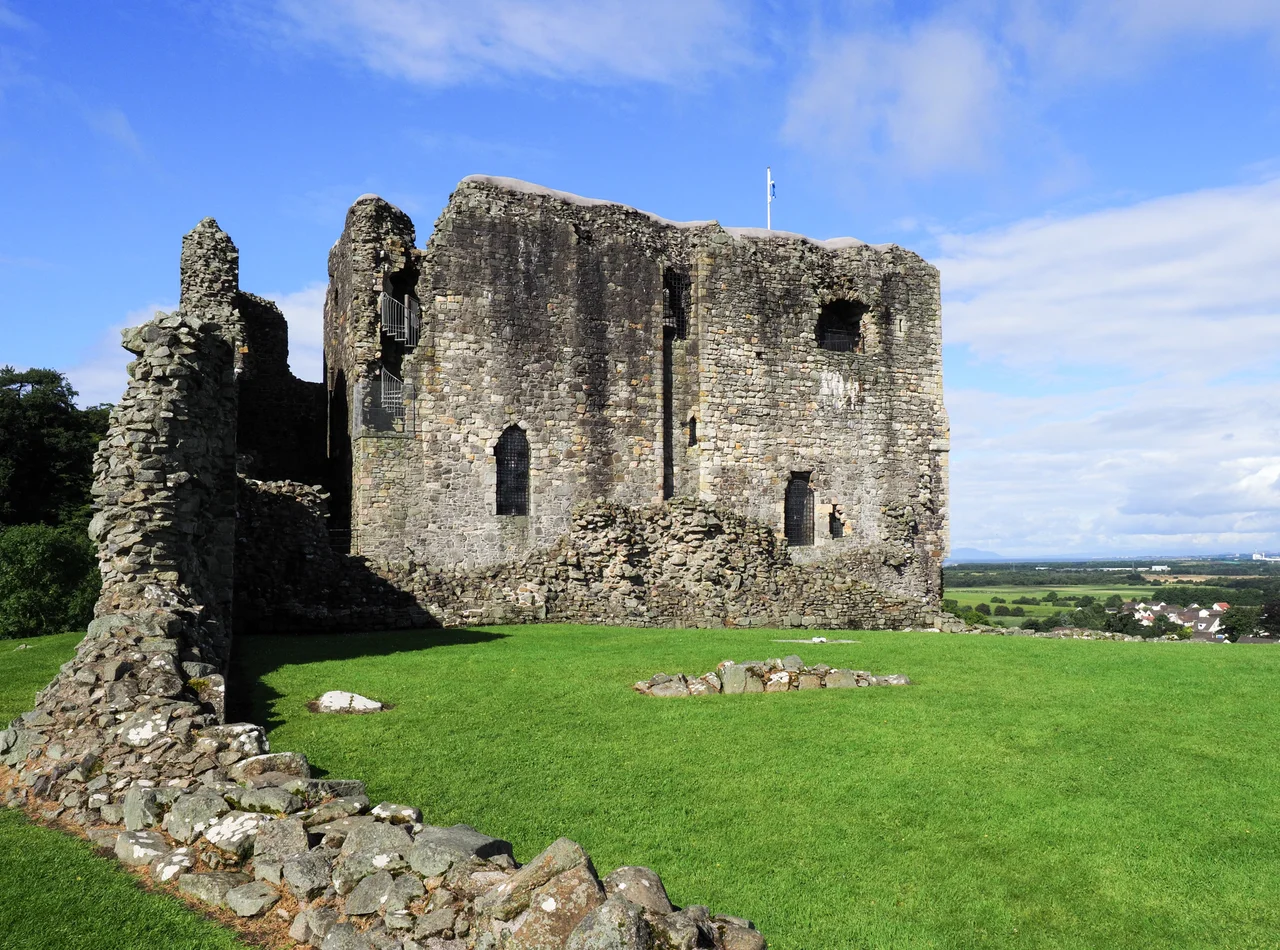

Dundonald Castle
Around 1000 AD, the timber lacing of the hill fort burned with such intensity that the surrounding stonework actually melted. Archaeologists call this *vitrification* - when stone reaches glass-transition temperatures and fuses. It is rare. It marks fires of extraordinary violence. And it seems to mark the end of the Dark Age hill fort on this Ayrshire hilltop, around the same time the British Kingdom of Strathclyde was being absorbed into the new Kingdom of Scotland. Three and a half centuries later, Robert Stewart climbed the same hill, became king of Scotland as Robert II, and built a new tower house here to celebrate the moment. The hill has been a place of power for as long as anyone can remember, and longer than anyone can prove.
The Fort of Donald
The place name means "fort of Donald," but the Donald in question is mysterious. The name is derived from the British *Din Dyfnwal* - the cognate of the Scottish Gaelic *Dòmhnall* and the English Donald. The eponym may have been any of several kings of Alt Clut and Strathclyde named Dyfnwal between the eighth and tenth centuries. Archaeology has found evidence of much older occupation than the vitrified fort. Recent excavations under the present castle's barmkin - the outer courtyard wall - turned up charcoal layers possibly Neolithic, Bronze Age pottery fragments, emmer wheat grains, and the remains of an Iron Age hillfort with several large wooden roundhouses. Shale or lignite bracelets and glass beads suggest the site continued in use into the fourth and fifth centuries AD. Successive cultures built and rebuilt on the same defensible ridge. The hillside has been busy for at least 3,000 years.
Three Castles, One Hilltop
Three medieval castles have stood here. The first was probably built by Walter, the first High Steward of Scotland, who came north in 1136 - nothing of it survives above ground. The second was built in the late 13th century by Alexander Stewart, 4th High Steward, and was reportedly one of the grandest baronial residences of its time. Robert the Bruce destroyed it during the Wars of Scottish Independence as part of his policy of slighting castles so they could not be held against him - the same policy he used against Edinburgh Castle and Roxburgh Castle. Only a well and a rounded tower stump remain from this second castle. The third castle - the one that dominates the hill today - was built by Robert Stewart around 1371 to mark his accession as Robert II. Three storeys high, with a great hall on the upper floor for the king's private use, a laigh hall below for feasting and baron courts, and a ground-floor storage area subdivided into cellars for wine, ale, foodstuffs, and fuel. The tower house was extended later in the 14th century to add private chambers and a prison. Robert II and his son Robert III both used it as a royal residence.
Wallaces, Cochranes, and a Long Decline
By 1520 the castle belonged to the Wallaces of Craigie. James V granted it to Robert Boyd in 1536, but Boyd never managed to take possession, and after a failed second attempt at eviction he gave up and let the Wallaces keep it. Debt forced the Wallaces to sell in 1632 - by then they had moved their main residence to Auchens House, partly built from stones removed from Dundonald. The buyer, James Mathieson, soon sold to Sir William Cochrane in 1638. In 1669 Cochrane was created 1st Earl of Dundonald in recognition of his Royalist support during the Wars of the Three Kingdoms. The Cochranes sold the estate in 1726 but kept the ruined castle, and in 1953 the 13th Earl handed it over to the state. A programme of reconstruction began. Today the castle is owned by Historic Scotland and the visitor centre by South Ayrshire Council, both operated by the Friends of Dundonald Castle. The interpretation exhibition includes detailed models of the earlier castles on the site - the only way most visitors can begin to picture what stood here before.
Donald Din and the London Bridge Dream
There is an old Ayrshire rhyme: *Donald Din / Built his house without a pin.* It refers to Dundonald, supposedly built entirely of stone without wooden pins, by a hero named Donald Din. The folktale goes that Donald was a poor man who dreamed three times in one night that if he went to London Bridge he would become wealthy. So he went. On the bridge he fell into conversation with a stranger and told him about the dream. The stranger laughed and said he had once had a similar dream, telling him to dig in a certain spot in Ayrshire, in a cabbage patch belonging to a poor Scotsman - but he had never bothered to obey. Donald recognised the description immediately. He went home, tore up his own kail-yard to the disgust of his wife who thought him mad, and found a pot of gold - which he used to build the castle. The same story appears in Rumi's 13th-century *Mathnawi*, in *The Thousand and One Nights*, and more recently in Paulo Coelho's novel *The Alchemist*. Jules Verne even used Dundonald in *The Underground City*, imagining it as a beacon for wreckers and as the entrance to a tunnel running to Loch Katrine. The castle has a way of drawing stories to itself - which is, perhaps, what royal residences are for.
From the Air
Coordinates 55.5767°N, 4.5973°W. Dundonald Castle sits on a prominent hill above the village of Dundonald in South Ayrshire, between Kilmarnock to the east and Troon to the west. The tower house is highly visible from the air and serves as a useful landmark. Recommended viewing altitude 1,500 to 3,000 feet AGL to take in the castle, the surrounding farmland, and the line of the Firth of Clyde to the west. Nearest ICAO airports: Glasgow Prestwick (EGPK) about 4 nm south-west - so circle with attention to Prestwick's traffic pattern - and Glasgow International (EGPF) about 22 nm north-east. Expect typical Ayrshire weather - low cloud and rain showers can sweep in from the Atlantic.
Nearby Stories
- Battle of Drumclog 2.2 km away
- Culzean Castle 3.3 km away
- Greenock 5.9 km away
- Lochranza 7.9 km away
- Battle of Kilsyth 16 km away
- Loch Fyne 19 km away
- Dunaverty Castle 25 km away
- Moniaive 27 km away