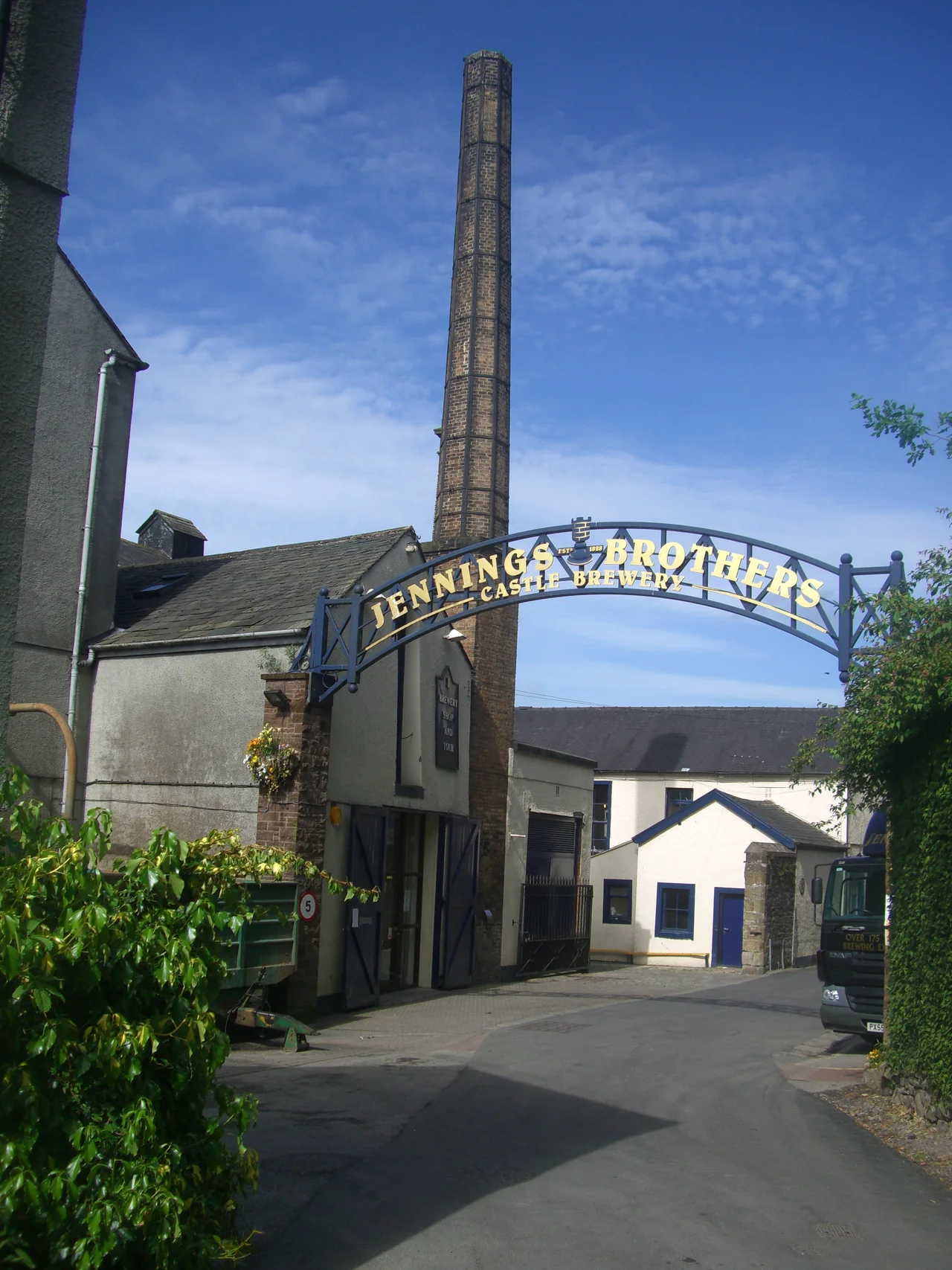

Jennings Brewery
John Jennings Snr was a maltster's son, and in 1828 he turned the family trade into a brewery in the village of Lorton, between Buttermere and Cockermouth. The arithmetic was favourable: a Lake District valley meant good water; west Cumbrian agriculture supplied the malt; and a thirsty mill-town economy down at the coast supplied the customers. Forty-six years later, in 1874, Jennings moved to its most famous home - the Castle Brewery in Cockermouth, directly beneath the leaning tower of the Norman castle, on the banks of the River Cocker. The brewery brewed there continuously, with one notable interruption, for the next 148 years.
What Went Into the Tank
Jennings's identity was tied to its ingredients in a way that grew increasingly unusual as British brewing industrialised. Water came from the brewery's own well, drawing from the Lakeland aquifer beneath the site. Malt was Maris Otter barley from Norfolk - a heritage variety prized by traditional brewers for its flavour and now grown in modest quantities. The hops were Goldings, Fuggles, and Challenger from Kent, Herefordshire, and Worcestershire. Two technical choices set Jennings apart: malt was screened and crushed rather than ground into flour, keeping the barley husks as intact as possible; and the hops were flaked, not pelletised, even as pellets became the industry standard. Each decision cost a little efficiency and bought a little character.
Cumberland Ale and Cocker Hoop
The flagship was Cumberland Ale at 4.0% abv, the brewery's biggest seller in the late 20th century. Jennings Bitter (3.5%) was the original and dominated in west Cumbria. The seasonal range read like a small dialect dictionary. Sneck Lifter at 5.1% - launched as a winter ale in 1990 and made all-year in 1995 - took its name from the northern word for a door latch; a 'sneck lifter' was a man's last sixpence, just enough to lift the pub latch and buy a pint, on the hopeful chance that new friends would stand him further rounds. Yan T'yan Tethera, at 3.8%, came from the Cumbrian dialect for 'one, two, three' - the old shepherd's counting system. Cocker Hoop at 4.6%, launched as September Ale in 1995, was renamed to remember the brewery's location on the banks of the Cocker. Golden Host took its name from a line in Wordsworth's I Wandered Lonely as a Cloud - Wordsworth, of course, having been born in Cockermouth. Tom Fool referred to Thomas Skelton of Muncaster Castle, whose pranks gave English the word 'tomfoolery'.
Sold, Merged, Closed
In May 2005, Jennings was purchased by Wolverhampton & Dudley Breweries, which renamed itself Marston's PLC in 2007. The Campaign for Real Ale opposed the sale on the grounds that consolidation would eventually close the Cockermouth site. Marston's initially invested £250,000 in expanded fermenting and cask-racking capacity - completed by 2008 - and the immediate fears looked unfounded. But the distribution centre in Workington was shut and the 127 tied pubs absorbed into the Marston's estate. In May 2020, Marston's merged its brewing business with Carlsberg UK in a £780 million joint venture. In September 2022, Carlsberg Marston's announced that the Cockermouth brewery would close in early October. The Cumberland Cask ale and bottled brands moved to Marston's main brewery in Burton upon Trent, Staffordshire. After 194 years, the Castle Brewery stopped brewing.
Coda: An Auction and a Revival
The site went on the market the following month at an asking price of £750,000. In March 2024, it failed to reach its reserve at auction. The estate agents said they would keep trying. Then, in February 2025, an announcement: Kurt and Rebecca Canfield, new owners, had bought the Cockermouth brewery and the rights to the Jennings brand for an undisclosed sum, with plans to reopen. The brewery held its official opening party on 3 July 2025, brewing again beneath the castle's tilting tower for the first time in nearly three years. By the end of its first fortnight it had already run short of stock. The well that fed nearly two centuries of beer still draws on the same aquifer, and the names - Sneck Lifter, Cocker Hoop, Yan T'yan Tethera - are once again attached to a place where someone is brewing them again.
From the Air
Coordinates 54.6649 N, 3.3632 W. Jennings Brewery sits beside the River Cocker in the centre of Cockermouth, immediately below the partly ruined Cockermouth Castle and its distinctive leaning tower. The brewery's tall industrial buildings are visible from the north as you approach Cockermouth along the A66 corridor. Recommended altitude 2,500-4,000 ft AGL. The site is in a flood-prone river junction; check NOTAMs after heavy precipitation. Nearest airport is Carlisle Lake District (EGNC) about 25 miles north-east; Blackpool (EGNH) lies further south. The Lake District fells immediately south generate frequent orographic cloud.
Nearby Stories
- Lowther Castle 5.5 km away
- Black Combe 6.6 km away
- Levens Hall 6.8 km away
- Threave Castle 13 km away
- Ruthwell Cross 18 km away
- Raeberry Castle 24 km away
- RAF Spadeadam 24 km away
- Cashtal yn Ard 33 km away