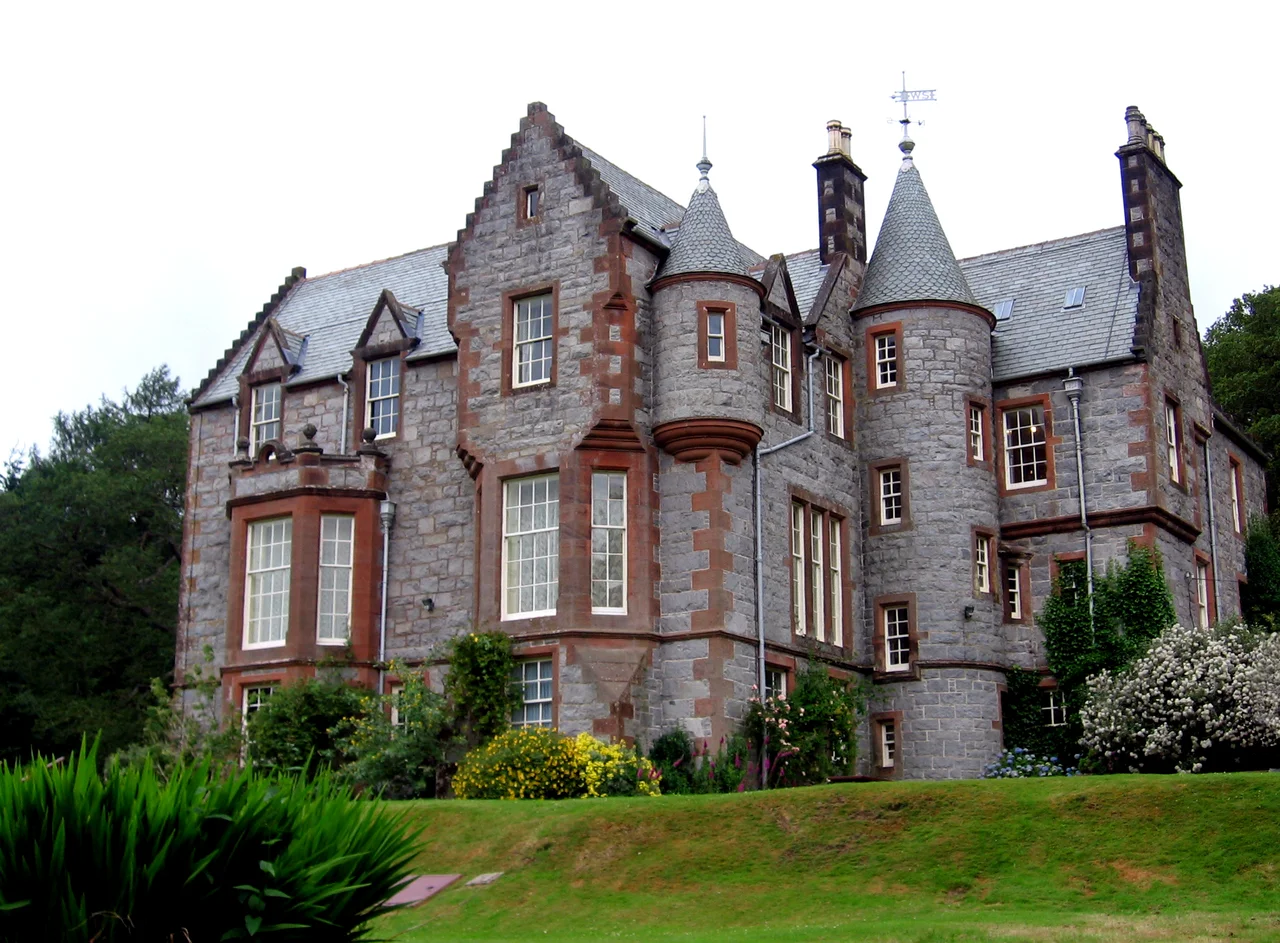

National Museum of Costume
The library set is dated to 31 December 1952. Father, mother, and daughter are dressed for the Dumfries Chamber of Commerce Hogmanay Ball at the Assembly Rooms. The daughter's gown is black machine-made cotton lace over taffeta, decorated with sequins and beaded festoons and pink nylon 'horsehair' rosettes with pearlised edges, sewn by the Cruikshank Salon on Princes Street in Edinburgh. Across the hall, the drawing room is set in May 1945, with a family gathered around the wireless to hear the war news, the hostess in a printed rayon dress bearing the wartime Utility label. Every room in Shambellie House is a year preserved.
A House Built for One Family
Shambellie House sits at the south edge of New Abbey, with views toward the ruins of Sweetheart Abbey and the bulk of Criffel rising 1,870 feet above the Solway plain. It was designed by the Scottish architect David Bryce in 1856 for the Stewart family - a Victorian country house in red sandstone, baronial in feel, modest in scale. Generations of Stewarts lived in it until the mid-20th century. Charles William Stewart's father had inherited the house before the Second World War. Charles himself built up a remarkable private collection of historic costume across the 1940s, 50s, 60s and into the 1970s, focused on the clothes of well-off British women between 1850 and 1950. In 1976 he gave the entire collection to the Royal Scottish Museum and handed Shambellie itself over to the Department of the Environment, on the condition that the house be opened to display the clothes in their natural setting.
Rooms as Scenes
The museum opened in 1982 and took a deliberately theatrical approach. Each room was furnished with appropriate period pieces and staged as a single moment in time. The dining room set a summer evening party in 1895, with the butler arranging glasses on a sideboard built by Alexander Burgess around 1890. The library was that Hogmanay 1952 scene. The playroom showed an August 1913 nanny caring for an infant, with the mother in a maroon wool day dress trimmed with maroon velvet, and a little boy in a white summer sailor suit - a style traceable to the 1846 Winterhalter portrait of Prince Edward in his miniature naval kit, which set children's fashion across two continents for the next sixty years. The bedroom captured an evening in September 1945, with a grandmother and granddaughter dressing for a local ball to celebrate the end of the war in the Far East.
Make Do and Mend
What gave the museum its emotional weight was how clearly it showed the ordinary economics of getting dressed. The granddaughter's red velvet evening dress in the bedroom set was made in 1943 - cut from an adult's clothing because wartime rationing left no new fabric to spare. The 'Make Do and Mend' slogan was government-issued, but the practice was older than any slogan. New long dresses were unavailable in Britain during the war; the rich began the conflict with bigger wardrobes and could keep up appearances longer, but everyone had the same coupons. The Utility Scheme, introduced in June 1941, controlled what fabric went where. Garments down to handkerchiefs carried the CC41 double-crescent label that meant they conformed. The scheme continued until 1949.
A Century in Cloth
Shambellie's permanent gallery traced the changes in silhouette across a hundred years: the whalebone crinolines that peaked around 1860, layered under flounced petticoats of brocade and taffeta; the bustles that came into fashion in the 1870s; the princess line of the 1880s, with no waist seam between bodice and skirt; the hobble skirts of the early 20th century, so close-fitting they seemed to shackle the knee. World War I cut shorter and wider, the bosom returned, the waist disappeared. The 1920s ideal was deliberately boyish - flattened, hidden - a generation grieving so many young men dead in the war that youthfulness itself became fetishised. The Great Depression brought the waist back up and the skirt back down. The 1942 Utility designs were drawn by a committee with controlled prices, then everyone tried to find ways to make their issued clothes look different from everyone else's.
Closure
In January 2013, National Museums Scotland announced that the costume museum would close. The decision was framed as a consequence of the economic recession - declining visitor numbers and the long aftermath of the 2008 crash made keeping a small rural site viable difficult. The house has not reopened as a museum since. Charles Stewart's collection moved into the broader National Museums Scotland holdings, where pieces still appear in exhibitions in Edinburgh. The rooms at Shambellie, however - the dining room set in 1895, the library at Hogmanay 1952, the bedroom in autumn 1945 - exist now only in photographs and the memories of the visitors who walked through them. The view from the upstairs windows, toward Sweetheart Abbey and Criffel, is unchanged.
From the Air
The site of the former National Museum of Costume at Shambellie House sits at 54.98 N, 3.63 W on the western edge of New Abbey, a mile west of Sweetheart Abbey. The nearest airport is Dumfries (former RAF Dumfries) about 8 nm north-northeast; Carlisle (EGNC) is 30 nm southeast. From 2,000 to 4,000 feet AGL the village reads clearly in the valley below Criffel, the 1,870-foot hill that dominates everything south of Dumfries. The Solway Firth opens to the south. Sweetheart Abbey's roofless red sandstone walls and bell tower are an unmistakable visual landmark within New Abbey itself.
Nearby Stories
- Keswick 7.7 km away
- Workington Lifeboat Station 8.2 km away
- Morton Castle 9.5 km away
- Quintinshill Rail Disaster 9.8 km away
- Garlieston 19 km away
- Cumnock 29 km away
- Point of Ayre Lighthouse 30 km away
- Kielder Observatory 35 km away