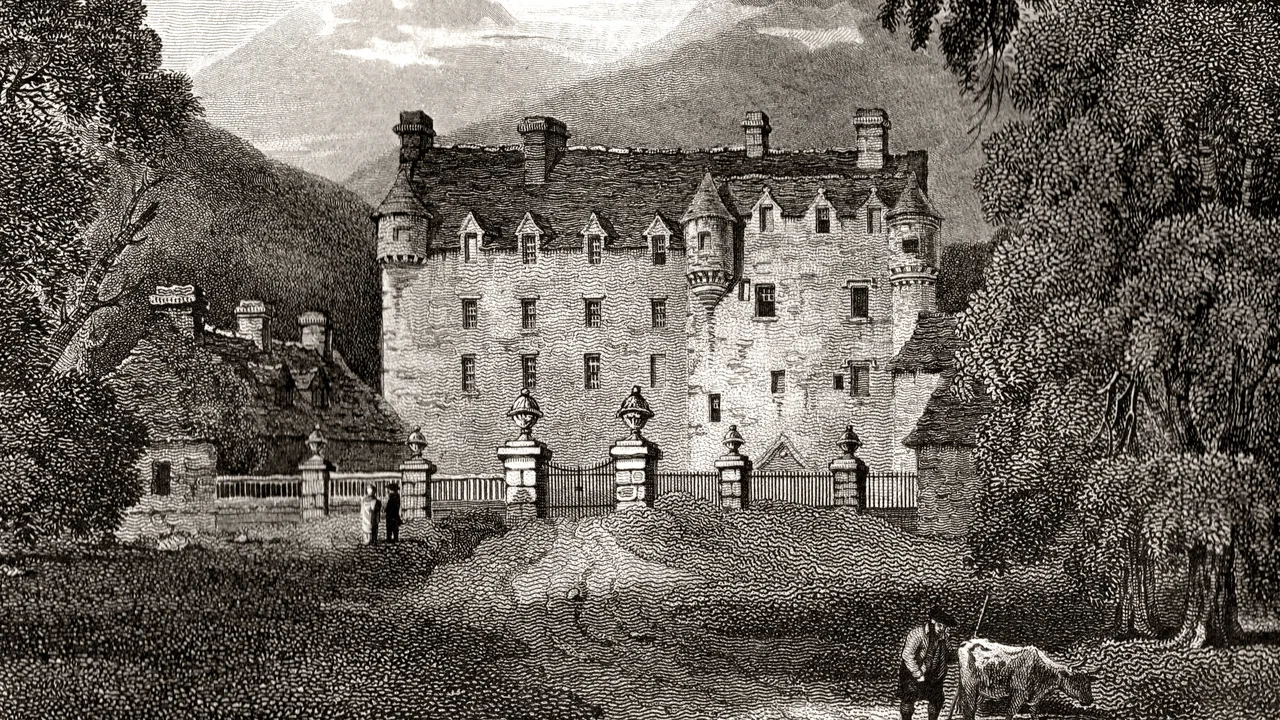

Traquair House
The Bear Gates have not been opened since 1745. They stand at the main entrance to the Traquair grounds - two stone pillars topped with carved bears - and the fifth Earl of Traquair, Charles Stuart, installed them in 1738. Seven years later, Bonnie Prince Charlie passed through them on his march south during the Jacobite rising. When he was gone, the Earl closed the gates and made a vow: they would not open again until a Stuart king sat on the throne of Britain. No Stuart king has sat on that throne since. The gates have stayed shut for 281 years. They are still shut today. The promise made in 1745 is still being kept.
The Oldest House
Traquair claims to be the oldest continuously inhabited house in Scotland - inhabited not just standing, inhabited as in someone has lived here, unbroken, since the 12th century. The current building was built on the site of a royal hunting seat, and Alexander I (king from 1107 to 1124) is recorded as having stayed and hunted here. No part of the present structure can be dated with certainty before the 15th century, but the foundations go back to the 1100s. After Alexander III died in 1286, the peace of the Borders shattered and Traquair became a key defensive link in the chain guarding the Tweed valley against English raids. Over the next two centuries the estate changed hands repeatedly - sometimes English, sometimes Scottish, briefly given by James III in the 1460s to a court musician named Dr William Rogers, who sold it in 1478. By 1491 it had passed to James Stuart, the illegitimate son of the Earl of Buchan, who became 1st Laird of Traquair. He was killed at the Battle of Flodden in 1513. The estate has belonged to his descendants ever since.
Mary's Room
Mary, Queen of Scots visited Traquair in August 1566. She slept in what is now called the King's Room, and some of her possessions are still there: her rosary, her crucifix, her purse, a silk quilt, and letters bearing her signature. James VI followed his mother's path here on 9 March 1602 - one of his last visits to a Borders house before he inherited the English throne the following year and left for London. The Museum Room next door contains a mural dating from 1530, one of the oldest surviving secular wall paintings in Scotland, alongside charters stamped with the seals and signatures of Scottish kings going back centuries. The library, added in the 18th century, holds more than 3,000 volumes. Outside the chapel, built in 1829 after Catholic emancipation, the family chapel still serves the Catholic faith that the Stuarts of Traquair held to through the centuries when Catholicism in Scotland was illegal.
The Brewery Under the Chapel
Ale has been brewed at Traquair since at least the reign of Mary, Queen of Scots. In 1739 a 200-gallon copper was installed in the brew house under the chapel - the same equipment that, two centuries later, would form the basis of the Traquair House Brewery revival. In 1965 Peter Maxwell Stuart, the 20th Laird, restarted the brewery using the original 18th-century domestic equipment that had previously made beer for the household. Ale is still fermented in the original oak tuns, some of which are now more than 200 years old. The two main brands are Jacobite Ale and House Ale, both heavy, dark, traditional Scottish ales of a kind that almost no other brewery still makes. The brewery is one of the smallest commercial breweries in the United Kingdom. Its product reaches connoisseurs across the world.
Tam-Lin and the Maze
In 1970, the horror film Tam-Lin was filmed at Traquair. Ava Gardner played the lead. The supporting cast included a very young Joanna Lumley, Stephanie Beacham, and Ian McShane. The film, loosely based on the Border ballad of the same name, is a strange artefact of late-1960s cinema - all velvet costumes, country house menace, and folk-horror unease. The maze in the grounds was designed by John Schofield and originally planted with Leyland cypress; the severe winter of 1983 killed over two-thirds of the trees, and it was replanted with hardier beech. The replanted maze has grown into shape over the four decades since. Visitors still lose their bearings inside it, which is the point of any maze worth the name.
The Stuart Line, Still Living Here
In 1875, Traquair passed by inheritance to Henry Constable Maxwell - a cousin of the Stuarts, descended through the female line. The family has held it ever since. Catherine Maxwell Stuart, born in 1964, became the 21st Lady of Traquair on her father's death; her 1992 portrait hangs in the National Portrait Gallery in London. She still lives at Traquair with her family, running the house, the brewery, and the visitor business that keeps the estate going. Nine hundred years after Alexander I came here to hunt deer in the surrounding forest, the lights still go on in the windows, the ale still ferments in the oak tuns, the maze still confuses the visitors, and the Bear Gates still stay shut, waiting for a Stuart king who is not coming back.
From the Air
Located at 55.6083 N, 3.064 W, about 1 mile south of Innerleithen and 7 miles southeast of Peebles in the Scottish Borders. Visible reference points: the house sits in parkland on the south bank of the River Tweed, with Innerleithen and Lee Pen across the river to the north. The Bear Gates and long avenue are visible from the air leading down to the road. Nearest airport: Edinburgh (EGPH), about 25 nautical miles north. Recommended viewing altitude 2,000-3,500 ft AGL for clear views of the house, grounds, maze, and the surrounding Tweed valley.
Nearby Stories
- Floors Castle 3.3 km away
- Dalkeith Palace 5 km away
- Cockburnspath 7.4 km away
- Otterburn Training Area 9.8 km away
- Linlithgow Palace 10 km away
- New Lanark 17 km away
- Morton Castle 18 km away
- Battle of Arkinholm 25 km away