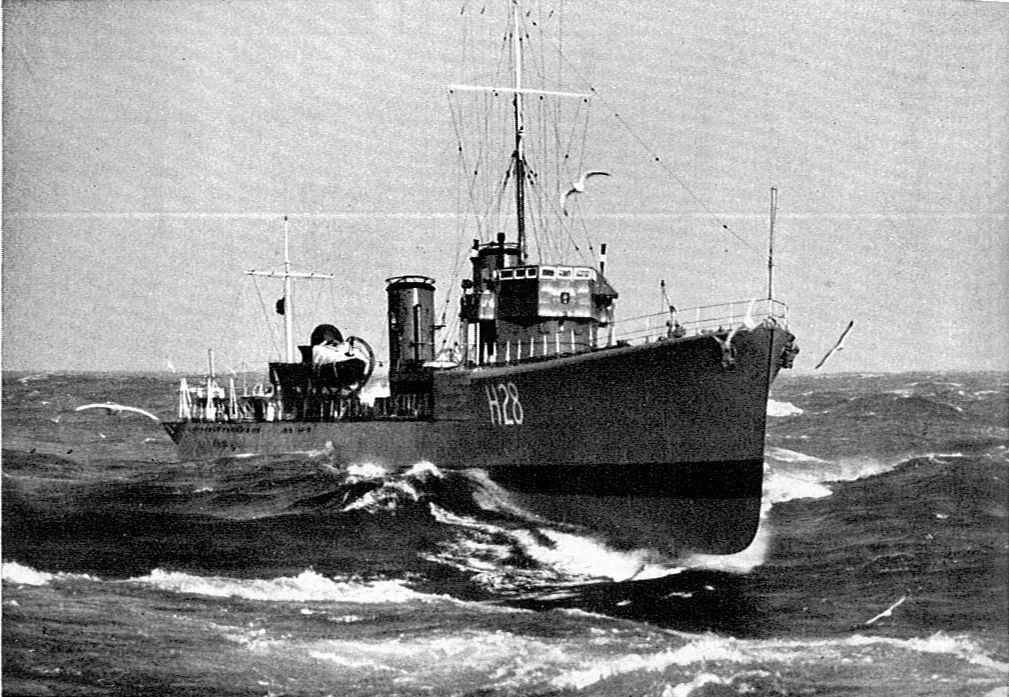
.jpg)
HMS Sturdy (1919)
By dawn on 30 October 1940, Lieutenant-Commander George Cooper had been guessing for two days. The weather had blown his destroyer apart from her sister ship, the convoy he was supposed to meet was somewhere out in the Atlantic dark, and Derry seemed a more sensible bet than another night of guessing. When the bow struck rock off the west coast of Tiree, the guess ran out. Sturdy stranded, the waves rolled in, and within hours the destroyer that had survived twenty-one years in the Royal Navy lay broken in half on a Hebridean shore.
An Admiralty Destroyer, Slightly Cheaper
The Admiralty had ordered her in June 1917, one of thirty-three S-class destroyers in the Twelfth War Construction Programme. The design was a deliberate compromise, derived from the earlier R class but trimmed for cost and speed. Scotts of Greenock laid her keel in April 1918 with yard number 495, and she slid into the Clyde on 26 June 1919, the war that birthed her already over. At 276 feet overall, with three Yarrow boilers driving Brown-Curtis turbines to a design speed of 36 knots, she carried three four-inch guns on the centreline, a pom-pom for aircraft, and four 21-inch torpedo tubes aft. The original plan included fixed torpedo tubes flanking the superstructure, but those required cutting away the forecastle plating, which made the ship miserably wet. The tubes came out. The crew was ninety officers and ratings.
Twenty Years of Almost Nothing
Commissioned in October 1919, Sturdy joined the Reserve Fleet at Portsmouth and stayed there. February 1920 brought a brief deployment to the Free City of Danzig, escorting High Commissioner Reginald Tower through the city's plebiscite, but the assignment lasted weeks. The next decade was a long Portsmouth idle. In 1931 she got eight months in Cobh and Berehaven on the Irish station before returning to reserve. Then, in 1934, the Royal Navy stripped her armament, bolted a davit to the forecastle, and turned her into a plane guard for the aircraft carrier Courageous, her job to fish ditched pilots out of the sea. She hosted the Lord Mayor of London in May 1935, steamed past George V and Queen Mary at the July fleet review, and sailed for Las Palmas and Tenerife in early 1936. By December her guns were back. She returned to reserve once more, waiting for the war she had been built too late to fight.
Convoy HX 79 and the Wolfpack
When that war came, Sturdy was configured as a minelayer, capable of carrying forty mines instead of her aft guns and torpedoes. She never laid one. The Battle of the Atlantic needed escorts, not minelayers, and Lt-Cdr Cooper took her into convoy duty. On 19 October 1940, she was screening Convoy HX 79 when a U-boat wolfpack found it. Twelve ships went down in a six-hour torpedo attack, one of the worst convoy maulings of the war. A week later she sailed from the Clyde with sister ship Tenedos to meet inbound convoy SC 8 from the United States. The weather thickened, the ships lost contact, and on 29 October Cooper decided alone. Derry, not the rendezvous. Early next morning the bow struck rock at roughly 56 degrees 29 minutes north, 6 degrees 59 minutes west, on Tiree's exposed western coast. Five sailors died in the evacuation. The rest reached shore. The Atlantic finished what the grounding started, snapping the hull in two, the stern swinging clear and the wreck left to the sea.
From the Air
Wreck site approximately 56.48 N, 6.99 W, on the rocky western coast of Tiree at the southern edge of the island's Atlantic-facing shore. Recommended viewing altitude 1,500-3,000 ft to trace the coastline. Tiree Airport (EGPU) is the nearest field, on Crossapol at the south of the island. Visual landmarks: Skerryvore lighthouse 12 mi southwest, Ben Hynish (141 m) on Tiree's south coast, and the long sandy bays of Balephuil and Hynish. The wreck itself dispersed long ago, but the same Atlantic swell that broke Sturdy still defines the coast. Weather here is notoriously raw and the cloud base often low.
Nearby Stories
- Muck 7.9 km away
- Calgary (Scotland) 7.9 km away
- Pabbay 15 km away
- Dubh Artach 19 km away
- Colonsay 22 km away
- Barra Head 34 km away
- Bullough Mausoleum 36 km away
- SS Athelstane (1941) 69 km away