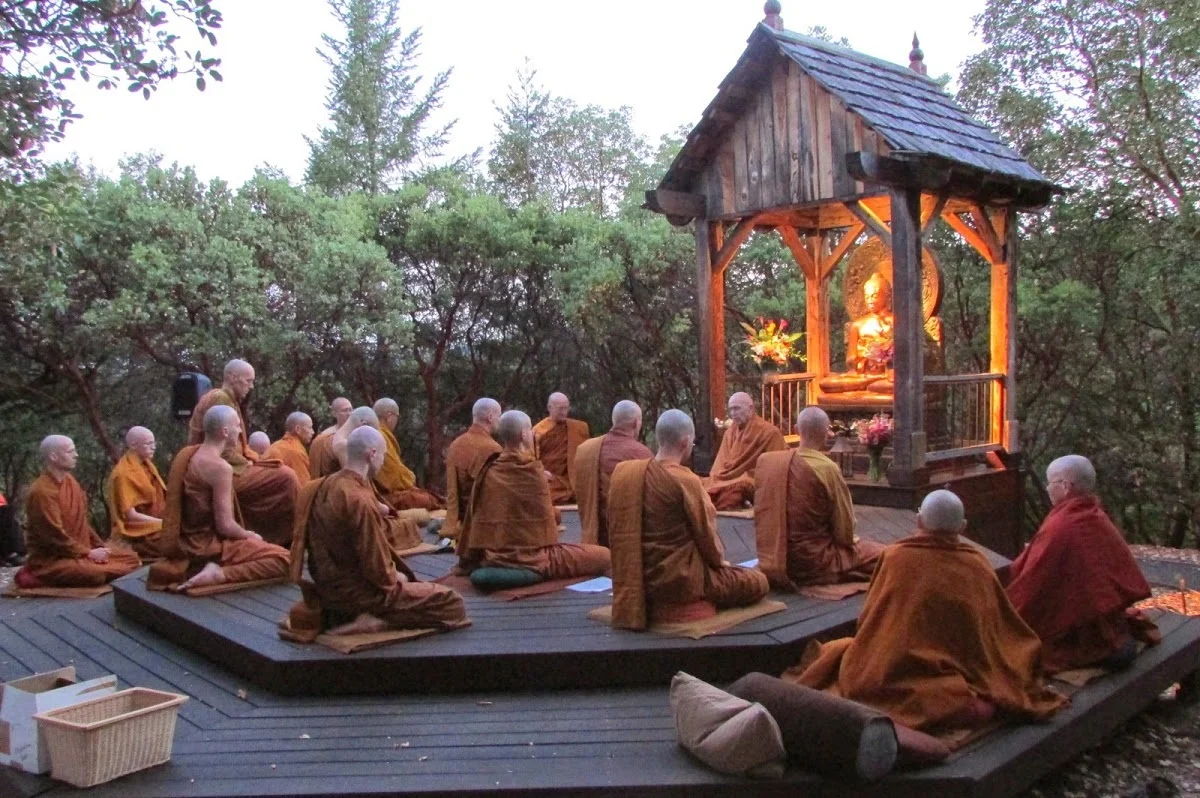

The Fearless Mountain
The name means "fearless mountain" in Pali, and the first thing you notice is the silence. Abhayagiri Buddhist Monastery sits on 280 acres of forested hillside about sixteen miles north of Ukiah, California, where the oaks give way to Douglas fir and the cell signal drops to nothing. This is not a retreat center or a meditation spa. It is a working monastery in the Thai Forest Tradition, where roughly twenty monastics live under a set of rules that have remained essentially unchanged since the time of the Buddha. They own almost nothing. They eat one meal a day, finished before noon. They sleep in small wooden huts scattered through the trees. And they have been doing this in Mendocino County since the mid-1990s, when a remarkable act of interfaith generosity gave them the land to begin.
A Gift Between Traditions
Abhayagiri's origin story is one of the more unlikely episodes in American religious history. In the 1980s, Ajahn Sumedho, a British-born monk and the foremost Western disciple of the revered Thai meditation master Ajahn Chah, began receiving invitations to teach in California. His visits drew enough interest that in 1988, supporters established the Sanghapala Foundation to find a permanent home for a monastery. The land came from an unexpected source: devotees of Chan Master Hsuan Hua, founder of the City of Ten Thousand Buddhas in nearby Talmage, donated their first 120 acres. A Chinese Chan community giving land to a Thai Theravada lineage -- across one of Buddhism's deepest historical divides -- was a gesture that set the tone for everything that followed. Master Hsuan Hua died in 1995, but his generosity had already taken root in the Mendocino hills.
Two Abbots and a Mountain
When Ajahn Amaro settled at the new monastery, Ajahn Pasanno arrived six months later to join him as co-abbot. The two would lead Abhayagiri together for over a decade, an unusual arrangement that reflected the Thai Forest Tradition's emphasis on collaboration over hierarchy. Under their guidance, the monastery transformed from raw forest into a functioning monastic community. Over twenty-five kutis -- the small one-room huts where monks live and meditate -- were built along the mountainside trails. A Dhamma Hall, kitchen, and offices took shape. In 2010, the co-abbots completed the Bhikkhu Commons, a 1,600-square-foot utility building affectionately nicknamed the MUB, which gave monks access to showers, a sewing room, and meeting space in the upper forest. That same year, Ajahn Amaro departed to become abbot of Amaravati Buddhist Monastery in England. Ajahn Pasanno continued alone, overseeing the construction of a new Reception Hall -- a two-story complex with 6,000 square feet of interior space that took seven years from groundbreaking to completion.
A Day Measured in Bells
Life at Abhayagiri follows a rhythm that would be recognizable to a monk from the fifth century. Residents rise well before dawn. Morning puja begins at 5:00 a.m. with chanting in Pali and English, followed by an hour of silent meditation. A half-hour of chores precedes a simple oatmeal breakfast, and at 7:30, a short Dhamma reflection opens the morning work period -- three hours of physical labor that keeps the monastery functioning. The single daily meal arrives around 11:00 a.m. and must be consumed before midday. After cleanup, the afternoon belongs to meditation, study, and the small maintenance tasks of monastic life: patching robes, sweeping hut floors, walking the network of trails that wind through the forest. Tea at 5:30 p.m. often includes a question-and-answer session with one of the senior monks. Evening puja at 7:00 brings another round of chanting and meditation. On lunar observance days, which mark the four quarters of the moon, the sitting and walking meditation continues until 3:00 a.m.
Fire and Resilience
In October 2017, the Northern California wildfires tore through Mendocino County with devastating speed. Abhayagiri lay directly in the fire's path. The monastery survived undamaged -- a fact that residents attributed less to luck than to the years of careful forest management the monks had practiced on their land. The experience deepened the community's relationship with the landscape they inhabit. By then, Abhayagiri had already begun extending its reach beyond the mountain. In 2010, Ajahn Pasanno supported the founding of the Pacific Hermitage, a branch monastery established by Ajahn Sudanto in the Columbia River Gorge near White Salmon, Washington. Members of the Abhayagiri community travel regularly to teach at centers across the country, from Yoga Mendocino in Ukiah to Spirit Rock Meditation Center and the Common Ground Meditation Center in Minneapolis.
The View from Above
From the air, Abhayagiri is a dark patch of forest on a hillside that looks like every other hillside in the Coast Ranges -- which is rather the point. The Thai Forest Tradition holds that the wilderness is the proper setting for contemplative life, and the monastery's 280 acres of oak and fir offer exactly the kind of solitude that drew monks into the forests of Thailand two millennia ago. What makes Abhayagiri remarkable is not its visibility but its invisibility: a community of people who have chosen to live with almost nothing, in a culture that celebrates having everything, on a mountain whose name asks them to be unafraid. Visitors are welcome for day visits or overnight stays. The monks ask only that you observe the eight precepts, which include no eating after noon and no entertainment. The silence, they have found, is its own kind of wealth.
From the Air
Located at 39.36°N, 123.23°W in the hills north of Ukiah, Mendocino County. The monastery's 280 forested acres blend into surrounding hillside terrain and are not easily distinguished from the air. Look for the clearing along Tomki Road approximately 16 miles north of Ukiah. Nearest airport: Ukiah Municipal Airport (KUKI), about 16 nm south. Recommended viewing altitude: 3,000-5,000 ft AGL. The Coast Ranges terrain in this area rises to 2,000-3,000 ft MSL, so maintain situational awareness of terrain. Best visibility in summer months; winter fog and rain are common.
Nearby Stories
- Elem Indian Colony: Poisoned Homeland 2.7 km away
- Anderson Valley Brewing Company 12 km away
- August Complex Fire 24 km away
- The Asbill Massacre 25 km away
- The Pawnee Fire 26 km away
- Pixieland 609 km away
- Neskowin Ghost Forest 646 km away
- Red Sand Beach 3682 km away