
Anderson Valley Brewing Company
If a beer label reads "Hop Ottin'," you are holding a bottle from a brewery that speaks a language most Americans have never heard. Boontling is a folk argot invented in the late nineteenth century by residents of Boonville, California -- a tiny Anderson Valley town so isolated that its people created their own vocabulary for amusement and privacy. Anderson Valley Brewing Company has been printing Boontling on its packaging since David Norfleet founded the operation in 1987, brewing ales, porters, and stouts in a 10-barrel system he designed and installed himself in the basement of the Buckhorn Saloon on Boonville's main street. In its first year, the brewery produced about 600 barrels. The language, like the beer, has only gotten more interesting since.
From Basement to Bavarian Towers
Growth came fast for a brewery located in a valley with no traffic lights. By 1996, demand outstripped the 10-barrel basement operation and Norfleet opened a 30-barrel facility a mile outside town at the intersection of Highways 128 and 253. Two years later, production hit 15,000 barrels annually and something more ambitious was underway. During a trip to Europe in 1995, Norfleet had discovered two vintage all-copper brewhouses in defunct German breweries -- one 100-barrel, one 85-barrel -- topped with the distinctive onion domes of Bavarian brewing tradition. He rescued both. Construction of a three-story brewhouse to house them began in 1998, and by August 2000 the copper kettles were producing beer again, this time in the hills of Mendocino County rather than the valleys of Bavaria. The original 10-barrel system still operates today, reserved for research and development batches.
The Boontling Tap List
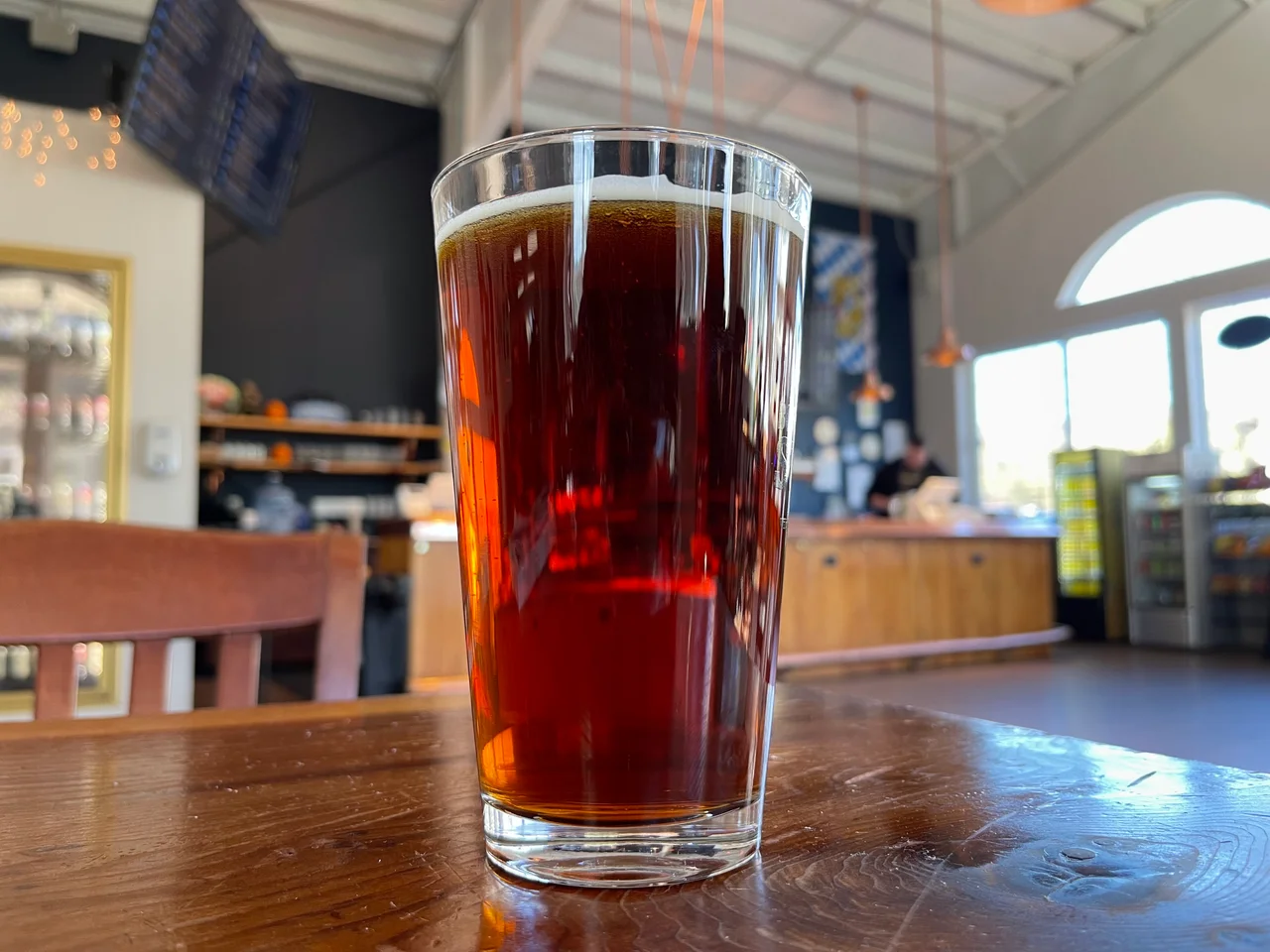
The brewery's core lineup carries names that double as a Boontling primer. Boont Amber Ale takes its prefix from the local shorthand for Boonville. Hop Ottin' IPA, added in the mid-1990s, borrows a term meaning "working hard" -- appropriate for an aggressively hopped India Pale Ale. Barney Flats Oatmeal Stout references a local landmark. Smaller batches push further afield: Brother David's Belgian-style Double and Triple, Heelch O'Hops Imperial IPA, and seasonal Summer and Winter Solstice releases. In 2012, the brewery collaborated with Wild Turkey bourbon to produce a barrel-aged stout, launching the "Barl" series of whiskey-barrel beers. Two years later came the gose experiments -- The Kimmie, The Yink, & The Holy Gose, Blood Orange Gose, and Briney Melon Gose -- tart, salty styles that pushed the brewery well beyond its original ale-and-stout identity.
Solar-Powered Suds
In 2005, Anderson Valley Brewing installed an $860,000 photovoltaic solar array on its 28-acre property, becoming what it claims as the world's first solar-powered brewery. The array generates a peak of 125 kilowatts, supplying roughly half the brewery's electrical needs. The environmental commitment extends beyond the panels. Spent grain, hops, and yeast go to local farmers for animal feed and composting. The brewery operates its own wastewater treatment plant, and the treated effluent irrigates the surrounding acreage. Plastic wrap, paper, cardboard, steel, glass, and aluminum are all recycled. California's Waste Reduction Awards Program recognized the brewery five times between 2000 and 2005. The approach is practical rather than ideological -- brewing generates enormous quantities of organic waste and wastewater, and in a small valley without municipal infrastructure, dealing with it responsibly is less a marketing choice than a survival strategy.
The Beer Park and the Festival
The Buckhorn Saloon was sold in 2004, replaced by the brewery's own tasting room and outdoor gathering space known as the Beer Park. Twenty beers pour from the taps, many of them exclusive to this location. An 18-hole disc golf course weaves through the property, threading past ponds, oak groves, and brewery buildings with par-3 holes ranging from 200 to 350 feet. Dogs and families are welcome. Since 1997, the brewery has hosted the annual Boonville Beer Festival each spring, an event that has grown from a local gathering to a major regional draw featuring dozens of breweries, multiple stages of live music, and local food. By 2010, the festival attracted 80 breweries, over 250 beers, and more than 6,000 attendees. Camping is available at the adjacent county fairground, and the local senior center runs a free shuttle between campsites and the festival grounds. Every dollar of proceeds goes to local charities -- as of 2020, the festival has donated over $1.75 million to Anderson Valley nonprofits.
Changing Hands, Keeping Character
Ownership has shifted three times since Norfleet's era, each transition bringing new stewardship while preserving the brewery's identity. In April 2010, industry veteran Trey White -- formerly executive vice president of United States Beverage -- purchased the company with two silent partners. In December 2019, the McGee family took over, with beer and wine industry veteran Kevin McGee serving as president and CEO. Most recently, in March 2025, local entrepreneur Jason McConnell acquired the brewery. Through each change, the Boontling labels have remained, the copper onion domes have kept steaming, and the Beer Park has stayed open. In a craft beer landscape littered with closures and corporate acquisitions, Anderson Valley has managed to stay independent, local, and deeply peculiar -- which, in Boonville, has always been the point.
From the Air
Located at 39.00N, 123.36W in Anderson Valley, Mendocino County, at the junction of Highways 128 and 253 near Boonville. The brewery complex with its distinctive Bavarian-style brewhouse and solar array is visible from low altitude in the narrow valley. Surrounding terrain is hilly with vineyards and oak woodlands. Nearest airports: Ukiah Municipal Airport (KUKI) approximately 25nm north; Little River Airport (KLLR) about 30nm west along the coast. The valley floor is relatively narrow; expect turbulence near the ridgelines. Best viewed at 2,000-3,000 feet AGL.
Nearby Stories
- The Valley That Drowned 6.2 km away
- Anderson Marsh State Historic Park 6.2 km away
- The River Beneath the Vines 6.5 km away
- People From the Top of the Land 10 km away
- Sites Reservoir 35 km away
- Pixieland 648 km away
- Neskowin Ghost Forest 686 km away
- ʻAkaka Falls State Park 3666 km away