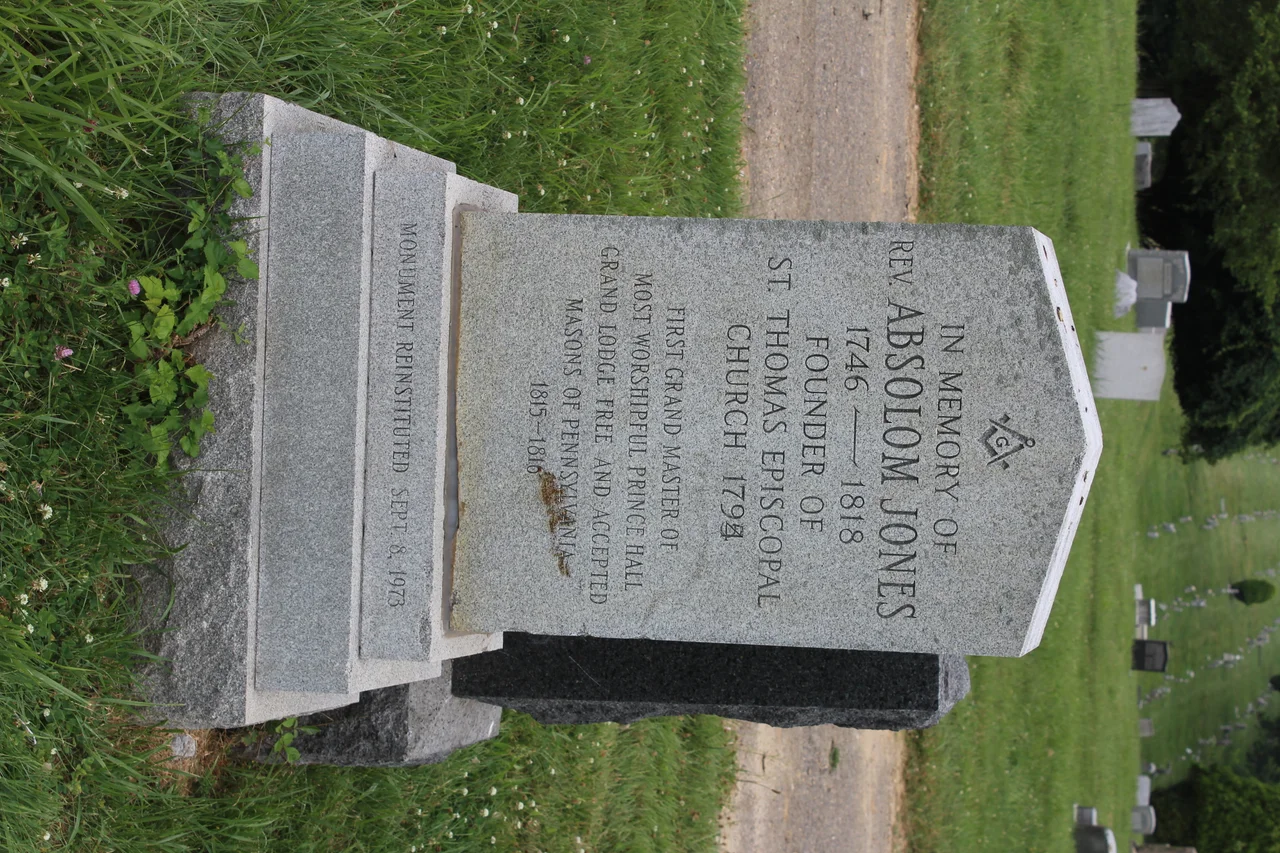

Absalom Jones
Absalom Jones bought his wife's freedom before his own. He was born enslaved in Sussex County, Delaware, in November 1746. By 1778 he had earned enough money to purchase Mary King's freedom for the cost of about $200 - a price he funded with a combination of his savings, donations from sympathetic Philadelphia Quakers, and borrowed money. He did it because colonial law said children took the status of their mother. If Mary remained enslaved, every child they had would be born into slavery; if she was free, their children would be free. Jones spent six more years saving the additional money to buy his own freedom. Manumission came on October 1, 1784. The order was deliberate: the wife first, the children freed by her, the husband afterward. He chose the surname Jones to mark his new American identity. He was 38 years old when he finally owned his own body.
The Walk-Out at St. George's
Jones moved to Philadelphia with his enslaver as a teenager. He attended Anthony Benezet's School - the Quaker abolitionist's school for Black children - where he learned to read and write. After manumission he became a lay minister at St. George's Methodist Episcopal Church, an interracial congregation that allowed Black members to preach. One Sunday in November 1792, ushers told Jones and other Black members of the congregation that they could no longer kneel for prayer in the section where they had been kneeling. They had to move to a segregated section against the wall, then to the gallery. Jones and the others completed the prayer they had begun, then stood up and walked out of the church together. Among them was Jones's friend and fellow lay minister Richard Allen. The walkout became a defining moment in American religious history - the founding moment of independent Black Protestant denominations in America. Allen went on to found the African Methodist Episcopal Church. Jones, who chose to stay closer to Anglican liturgy, founded the African Episcopal Church of St. Thomas, which opened on July 17, 1794, as the first Black church in Philadelphia.
The First Black Priest in the Episcopal Church
In September 1802, Absalom Jones was ordained a priest in the Episcopal Church of the United States - the first African American to be ordained as a priest in any major American denomination. The ordination came after Jones had spent more than a decade leading St. Thomas as a deacon. The diocese had agreed that Jones could be ordained on the condition that St. Thomas not seek membership in the diocese's general convention - a compromise that established Jones's authority while limiting the church's institutional voice. The condition was eventually removed. Jones served St. Thomas until his death in 1818. He was famous for his oratory, which white observers sometimes attributed to supernatural ability rather than skill - the racist assumption being that rhetoric exceeded the capabilities of African-descended preachers. His 1808 Thanksgiving Sermon, delivered on January 1 to mark the constitutional end of the African slave trade, was published as a pamphlet and became one of the most widely circulated anti-slavery sermons of the early republic. The Episcopal Church remembers him liturgically on February 13, the anniversary of his death.
The Petition That Failed
On January 30, 1797, U.S. Representative John Swanwick of Pennsylvania presented a petition to the House of Representatives signed by Jones and three other Black Philadelphians. The petition asked Congress to address the Fugitive Slave Act of 1793 and the continued kidnapping of free Black people from Northern states to be sold into Southern slavery. It was the first known petition to Congress from Black Americans on their own behalf. The petition cited specific cases where free men and women had been seized off the streets of Philadelphia. Representative George Thatcher of Massachusetts argued the petition should be accepted and referred to committee. Most of the House disagreed. The petition was rejected by a vote of 50 to 33. Jones's approach was moral suasion - he wrote and preached to convince white Americans that slavery was incompatible with both Christian faith and the founding ideals of the republic. The strategy did not succeed in his lifetime. Sixty-eight years would pass between the rejection of Jones's petition and the Thirteenth Amendment.
The Free African Society and the Yellow Fever Plague
Before founding St. Thomas, Jones and Richard Allen organized the Free African Society in April 1787 - a mutual aid society for newly freed Black Philadelphians, established before any major denomination, before either man's church existed. The Free African Society provided burial expenses, widow's pensions, and aid to the sick. During the catastrophic yellow fever epidemic of 1793, when about a tenth of Philadelphia's population died, Jones and Allen organized Black Philadelphians to nurse the sick and bury the dead at a moment when white residents were fleeing the city. Benjamin Rush, the prominent Philadelphia physician, had erroneously asserted that Black people were immune to yellow fever; Jones and Allen knew this was false but organized the response anyway, at considerable personal cost to the Black community. After the epidemic ended, a white pamphleteer accused the Black nurses of price-gouging. Jones and Allen wrote a public response - their Narrative of the Proceedings of the Black People - documenting the work and pricing of the nursing operation. It was one of the earliest published works of African American historical journalism.
Sussex County, Delaware
Absalom Jones was born on a farm near present-day Milford, in central Delaware. Sussex County in 1746 was a slaveholding agricultural region, with most enslaved African Americans working the corn and grain operations that had replaced the original tobacco economy. The Delaware River and the bay shaped the labor flows: enslaved people were sometimes moved between counties as families were broken up. When Jones was sixteen, his enslaver sold his mother and his siblings while keeping Jones to take to Philadelphia. The forced separation was the kind of common cruelty that the system relied on. Jones never recorded what happened to his mother or his brothers and sisters. The historical record loses them. Sussex County now sits between the Maryland border and Delaware Bay, with the Atlantic beaches forming its eastern edge and the agricultural and poultry-producing center extending west. The Episcopal Diocese of Delaware honors Jones each February. The farm where he was born is unmarked. There is a roadside historical marker on Delaware Route 1 north of Milford. Most drivers pass it without noticing. The man who walked out of a segregated church and founded America's first Black Episcopal congregation began life as a child sold to a farmer who took him north.
From the Air
Absalom Jones's birthplace near Milford sits at approximately 38.91 degrees north, 75.40 degrees west, in central Delaware. Delaware Coastal (KGED) is 17 nautical miles south in Georgetown; Delaware Airpark (33N) is 21 north near Cheswold. Pattern altitudes of 1,500 feet AGL show the gentle flat agricultural terrain typical of central Delaware, with the Mispillion River winding east toward the Delaware Bay. Watch for waterfowl migration in fall along the Mispillion and the larger bay. The Milford area is also where the Mispillion Light, a small lighthouse marking the river's entrance to the bay, stood from 1873 until it was decommissioned and dismantled in 1932.
Nearby Stories
- Battle of Turtle Gut Inlet 4.4 km away
- Woodbine, New Jersey 7.1 km away
- Bombay Hook National Wildlife Refuge 8.7 km away
- Harriet Tubman Byway: The Routes That Led to Freedom 30 km away
- USS Jacob Jones (DD-130) 31 km away
- Bethany Beach 34 km away
- Annapolis Convention (1786) 48 km away
- Francis Scott Key Bridge Collapse 51 km away