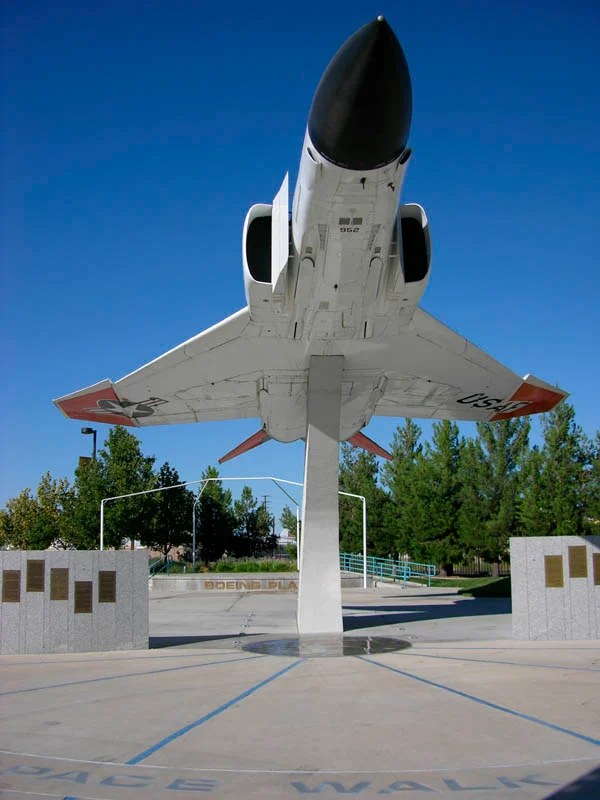

Aerospace Walk of Honor
Lancaster sits in the Antelope Valley at the edge of the Mojave Desert, and for much of the twentieth century, the most important things happening in American aviation were happening just to the east. Edwards Air Force Base and Air Force Plant 42 occupy desert terrain where the dry lakebed runways provided essentially unlimited landing space for aircraft that had never flown before and might not fly again the way their designers intended. The pilots who flew those aircraft — the ones who took experimental machines to the edge of what physics permitted and brought back data — are remembered on Lancaster Boulevard in the city's downtown, in a walk of granite monuments that honors them by name.
The Walk and Its Inductees
The Aerospace Walk of Honor was established in 1990 by the City of Lancaster to recognize test pilots who had made significant contributions to aviation and space research. The walk runs along Lancaster Boulevard between Sierra Highway to the east and 10th Street West, anchored at one end by Boeing Plaza, where a restored F-4 Phantom II stands on display. The inaugural class in 1990 included Albert Scott Crossfield — the first pilot to fly at twice the speed of sound — and James H. Doolittle, who led the 1942 Tokyo raid. Neil Armstrong was inducted in 1991, Albert Boyd in the same year. Subsequent inductions brought in Jacqueline Cochran, the first woman to break the sound barrier; Eileen Collins, the first female Space Shuttle commander; and Michael Collins, command module pilot of Apollo 11.
What the Valley Produced
The Antelope Valley's claim on American aviation history begins with geography and expands from there. The dry lakebeds east of Lancaster provided the flat, hard surface that early jet-age aircraft needed when their landing systems failed or their experimental configurations made conventional runways dangerous. Chuck Yeager broke the sound barrier over this desert in 1947 in a Bell X-1, an event that defined what was possible in the air. The X-15, which reached the edge of space, flew from Edwards. NASA Space Shuttles landed on the lakebed after orbital missions. Plant 42 in Palmdale produced the U-2, the SR-71, and the B-2 Spirit — aircraft so advanced they were classified secrets for years after their first flights. The monuments on Lancaster Boulevard are the public face of a history mostly conducted in secrecy.
The Final Induction
The Walk of Honor program officially concluded in August 2009, when Harry Andonian received the final induction. Nineteen years of annual ceremonies had added monuments to Bud Anderson, Stan Butchart, Bob Rahn, Bob Rushworth, Bruce Peterson, William Dana, and others whose names are less famous than Armstrong's but whose contributions to flight testing were equally fundamental. The walk continues to exist as a public monument — the granite markers remain on Lancaster Boulevard, the F-4 still stands in Boeing Plaza — but no new inductees have been added since 2009. It is a completed record of a particular era in American aviation, when what happened in this desert shaped what the world believed was possible.
From the Air
Located at 34.6987°N, 118.137°W on Lancaster Boulevard in downtown Lancaster, California. The Antelope Valley lies at approximately 2,300 feet MSL, with flat desert terrain extending to the east and mountains rising to the south and west. Air Force Plant 42 (KPMD, Palmdale Regional Airport) lies approximately 12 miles to the south. Edwards Air Force Base (KEDW) lies approximately 25 miles to the northeast — its restricted airspace dominates the eastern Antelope Valley. Be alert to MOAs and restricted areas throughout this region.
Nearby Stories
- Fillmore and Western Railway 9.7 km away
- Placerita Canyon State Park 16 km away
- The Desert Tortoise Natural Area: Where the Slow Survive 39 km away
- Bakersfield: The Oil Town Where Country Music Got Its Sound 47 km away
- San Bernardino Train Disaster 53 km away
- Amgen 60 km away
- The Trona Pinnacles: California's Most Alien Landscape 80 km away
- Calico: The Ghost Town Walter Knott Saved 87 km away