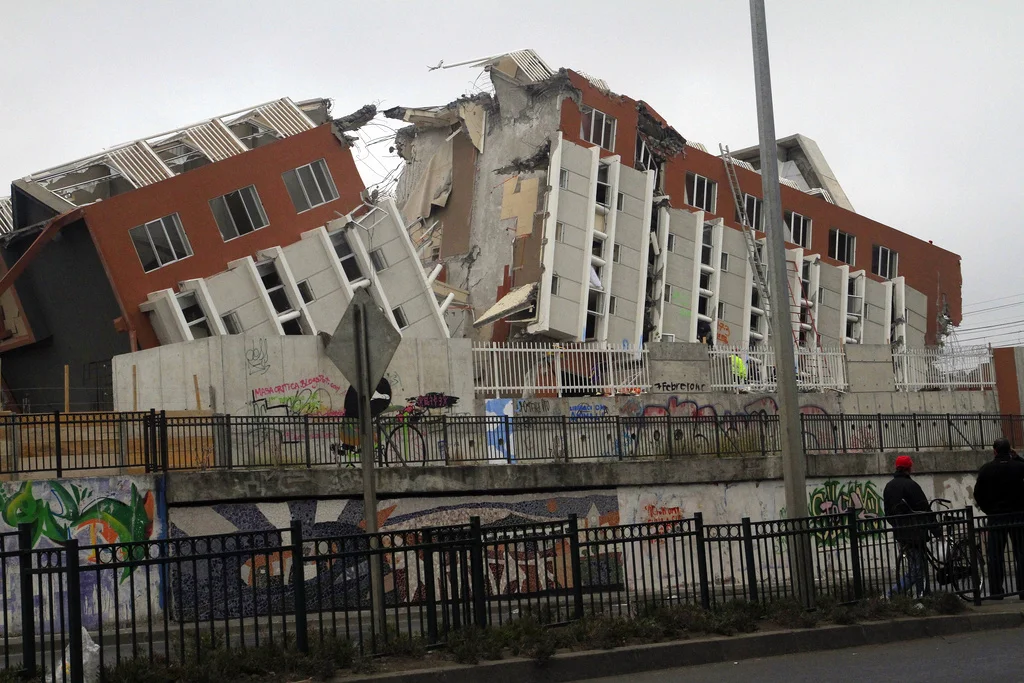

Alto Río Building Collapse
It was barely a year old. The Edificio Alto Río, fourteen stories of fresh concrete and glass on Los Carrera Avenue, was the kind of building people save for and move into with pride, a new apartment in a growing city. At 3:34 in the morning on February 27, 2010, while its residents slept, one of the most powerful earthquakes ever recorded tore through south-central Chile. Across Concepción, older structures cracked and swayed but stood. The Alto Río did something else. It snapped in two and fell, carrying its sleeping residents down with it. Of every multi-story building in the city, this new one was the only near-total collapse.
The People Inside
The numbers are stark, but they were people. Eight residents died when the building came down, trapped in apartments that had been homes hours earlier. Nearly seventy others were pulled from the wreckage alive, many of them injured, in a rescue effort that worked through the rubble of a structure that should have protected them. These were not statistics from a distant tragedy. They were families who had signed leases and mortgages, who had chosen the Alto Río because it was new and safe and theirs. The earthquake that killed them was a force of nature. The building that failed around them was not.
8.8
The earthquake measured magnitude 8.8, its epicenter offshore in the Maule region to the north. It ranks among the strongest quakes ever instrumentally recorded, and it reshaped the very ground beneath the city. Yet Chile is one of the most earthquake-prepared nations on Earth, with building codes written in the hard memory of disasters like the great Valdivia quake of 1960. Across Concepción, the overwhelming majority of buildings honored that lineage and held. They cracked, they leaned, they frightened everyone inside, but they stayed standing. That is precisely what makes the Alto Río so haunting. It was not supposed to be possible. The whole point of those codes was that a new building, of all things, would never break in half.
Returning to the Ruins
In January 2011, almost a year after the collapse, the former residents were finally allowed back into what remained of the Alto Río to recover what they could. They climbed into the ruins of their own homes searching for the ordinary fragments of interrupted lives. Many managed to retrieve treasured belongings; some even recovered their cars from the wreckage. It is a quietly devastating image, people picking through the broken shell of a place that was meant to last decades, gathering up photographs and keepsakes from a building younger than the cars parked beneath it.
A Verdict and Its Outrage
The reckoning came in a courtroom. The legal proceeding, known simply as the "Alto Río Case," stretched over two years and included four months of hearings. In the dock sat the leadership of the construction firm Socovil and the building's engineers, project managers, and supervisors. On October 31, 2012, the court delivered its judgment: of all the defendants, only one engineer, René Petinelli, was convicted. Everyone else walked free. The acquittals struck many Chileans as a betrayal, and the outrage reached all the way to government ministers and members of parliament. For the families who had lost homes and loved ones, a single conviction was a thin answer to a building that should never have fallen.
What a Broken Building Leaves Behind
The Alto Río did not vanish quietly. In a country that has long taken pride in building to survive its own restless ground, the sight of a year-old tower lying snapped across an avenue became a national wound and a national warning. The 2010 earthquake, for all its destruction, confirmed that Chile's seismic engineering largely worked; the Alto Río became the unforgettable exception that proved how high the stakes are when it does not. Its collapse fed a hard public conversation about oversight, accountability, and the gap between a building code on paper and a building actually standing on a corner. For the eight who died and the dozens injured, no debate could undo the loss. But their names are tied now to a reckoning that outlived the building, a reminder bought at a terrible price that in a seismic land, construction is never only about concrete. It is about the people who trust it to hold.
From the Air
The Alto Río building stood at 36.83°S, 73.06°W on Los Carrera Avenue in central Concepción, Chile, near the Bío Bío River. The nearest airport is Carriel Sur International (ICAO: SCIE, IATA: CCP) in neighboring Talcahuano, roughly 8 km away and the main air gateway for the Greater Concepción region. From a viewing altitude of 6,000 to 10,000 feet in the area's typically clear, mild Mediterranean climate, the dense urban grid of Concepción spreads along the river plain, the same compact downtown that absorbed the 2010 magnitude 8.8 earthquake. Santiago lies about 500 km to the north; the Pacific coast and the port of Talcahuano are just to the west.
Nearby Stories
- Battle of El Roble 7.8 km away
- Chivilingo Hydroelectric Plant 18 km away
- Ninhue 18 km away
- Santa María Island, Chile 25 km away
- Tucapel 47 km away
- 2010 Chile Earthquake 49 km away
- Coal Mining in Chile 51 km away
- 1687 Peru Earthquake 2386 km away