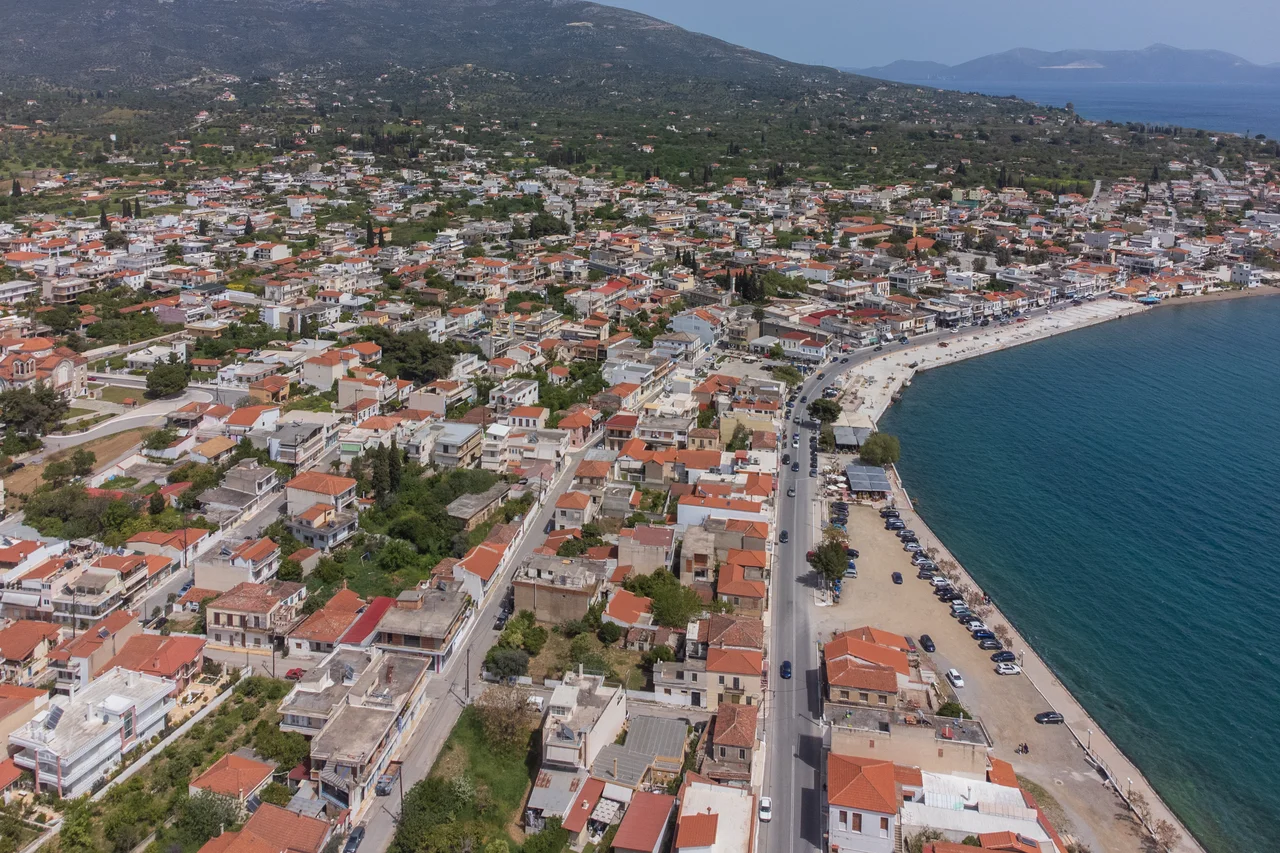

Amarynthos
For more than a hundred years, archaeologists knew that one of the most renowned sanctuaries in ancient Greece had to be hiding somewhere near Amarynthos, and they could not find it. Ancient writers were clear that the Eretrians worshipped Artemis Amarysia at a great shrine on the Euboean plain, that the whole island and beyond flocked to her festival. But the temple itself had vanished so completely that its location became one of the great open questions of Euboean archaeology. The answer, when it came in 2017, was buried at the foot of a low hill the locals called Paleoekklisies, and it was confirmed by the most decisive evidence of all: inscriptions, carved in stone, naming the goddess herself.
The Sanctuary That Hid for a Century
Eretria's most important place of worship lay outside its city walls, roughly ten kilometers east, near present-day Amarynthos. Its annual festival, the Artemisia, drew crowds from across Euboea. Yet for generation after generation, archaeologists searched the plain and came up empty. Beginning in the early 2000s, the Swiss School of Archaeology in Greece, working with the local Ephorate of Antiquities, brought modern tools to the hunt, surveying the ground with geophysical equipment that reads what lies beneath the surface. The trail led to the hill of Paleoekklisies. In 2017, the digging turned up inscriptions that mentioned Artemis Amarysia by name, and the century-old mystery closed. Excavations have since revealed a temple, porticoes, and votive monuments spanning from the Bronze Age to Roman imperial times, including an extraordinary deposit of sixth-century BC offerings found inside the temple itself.
Deep Roots in the Plain
Long before the sanctuary, people lived here. The flat coastal ground around Amarynthos has held a settlement since the Late Neolithic, around 3000 BC, when it was one of the most significant Helladic communities and a working port on the South Euboean Gulf. Its people traded with the Cycladic islands, worked copper, fished, and farmed, and in time produced fine pottery. The name Amarynthos itself surfaces in clay tablets written in the Linear B script of the Mycenaean age, which is why some scholars have argued that the Eretria of Mycenaean legend actually stood here rather than at the later classical site. In Greek myth, Amarynthos was a man of Eretria who chased the goddess Artemis out of love, and gave the town his name.
Layers of Faith and Memory
Amarynthos wears its long history quietly. The ancient sanctuary gave way, over the centuries, to other forms of devotion. Byzantine churches dedicated to the Dormition of the Theotokos, the Transfiguration, and the Life-Giving Spring still stand in and around the town, and to the northeast the monastery of Agios Nikolaos preserves wall paintings from the twelfth century. A Macedonian tomb from the fourth century BC was excavated just outside town in 1897. Power passed through here in waves, Macedonian, Roman, Byzantine, Venetian, and Ottoman, before the town joined the modern Greek state around 1830. In the twentieth century, refugees from Asia Minor settled here after the population exchange of the 1920s, and during the Second World War German troops burned part of the town. Each layer left its mark on a place that has been continuously inhabited for some five thousand years.
A Working Coast
Today Amarynthos is a relaxed coastal town on the South Euboean Gulf, its waterfront lined with tavernas and its flat farmland running back from the beach toward the mountains. The Euboean Olympus rises ten kilometers to the north, watching over the plain where the goddess was once worshipped. Visitors come for the beach and the easy pace, often without realizing that the unremarkable hill nearby held, for a century, one of Greek archaeology's most wanted prizes. The excavations continue, and most years bring something new out of the ground, so that the town's deep past keeps surfacing into its quiet present.
From the Air
Amarynthos sits at 38.39 degrees north, 23.88 degrees east, on the north shore of the South Euboean Gulf in central Euboea (Evia), about 8 km east of Eretria and 27 km southeast of Chalkida. From the air, follow the gulf coast east of Eretria to the flat farmland fringing the beach town; the Euboean Olympus stands 10 km inland to the north. Nearest major airport is Athens International (LGAV) about 40 km to the south across the gulf. Clear weather and morning light bring out the contrast between the coastal plain and the mountainous interior.
Nearby Stories
- Hellenic Police 2.9 km away
- Tower of Aliartos 8.5 km away
- Great Sand Beach 13 km away
- John the Russian 22 km away
- Saint George Monastery, Aidipsos 23 km away
- Sousaki Volcano 25 km away
- Skyros 32 km away
- Carystus 46 km away